Big Screen, Small Price: AWALL Wants to Bolt a MicroLED Wall Into Your Living Room
AWOL Vision spent five years selling laser projectors. Then it bolted LED chips to a board, called it AWALL, and started shipping 108-inch video walls to living rooms.
There is a quiet moment in the home-theater business when someone with a laser projector looks at a wall and thinks: what if the wall did the work instead? AWALL is the company that acted on that thought. It is the MicroLED display brand of AWOL Vision - the Florida-rooted maker of 4K triple-laser ultra-short-throw projectors - and it sells the exact thing a projector spends its life competing against: a wall that makes its own light.
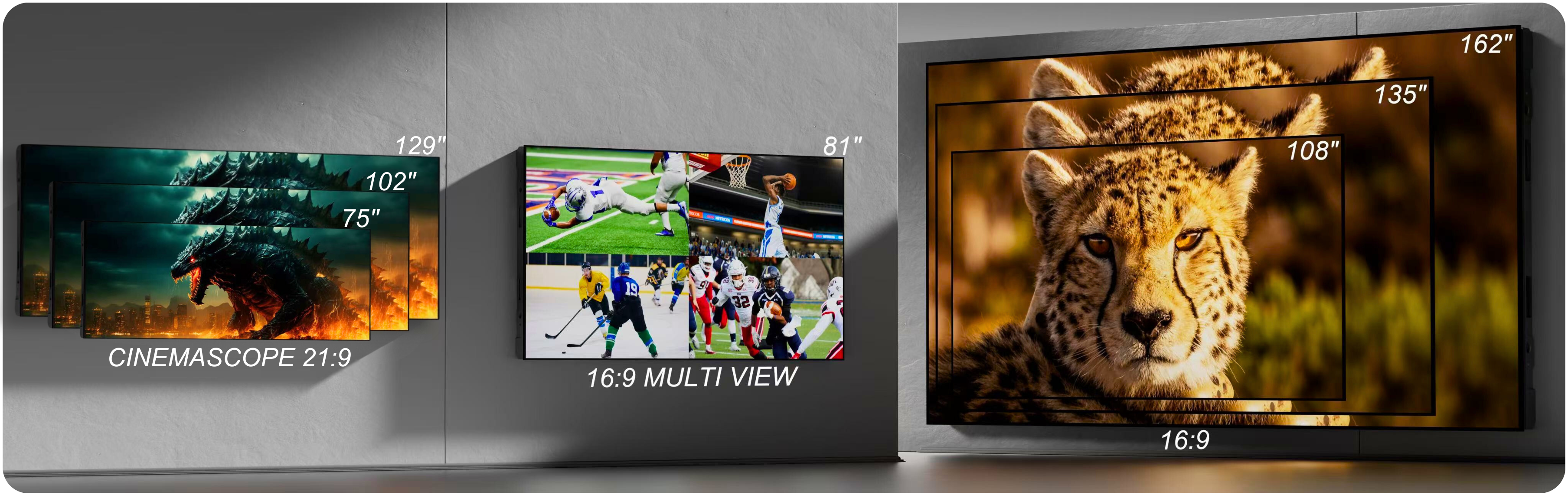
The product is a Chip-on-Board, or CoB, MicroLED video wall. In plain terms, thousands of tiny LED chips are mounted directly onto a board and sealed under a layer of protective resin, so there are no visible seams and no bezels breaking up the image. AWALL sells these panels in preconfigured sizes - roughly 75 to 162 inches - and builds custom walls that scale past 300 inches for spaces that need them. The tagline it keeps repeating is four words long: "Big Screen. Small Price."

The BetA projector company that decided to sell the wall
Most companies wait for a competitor to disrupt them. AWOL Vision decided to do it in-house. After spending 2020 to 2022 interviewing customers before shipping its first ultra-short-throw projector - and opening a retail store in Delray Beach, Florida in 2022 - the company understood the ceiling of projection: ambient light, throw distance, and the eternal compromise of bouncing an image off a surface. MicroLED erases all three by being the surface. So AWOL Vision launched AWALL in late 2024 as a separate brand, and let it go after the same premium home-theater buyer from the other direction.
The strategic logic is worth stealing. Build a hard-earned reputation in one category, then use that trust to enter the adjacent premium category as a distinct brand rather than a footnote. A projector customer already trusts AWOL Vision on color, brightness, and installation. AWALL inherits that credibility without having to explain who it is.
The MathTake a stadium technology and delete a zero
MicroLED walls have existed for years in stadiums, network control rooms, and Fortune 500 lobbies. The reason they never reached homes was the invoice - a serious CoB wall meant an integrator, a scaffold, and a six-figure purchase order. AWALL's entire business model is aimed at that number. Its preconfigured models list from roughly $8,250 to about $56,900, and it sells them the way you would buy any premium electronics: direct, online, with Apple Pay and PayPal at checkout. Custom large-format installations still reach into six figures, but the entry point is no longer a fantasy.
Getting the price down was an engineering problem before it was a marketing one. AWALL uses flip-chip CoB packaging, which reduces solder joints and improves reliability, and leans on aluminum panels with high thermal conductivity to manage heat. The claimed payoff shows up as physical numbers: panels around 45% lighter and 55% thinner than conventional LED walls, drawing roughly 64% less power. Lighter and thinner is not vanity - it is what lets two people, rather than a crew, hang a 162-inch wall in about two hours.
AWALL panel vs. a conventional LED wall (claimed)
The Spec SheetNumbers that read like a lab report
AWALL talks in specifications, and the headline figures are genuinely high-end: 115% NTSC color gamut, a native contrast ratio quoted as high as 15,000:1 with an effectively infinite dynamic range, peak brightness up to 1,200 nits, and a 3,840Hz refresh rate that keeps motion flicker-free. There is a comfort angle too - TUV-certified reduction of harmful blue light in the 415 to 455nm range - and a durability angle, with an IP65 front rating that makes the surface water-, dust-, and scratch-resistant. It is, unusually for a display this large, a wall you are allowed to touch.
| Pixel pitch | 0.9mm / 1.2mm |
|---|---|
| Color gamut | 115% NTSC (≥90% BT.2020) |
| Peak brightness | Up to 1,200 nits |
| Refresh rate | 3,840Hz |
| Lifespan | 100,000+ hours |
| Protection | IP65 front / IP30 rear |
Specs alone do not sell a living room, though, which is why AWALL frames the same panel two ways. To a home-theater buyer it is the centerpiece that finally beats the projector in a bright room. To a business it is a command-center display, a visualized data wall, a showroom backdrop, or digital signage. Same hardware, two audiences, two vocabularies.
The CustomerOne panel, two very different buyers
The home side is the emotional sale. It is the custom-install client who has already spent on acoustics and seating and now wants a picture that does not dim when the afternoon light comes in. For that buyer, MicroLED's emissive image - each pixel producing its own light, so black is genuinely black - is the upgrade a projector cannot match in a room with windows. AWALL leans into that with preconfigured 16:9 and 21:9 sizes and magnetic, modular panels, so the wall arrives as a product rather than a construction project.
The commercial side is the rational sale. A retailer wants a seamless backdrop that survives being walked past all day; a corporate lobby wants scale; a control room wants a wall that runs continuously for years, which is where the 100,000-hour lifespan and the IP65 rating stop being marketing and start being a maintenance budget. AWALL supports quad-view input over multiple HDMI 2.0 connections, so a single wall can show four sources at once - the sort of feature a living room never needs and a data center always does. The company's team is small - the AWALL brand runs lean, at around ten people - but it sits on top of AWOL Vision's larger manufacturing and dealer base, which is how a lean team ships walls this large.
Ownership is the part AWALL keeps trying to simplify. The panels are compatible with Windows, macOS, iOS, and Android sources, ship with a two-year standard warranty, and carry CE, ETL, and FCC certifications. None of that is glamorous, and all of it is exactly what a buyer spending five figures on a wall wants to hear before they commit. The two-hour, two-person install is the same idea expressed physically: remove the friction that used to make a MicroLED wall a project only professionals could attempt.
The ShowpieceA screen that unfolds and stands up
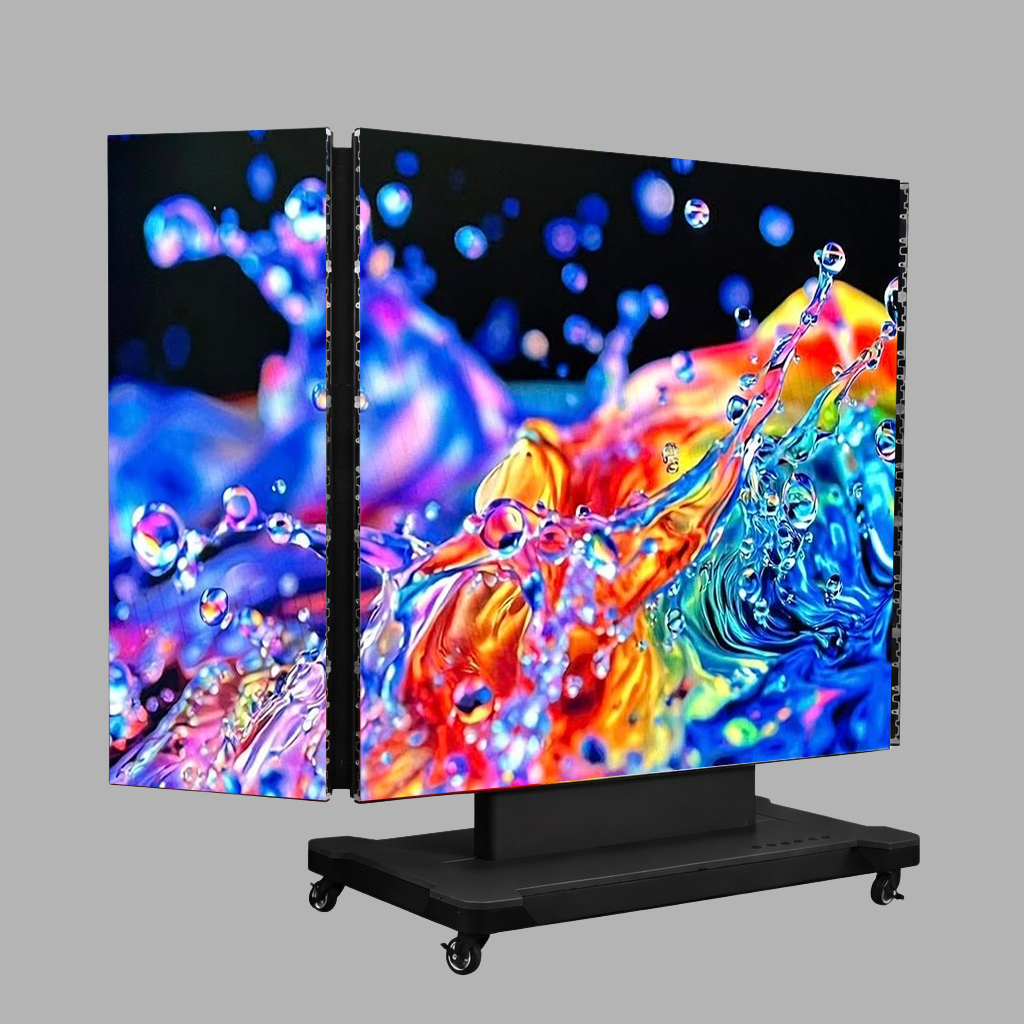
In July 2026, at InfoComm, AWALL introduced the Phoenix - an all-in-one MicroLED panel it describes as the first motorized MicroLED display that folds flat and then unfolds and elevates into a 135-inch, 0.9mm-pitch screen. As a party trick it is fun. As a signal it is more interesting: it suggests MicroLED is coming for furniture, not just walls, and that the category's next fight is about where the screen goes when you are not using it.
The FieldWhere AWALL sits on the map
On paper, AWALL is up against the giants of the LED-wall world - Samsung's The Wall, LG MAGNIT, Sony's Crystal LED, and commercial specialists like Planar and Leyard. Those names own the corporate and broadcast market. AWALL's wedge is the buyer those companies treat as an afterthought: the custom-install home-theater customer, and the smaller business that wants a real MicroLED wall without a real MicroLED budget. It reaches them through a Shopify storefront and AV dealers such as Dreamedia AV, rather than a national sales force.
Its other, quieter competitor is its own parent. AWOL Vision's laser projectors - built on ALPD laser-fluorescent technology that traces back to Appotronics - remain the cheaper way to get a very large image, and for a dark, dedicated theater a top ultra-short-throw projector is still a legitimate choice. AWALL's answer is that the two products are not really the same purchase: projection is for the room you can control, and MicroLED is for the room you cannot. By owning both sides, AWOL Vision gets to sell whichever answer the customer's room demands, which is a more comfortable position than betting the company on one.

The honest caveats belong here too. Most of AWALL's advantage numbers are manufacturer figures, the brand is young - public since late 2024 - and MicroLED at home is still a premium purchase, not a mass-market one. The Nova and I Series names move around between AWALL's own store and AWOL Vision Pro channels, which can make the catalog feel like it is still settling. What is not in doubt is the direction: take a technology that used to arrive on a scaffold, make it lighter, thinner, and cheaper, and let people buy it like a television. Whether that is enough to move MicroLED from the lobby to the living room is the experiment AWALL is running in public.