Avshalom Kalichstein has an unusual answer to the question of what he does for fun. He reads mathematics textbooks. At the Milken Institute’s 2026 Global Conference, amid a discussion of private capital, he mentioned his interest in the Langlands program. A room convened to discuss investment returns briefly acquired the atmosphere of a graduate seminar. Leisure, apparently, can come with prerequisites.
There was another possible life. His father was a musician, and Kalichstein said he would probably have tried music himself had he taken a different path. He also volunteered a reservation about whether he would have been good enough. The admission gives the finance executive a pleasingly human outline: someone able to describe both a serious interest and the limit of his confidence.
His actual profession asks a different sort of question. What makes an investment firm worth owning? The obvious answer involves the investments. Kalichstein’s work at Hunter Point Capital reaches further into the institution that makes them: its people, financing, relationships and ability to continue growing. The fund attracts attention. Behind it sits a business with a future to arrange.
A mathematician’s education, with a Japanese chapter
Kalichstein graduated from Brown University with a B.A. in mathematics and economics, magna cum laude. Brown identifies him as a member of its class of 1996. His career began in Goldman Sachs’s financial institutions group, putting banks and other financial businesses at the center of his working education. The combination of mathematics and economics is an apt starting point for a career spent examining institutions that turn capital into a service.
Japan became an important part of that education. Chris Flowers, whom he met early in his Goldman career, sent him to work on the revitalization of Shinsei Bank. Kalichstein’s account of that experience includes learning about cultural differences. He served as the bank’s head of corporate development before becoming a managing director at J.C. Flowers & Co.
That sequence matters. A bank is an operating institution, with people making decisions inside an organization. Working on one creates a different vantage point from considering a security at a distance. In the career that followed, the institution itself kept returning as the object of attention. Investment performance and the business producing it were closely related questions.
At J.C. Flowers, he helped build a financial services investment firm whose assets under management grew beyond $10 billion during his tenure. He later launched Solel Investment Group, which created joint ventures investing more than $1 billion in consumer and commercial credit opportunities. At Easterly, he was a managing principal focused on investing in and building investment management businesses. The route to Hunter Point ran through several versions of building a financial enterprise.
The investment manager has a business, too
In 2020, Kalichstein and Bennett Goodman founded Hunter Point Capital. The firm’s initial GP stakes strategy purchases ownership interests in alternative investment managers. Its territory includes private equity, credit, real estate and infrastructure. The phrase can sound forbiddingly specialized, but the underlying object is familiar: an ownership interest in a company.
A fund manager oversees a pool of investments. The management company has a separate life: a team, a reputation, relationships with investors and decisions about what to build next. Buying a stake in that company makes its development part of the investment. A new strategy, a stronger organization or a wider investor network can matter alongside the performance of an individual fund.
Think of the distinction as two levels of a building. On one floor are the assets being bought and sold. On another are the people responsible for finding those assets and persuading investors to entrust them with money. Kalichstein works on the second floor. The view includes the first, but also the stairs, the lease and who will still be there in ten years.
Hunter Point describes its contribution in practical terms: capital formation, business development, group purchasing and talent support. These are ordinary business needs wrapped in an industry with unusually elaborate vocabulary. Firms need investors, people need development, and shared purchasing can reduce costs. Even an investment partnership eventually encounters the less glamorous business of running a business.
There is a particular consequence to taking an ownership stake. The relationship reaches beyond a transaction’s closing date. Decisions about expansion and leadership continue to affect both sides. Kalichstein has described GP stakes as enduring partnerships, with partner selection central to the arrangement. The choice of company therefore includes a choice of people with whom to keep working.
One first fund, $3.3 billion
In March 2024, Hunter Point announced the close of its inaugural GP stakes fund at $3.3 billion in permanent capital commitments, against an initial target of $2.5 billion. By that announcement, it had formed eight investment management partnerships. They included Pretium, Coller Capital, Inflexion, L Catterton, The Vistria Group, SLR Capital Partners, Iron Park Capital and MidOcean Partners.
The list provides a useful sense of his working world. Kalichstein’s counterparties are investment organizations with their own identities and specialties. An ownership partnership has to fit the business already there. It cannot assume that a consumer investment specialist and a real estate manager will need identical help simply because both operate in private markets.
Permanent capital commitments
Bars compare the announced target and close. These are commitments, not investment returns.The permanence is consequential. This is capital intended for a continuing relationship with a management business. The arrangement puts business-building questions beside investment questions: how ownership develops, how people progress and how the organization expands. The first fund’s size measures investor commitments to that approach. Its eventual results will depend on what happens inside the partnerships.
More ways to finance the same ambition
Hunter Point subsequently broadened its offering through GP Financing Solutions. In June 2026, it announced final closes for the inaugural vintages of its NAV Lending and Preferred Solutions strategies, totaling $4.3 billion in commitments. Together, those strategies had completed 13 transactions. The announcement put the firm’s total assets under management and commitments at approximately $10 billion.
The distinction between products matters. A permanent ownership interest, a loan and preferred financing arrange the relationship between investor and business differently. A manager’s need for capital does not automatically settle which arrangement fits. Hunter Point’s expansion gave Kalichstein more than one way to approach the conversation.
Own a piece
A minority interest in an investment management business.
Finance a need
NAV-based loans and preferred financing for managers and portfolios.
The figures require careful reading. Hunter Point’s approximately $10 billion in June 2026 refers to its own assets under management and commitments. In a subsequent update, Kalichstein said aggregate assets under management across its underlying GP stakes managers exceeded $400 billion. Those numbers describe different organizations and different layers of the investment system. A large network and a large fund are separate measures.
Japan returns to the story
In April 2026, Sumitomo Mitsui Trust Bank and Hunter Point announced a strategic partnership. The Japanese bank made a minority equity investment in Hunter Point. Their plans included bringing private markets opportunities to Japanese investors and exploring a Japan-focused GP stakes strategy to support local alternative investment managers.
The connection gives Kalichstein’s career an unusual continuity. Japan had been a place where he learned about rebuilding a financial institution. It was now part of a partnership intended to help investment businesses develop and reach investors. The context had changed, but the work again involved institutions, capital and relationships across borders.
In May, Hunter Point opened a Hong Kong office led by Peter Rosenbloom, its head of Asia Pacific. The office established a permanent regional presence, building on the firm’s existing activity. Geographic expansion brings the partnership idea down to earth: relationships need people who understand local markets and can keep showing up. A global ambition eventually needs a local address.
A school, a scholarship, a continuing curiosity
Kalichstein’s interest in learning appears outside his own reading habits. Hunter Point launched HPC University in October 2025, with in-person and virtual programming for the private markets community. Plans included presentations, sessions with network partners and participant-led discussions. The initiative gives the firm’s relationships another use: bringing people together to exchange knowledge about the work.
He also sits on the external advisory committee of Brown’s Data Science Institute. It is a connection to the university where he studied mathematics and economics, now through a field concerned with what can be learned from data. The institutional connection is concrete. Any suggestion that his recreational reading explains his investment results would be a much longer leap.
Music remains part of the story in a more personal way. Kalichstein created the Joseph Kalichstein Memorial Piano Scholarship at Juilliard in memory of his father. Joseph was a pianist and longtime member of the school’s faculty. The gift supports students pursuing the profession Avi once imagined for himself. One career followed finance; another generation gets help pursuing music.
“I was a math geek when I was at school.”Avshalom Kalichstein · April 2024
His recollections contain less formal education, too. As a student, he spent a year in London and remembers late-night espresso at Bar Italia. He has also recalled deciding at four that investment banking sounded like the career for him, after asking his mother about a family friend’s work. The accounts sit comfortably together: an early professional ambition, a lasting love of mathematics and a student’s memory of coffee after midnight.
The builder’s next question
By September 2026, Hunter Point was adding operating leadership for its expanded business. William Sonneborn became president and chief operating officer, while Mike Arpey moved to vice chairman. Kalichstein described the appointments in terms of building capabilities and giving Arpey more time with limited partners and the managers Hunter Point backs.
The development closes a small circle in his story. A firm founded to help investment managers grow must make its own decisions about management as it grows. More capital, more products and more relationships bring organizational demands of their own. Kalichstein is now both evaluating those decisions in other businesses and making them inside his.
The most revealing detail may still be the textbooks. He has kept an appetite for a subject whose pleasures do not require an audience or a transaction. Beside the announced commitments and new offices sits someone who enjoys working through mathematics. His professional story follows a related curiosity about what lies underneath: the business behind a fund, the people behind a business, and what they might build next.
Keep reading and listening
- Hunter Point · official biography
- EY · conversation with Bridget Walsh
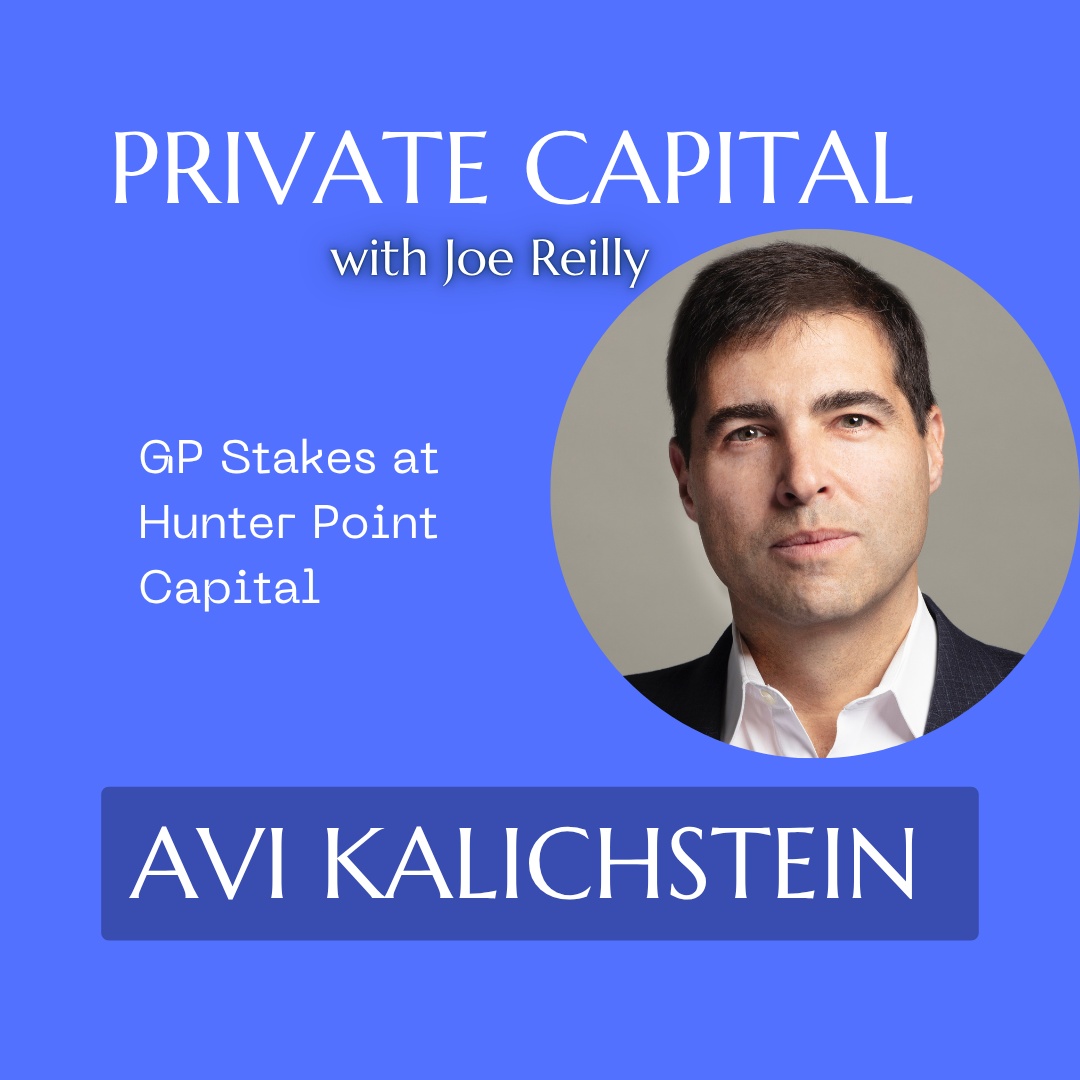
- Private Capital · conversation with Joe Reilly
- Milken · May 2026 panel transcript
- The March 2024 fund close
- The June 2026 financing close
- The Japanese strategic partnership
- September 2026 leadership appointments
- Juilliard · the memorial scholarship
- Avshalom Kalichstein on LinkedIn
- Hunter Point Capital