Ava McCoy keeps choosing jobs in which attention cannot be faked. On a sideline, the game moves whether the reporter is ready or not. At a newspaper, the names and numbers must survive an editor. In marketing, an audience can scroll past without apology. In film, a beautiful frame is still useless if the story underneath it has gone missing. McCoy has put all four tests into one undergraduate life, then added varsity cheer and economics homework for good measure.
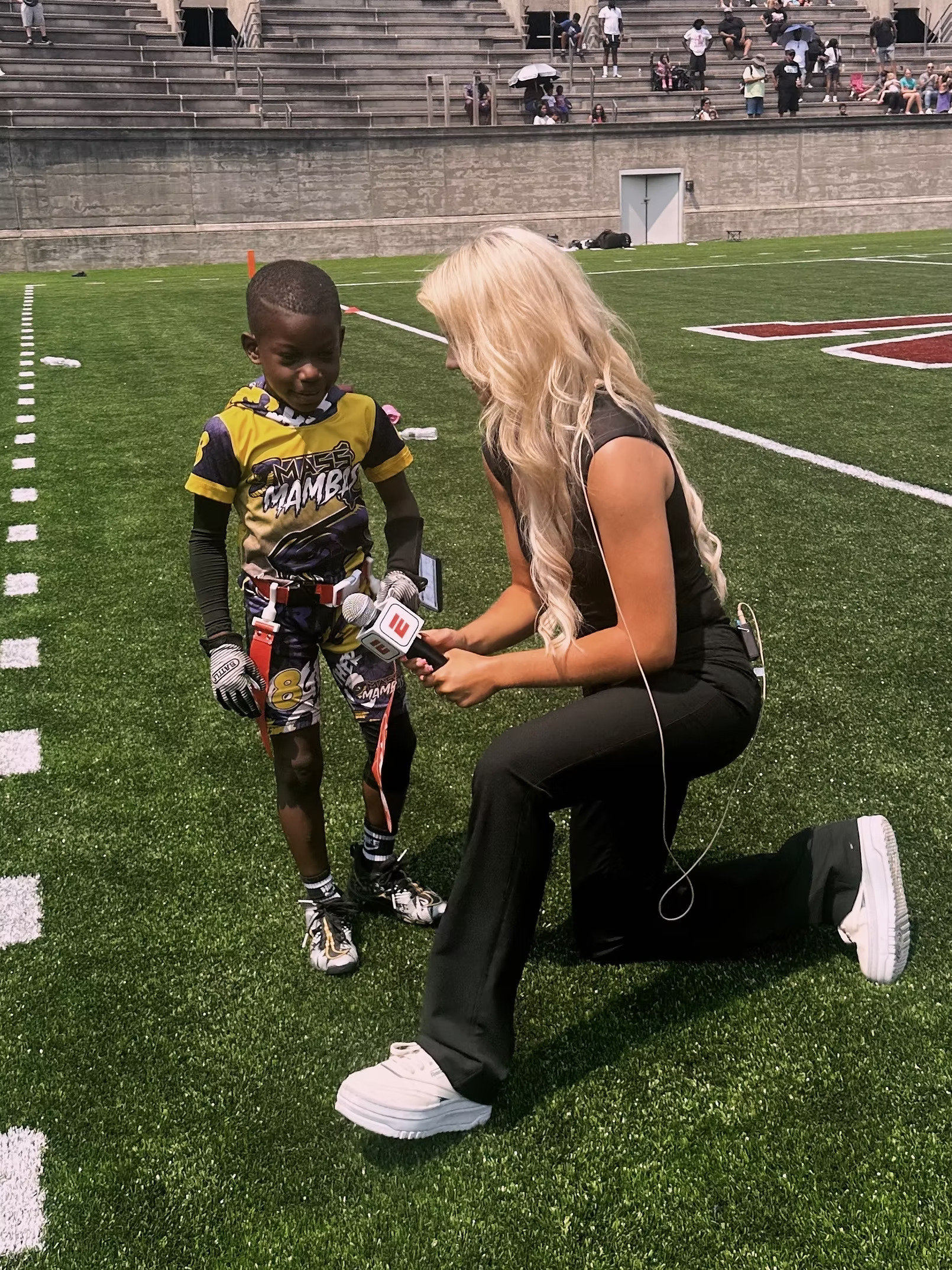
The resulting schedule sounds less like a career plan than a particularly ambitious group chat. McCoy is a Harvard College junior from Lincoln, Nebraska, concentrating in Economics and Art, Film, and Visual Studies, with a minor in Russian. She is Chief Marketing Officer of Harvard Student Agencies, a staff writer on The Harvard Crimson's Sports Board, a filmmaker, a digital media producer and a member of Harvard's cheerleading roster. During a 2025 internship with Harvard Athletics, she supported live ESPN+ broadcasts through sideline reporting and real-time analysis.
There is an easy way to tell this story: applaud the quantity. The more interesting question is what travels between the roles. McCoy's public portfolio supplies an answer. She describes film, journalism and brand as different muscles animated by the same instinct: find the truth in the room, frame it well and bring people along. The work becomes a field experiment in transferable attention.
The education hiding between the classes
McCoy arrived at Harvard after graduating as valedictorian of St. Pius X High School in Lincoln. Her résumé records a 4.0 GPA, varsity softball and tennis, and leadership in several student groups. It also records an unusually early piece of operating experience: from 2021 to 2024, she founded and led Fuel for the Fight, then negotiated the organization's transfer so that its work could continue.
At Harvard, she has built a different kind of curriculum around projects with visible consequences. A sports feature needs reporting deep enough to reveal a person rather than merely recap a box score. Her 2025 profile of basketball player Robert Hinton begins with an Al Green record from his father's collection. The detail is modest, domestic and useful. It introduces a family story before the statistics arrive. McCoy's reports on championship sailing and women's tennis use another register: close observation, orderly chronology and the discipline of getting a result onto the page.
Broadcast compresses those same instincts. There is no generous paragraph in which to wander toward the point. The reporter must notice, decide and speak while the event is still alive. McCoy's athletics work put her beside producers, camera operators and on-air talent. That setting makes collaboration concrete. Every person has a cue. Every second has a price.
“I'm not interested in choosing one medium. The story decides whether it wants to be a film, a column, a broadcast - or a TikTok at midnight.”Ava McCoy, on her portfolio
A CMO who knows the other side of the feed
In July 2025, McCoy became Chief Marketing Officer of Harvard Student Agencies. HSA's official managers page lists her in the role and gives the résumé a welcome crumb of humanity: she is a cheerleader and loves Snickers. The company itself contains a compact campus economy of shops and services, including tutoring, tours, apparel, dorm essentials and distribution. McCoy's job sits above a portfolio in which the customer might be a visitor, a student, a parent or an organization trying to understand campus.
Her portfolio says HSA generates more than $13 million in annual revenue and that her digital strategy tripled engagement across platforms. Those claims matter less as decoration than as evidence of feedback. Marketing gives McCoy numbers to place beside instinct. A campaign can feel elegant and still fail to move. An inelegant post may locate a real nerve. The dashboard is not the work, but it is a candid witness.
McCoy already knew what it felt like to live on the creator's side of that witness. Since July 2024, she has built a personal media brand to more than 25,000 followers and worked on sponsored campaigns with Prime, Edikted and Cider. Her portfolio describes the channel as a running journal of college, cheer and not having everything figured out in public. That last phrase is more revealing than a polished follower count. A personal audience asks for a controlled form of candor. Too much varnish and the voice disappears; too little judgment and the diary overwhelms the story.
The McCoy transfer loop
This is the useful piece others can borrow. McCoy is not collecting unrelated identities like lanyards. She is constructing a loop. Reporting improves the questions in an interview. Editing teaches her where attention drifts. Analytics reveal whether the intended audience stayed. Live television improves her tolerance for imperfect conditions. Then the next story begins with sharper instincts.
The frame can change
Film is where McCoy's interest in control meets its limits. Her portfolio lists two nonfiction shorts. Answered was made in partnership with the Daughters of Saint Paul. What's Left is a personal film about family, memory and what remains. Both sit beside reporting clips and brand work rather than in a sealed-off cinema cabinet. McCoy's presentation makes an editorial point: medium is a decision made in service of material.
The idea sounds obvious until professional identity enters the room. Titles are comforting because they simplify introductions. McCoy's list does the opposite. Filmmaker. Journalist. Sideline reporter. Creator. Cheerleader. CMO. She has said she is not interested in choosing one medium. The story gets the vote.
That flexibility does not mean every skill is interchangeable. A reported article cannot borrow the liberties of a personal film. A paid campaign has obligations that a diary post does not. Live analysis must be fast without becoming careless. The craft lives partly in understanding those borders. Range becomes credible when the practitioner respects the rules of each room.
A workshop with the doors open
McCoy is still early enough in her career that any final verdict would be silly. Harvard lists her in the Class of 2028. The compelling thing is not arrival but visibility: the workshop is open. The bylines can be read. The broadcast reel can be watched. The films can be seen. The campaigns leave public traces. Her progress is available in artifacts, not just adjectives.
The artifacts also resist the tidy myth that good work appears fully formed. Newspaper clips accumulate one assignment at a time. A reel is assembled from minutes that first had to be performed live. An audience grows post by post, with each result offering a small argument about what to try next. Even a leadership title is finally a collection of meetings, decisions and revisions. McCoy's public record is useful because it shows several versions of practice at once. You can watch the same instincts being trained under different rules.
For students tempted to copy the surface, the lesson is not to acquire six titles before breakfast. It is to choose work that produces honest feedback. A match report is either accurate and readable. A live segment either meets its moment. A campaign either reaches people. A film either holds together. Projects with consequences teach faster because taste has something firm to push against. McCoy's range works when each commitment returns a distinct kind of evidence. Without that exchange, busyness would merely be busyness wearing a credential.
Her public invitations point toward more of the same. She welcomes film projects, broadcast bookings, brand partnerships, speaking and press work. Her portfolio calls her a Nebraska valedictorian with a camera, a byline and a long list of things she wants to make. It is a good kind of ambition because it names the work before the acclaim.
There is also a small lesson in the geography. Lincoln to Cambridge can be told as a grand migration, but McCoy's story is built from repeated ordinary acts: show up to practice, ask the next question, check the cut, read the analytics, learn the names, hit the cue. The glamour of a crowded portfolio is mostly scheduling. The value is accumulated attention.
For now, McCoy's most convincing title may be student in the broadest sense. She is studying audiences as a marketer, people as a reporter, time as a broadcaster and memory as a filmmaker. Each room corrects the habits learned in another. The spreadsheet keeps the instinct honest. The sideline keeps it quick. The edit keeps it sharp. And somewhere between them, usually with a camera nearby, the next story decides what it wants to become.