A customer wants another car. The dealer wants a sale. Between them sits the customer's current vehicle: part payment, part pricing argument, part future inventory problem. Somebody must inspect it, decide what to offer and work out who will buy it next. Auto Avaliar has made that awkward middle of the transaction its business.
The Brazilian company supplies the appraisal software, dealer marketplace and pricing tools that connect those decisions. Its name means, roughly, “auto appraise.” The more revealing description is a trading system for professionals who need to move used vehicles without making every transaction a fresh round of phone calls.
Stellantis put a substantial price on that position. Its 2025 annual report records a €54 million payment for an additional 51.7% of Auto Avaliar in September, taking ownership from 43.3% to 95%. The stated rationale included stronger analytical capabilities and more services built around data. A manufacturer of new cars had bought deeper into the information surrounding old ones.
Paid by Stellantis for an additional 51.7% interest
The second sale inside the first
Auto Avaliar's original insight lives inside a familiar dealership routine. When a customer brings in a trade-in, an appraisal request enters the system. An evaluator records the vehicle's details and photographs through the app. The dealership can then advertise the car for retail sale or offer it to other businesses through the online bidding marketplace.
Brazilian dealers call this onward wholesale sale repasse. A car that does not suit one showroom may be exactly what an independent dealer needs. Auto Avaliar gives those businesses a place to meet. The company reports a network of 5,000 dealerships and 38,000 multibrand stores. Those are network counts, not a tally of software subscribers.
The scale has a geographic dimension. In an October 2020 interview with Mobile Time, co-founder Daniel Nino said more than 40% of the platform's sales crossed state borders. That is a dated snapshot, but it illustrates the point: the next buyer need not be the usual local contact. Geography becomes a choice in the deal.
- 01RecordPhotos + condition
- 02PriceVehicle + market
- 03RouteRetail or repasse
- 04TradeBuyer + seller
A price is useful. A buyer is better.
The distinction from a consumer listing site is where Auto Avaliar enters the transaction. Webmotors and Usadosbr belong to the broader automotive marketplace landscape; Auto Avaliar's core proposition starts with the dealer acquiring and evaluating stock, then connects that work to wholesale demand. Different tools compete for different parts of the same working day.
Its Tabela Auto Avaliar uses transaction observations to produce price references. The company describes separate consumer-to-business, business-to-business and business-to-consumer views, with minimum, average and maximum prices for comparable vehicles. Region matters too. A retail sticker, a wholesale bid and a trade-in offer answer different questions, even when the registration plate is identical.
Car Invest turns that information into inventory decisions. It examines pricing, turnover and scarcity, including regional supply and demand. A dealer can investigate where a model attracts interest and how long similar stock takes to sell. The practical attraction is straightforward: a tempting margin is less tempting if the vehicle occupies the same parking space for months.
The product's recommendation score combines turnover, profitability and scarcity. That makes it a prompt for commercial judgment. A model that looks attractive in the data still has to fit the dealer's customers, cash position and ability to prepare it for sale. A dashboard cannot make those operating choices disappear.
The fee is only the beginning
The dealer marketplace's published FAQ lists free access, followed by a transaction charge when a vehicle is purchased. For light vehicles, it lists R$999. For heavy vehicles, it lists R$999 plus 1.5% of the purchase price. Seller-specific conditions may apply. These are the published terms checked in September 2026.
For an illustrative R$50,000 light vehicle, R$999 adds almost 2% before transport, repairs or the cost of holding inventory. That arithmetic matters more than the word “free.” A dealer needs enough room between acquisition cost and eventual sale proceeds to pay for the entire journey.
Transport, preparation, taxes and financing are excluded. This is arithmetic, not a quoted vehicle offer.
Software brings another revenue stream. Dinamika advertises a Starter subscription at R$499 a month for up to 100 appraisals, with an excess-use charge of R$4.99 each. Its job is to turn a website visitor's vehicle into a priced acquisition lead, using the dealership's own business rules and links to its customer-management tools.
There is a useful detail in Dinamika's FAQ: a lead priced on a landing page does not automatically create an appraisal in USBI. The distinction separates an online expression of interest from the fuller appraisal workflow. For an operator adopting the product, that handoff deserves an owner and a clear process.
The dent gets a line item
USBI ties appraisal management to the mobile app, carrying vehicle data and photographs into the system. Auto Sync publishes stock across advertising portals. Together, these products tackle a prosaic source of wasted effort: recording a car's information and then having to move it into the next tool.
Car Damage addresses the uncertainty inside that record. Auto Avaliar markets it as an AI-assisted way to identify damage and estimate repairs, integrated with USBI. It also offers battery-health analysis for fully electric vehicles, comparing current information with manufacturer specifications. The yellow car on its product page shares the screen with a repair estimate and battery information. Showroom glamour meets the workshop bill.
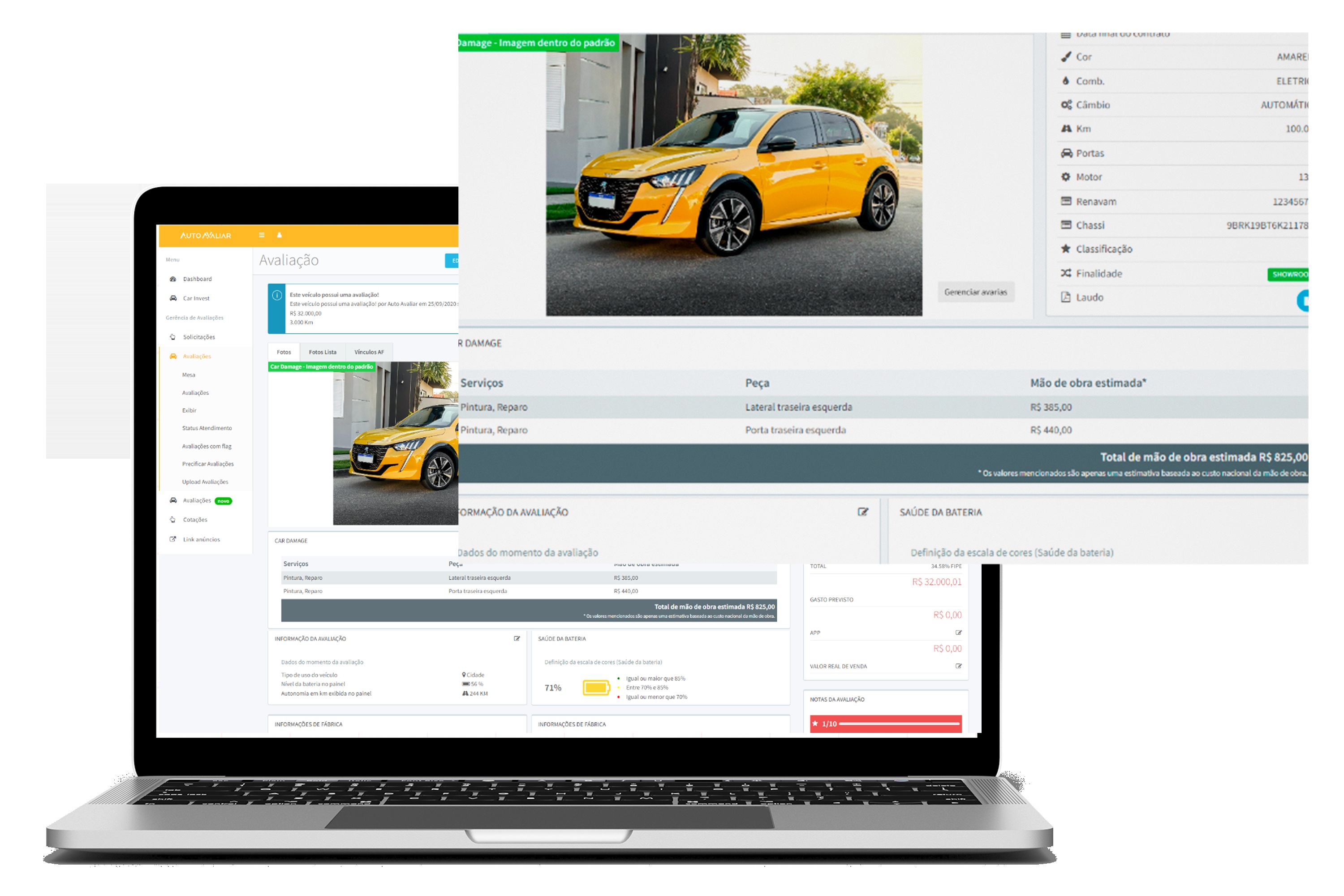
That is a commercially sensible place to put AI: next to a decision that can lose money when condition is misunderstood. The estimate remains an input to the deal. Dealers still need to read the vehicle description, understand the seller's conditions and allow for preparation costs before deciding what to offer.
When the bidding room slowed down
Growth exposed a specific weakness in the infrastructure. In a Google Cloud customer case study, development director Rogério Alves recalled that the appraisal app and bidding portal slowed above 5,000-6,000 simultaneous connections. IT problems could take hours to resolve. The company needed more capacity and less time spent nursing its systems.
“Our appraisal app and bidding portal slowed considerably”
Rogério Alves
Development director, in a Google Cloud case study
Auto Avaliar migrated with Google Cloud and SantoDigital, adding automatic scaling and operational monitoring. Alves reported incident-resolution time falling from four hours to less than ten minutes. These are company-reported results in a supplier case study. The business lesson is tangible: expanding a bidding network is of limited use if participation makes the bidding room harder to enter.
Capacity was not the only constraint. In January 2021, Caporal told AutoData that the pandemic and reduced availability of cars had hurt transaction volume. Software can distribute the stock that exists; it cannot conjure vehicles into the market. The same limit applies to the dealer at the other end: finding a car is useful only when buying, moving and reselling it still makes economic sense.
People who know both sides of the desk
J. R. Caporal, Daniel Nino, Silvio Silva and Aleander Monteiro began assembling the startup in 2012. The appraisal app followed in 2013, before Auto Avaliar's formal establishment in April 2015. The sequence helps explain the company: practical dealership software came before the broader marketplace and its expanding catalogue of services.

The company describes its roots as a meeting of automotive experience and technical expertise. Historical recruitment advertising made that combination unusually concrete: remote engineering roles sat alongside invitations to applicants with disabilities, refugees and LGBTQ+ candidates. The same advert offered a technical-development plan, a pool table and plenty of coffee. It is recruitment copy, but also a glimpse of how the employer presented itself.
The expertise now extends beyond application development. Data leader Matheus Duzzi Ribeiro describes a team spanning data science, machine learning, engineering, business intelligence and product management, with work on recommendations and analytics. The recurring task is to turn records from ordinary transactions into information a dealer can use before the next purchase.
Next stop: the excavator
The company has already tested adjacent business problems. Its Carflip venture with Karvi pursued used-car rent-to-buy subscriptions. Karvi co-founder Matias Fernandez Barrio described the impetus as buyers who lacked the credit history needed for financing. Following proof-of-concept work in 2022, the partners brought the project to Stellantis. It broadened the question from finding stock to making ownership accessible.
In March 2026, Auto Avaliar launched MAQ360 for used heavy equipment. Folha reported an initial focus on machines serving construction, mining and infrastructure. The logic resembles repasse: connect fragmented supply, make condition and provenance easier to assess, and bring professional buyers into the same marketplace.
Machinery also sharpens the challenge. Jonathan Pedro Butzke, the company's machinery operations head, told Folha that equipment lacks a centralized registration system comparable to the automotive market, making ownership and maintenance histories harder to trace. A successful car platform brings experience, but each excavator still needs a credible record.
For another business looking for something to copy, Auto Avaliar offers a specific sequence: identify an expensive handoff, make the record usable, connect the next buyer, then build decision tools from the transactions. It works best where enough professional participants bring reliable information and real buying power. The essential work begins before the bid: making an unfamiliar asset familiar enough for someone to put money behind it.