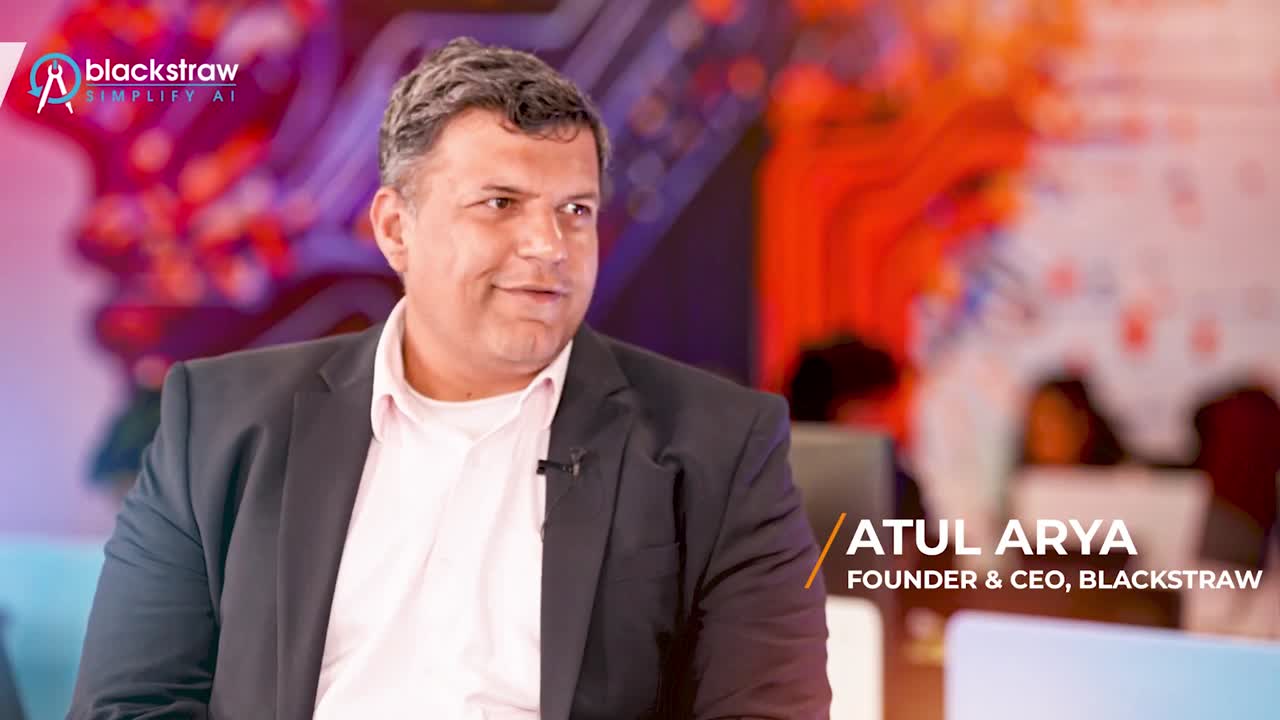
Atul Arya chose his 35th birthday to quit. His elder son was about a year old. He had long wanted to build something of his own, and the small child supplied a rather effective calendar. Waiting had begun to look less like prudence and more like a habit. Some people mark a birthday with dinner. Arya marked his with a resignation.
He recalls the calculation plainly: if he did not make the move then, he might never make it. Blackstraw followed in 2018, after a career that had brought him into artificial intelligence at Nielsen. The opportunity came from a problem he already understood. Large organizations could see what AI promised, yet getting it to work throughout a business remained difficult.
The leap did not immediately produce an orderly company. Arya remembers trying to recruit without an office or a client, spending nearly 200 hours explaining the idea to prospective colleagues. He says some of those earliest recruits stayed. Before there were implementations to point to, there was a founder asking people to accept an explanation of a future workplace. A job offer is an unusual document when much of the job still needs inventing.
Why Chennai was never a footnote
Arya was born in Chandigarh. In 1989, his father’s bank transfer took the family to Chennai, where he spent the years from six to thirteen. Punjabi culture remained part of home; Tamil became part of his wider world. He remembers the city’s slang and the music of Ilaiyaraaja and S. P. Balasubrahmanyam. Northern friends came to call him Anna.
Those details matter when people ask why Blackstraw chose Chennai for its Indian base. For a founder now based in Tampa, the answer has a childhood inside it. His account of Chennai emphasizes steady work, knowledge and loyalty. He places the city at the center of the company’s skilled engineering work. The geography is personal before it becomes a business explanation. Speaking Tamil gives that relationship an everyday form. A city can remain familiar long after a person has moved away; in Arya’s case, the company gives him a continuing reason to return to the place that helped form him.
He also sees India’s universities producing graduates with a different level of AI familiarity than a few years earlier. In his telling, Chennai is the starting point for a broader engineering ambition. There is affection in that view, certainly, but also a hiring argument. The place where he learned a language became the place where he wanted a company to do difficult work.
What the retail shelf taught him
Arya studied electrical engineering at Veermata Jijabai Technological Institute in Mumbai. His public education record includes debate and a sports secretary role. The combination suits the later job: understand a technical system, explain an argument, persuade people to participate. It is tempting to make university activities into prophecy; the safer observation is that engineering and organizing both appear early in his record.
At Nielsen, he held technology leadership roles and became Global VP of Innovation. His responsibilities included computer vision, image recognition, augmented reality and early chatbots. Retail shelves were one practical setting: machines identifying products so retailers could better understand what was in front of them. By the time he left, his work involved a global team covering several parts of AI development.
Blackstraw grew from seeing how often teams had to rebuild the surrounding machinery for each project. Arya wanted reusable tools to shorten that work. His original ambition for an image recognition and deep learning platform changed as customers’ needs became clearer. White labeling work for clients helped turn the idea toward services, with clients able to own their intellectual property.
- ChandigarhWhere the story begins
- ChennaiChildhood from 1989;
later, an engineering base - TampaBlackstraw founded
in 2018
A short assignment acquired a much longer life
One early break began six or seven months after Blackstraw started. A former colleague, newly appointed to lead a retail inventory management business, brought Arya’s company in for a consulting assignment lasting only a few days. The task expanded into a multimillion-dollar contract. Blackstraw built a scheduling and routing system for the customer’s field workforce; Arya later reported annual savings above $20 million.
Another opening came through a chance encounter with an R&D leader at a large consumer goods multinational. The business needed image recognition to read competitive claims from packaging. Arya says Blackstraw delivered a solution in 90 days. Both stories belong to his account of the company’s early work, and both begin with a conversation about a specific operational problem.
The appeal of these examples is their modest vocabulary. Routes. Schedules. Packaging. They make the customer’s difficulty easy to picture. They also explain the shape of Arya’s business: expertise that can be reused, followed by work specific to the customer. A reusable component can save time. Someone still has to make it fit the actual assignment.
Loyalty gets a line in the accounts
For Arya, keeping a team together has a financial expression. He says Blackstraw shares 10 percent of its profits through a pool for people who have been with the company for more than two years. At the five-year mark, the company also seeks to reward employees’ parents and families. Loyalty, he argues, runs in both directions.
The family detail gives that policy a particular texture. A startup asks for more than a name on an employment agreement. Its uncertain early years can affect the people waiting at home, too. Recognizing relatives acknowledges that wider circle. The arrangement also puts a date and a threshold on an otherwise rather slippery management word. Gratitude becomes easier to assess when someone can explain how it works.
In February 2026, Blackstraw received Great Place to Work certification for a fourth consecutive year, for a period running into February 2027. The announcement described a team of more than 450. Arya welcomed the recognition as feedback from employees. He had already appeared in Tampa Bay Business Journal’s 2020 40 Under 40. The workplace recognition speaks to a different constituency: the people doing the work every day.
of profits shared through an employee pool, according to Arya
2+ yearsEligibility for the pool
5 yearsRecognition includes families
The inconvenient life after launch
Arya’s technical argument keeps returning to what happens after the demonstration. He identifies three recurring obstacles: data that is unready for real use, deployment treated as a single event, and people who never adopt the resulting system. A model can lose effectiveness as incoming information changes. A tool can also be technically sound and sit unused because it does not fit how a team works.
That makes his version of leadership unusually interested in maintenance. Monitoring, retraining and integration are part of the work from the beginning. He favors continuing enterprise relationships in which Blackstraw becomes closely involved with a customer’s systems and operations. The visible launch is only one moment in that arrangement.
His customers’ questions have changed, too. Early on, he remembers having to argue that AI could be put into real use at all. Later, clients began asking why implementation should cost so much when so many tools were available. Both conversations leave him explaining the engineering between a capability and a working business process. Enthusiasm can be as demanding a customer as skepticism.
- 01Ready the dataBuild for real inputs
- 02Fit the workflowMake adoption possible
- 03Watch & improveMonitor and retrain
An agent needs boundaries before freedom
By September 2026, Arya was writing about another change in customer expectations. Questions about summarizing a document or classifying a ticket were giving way to requests for systems that could take action. An AI agent can move work across applications. The responsibility for its actions has to be decided before it starts.
His advice to enterprise technology leaders begins with trusted data, access controls and traceability. Someone must own monitoring and maintenance after deployment. In government contracting, he extends the same argument to approval chains, separated responsibilities and records of how a decision was made. These are environments where explaining the route to an answer can matter as much as the answer itself.
He advocates beginning with a narrow set of permitted actions and expanding only as evidence accumulates. That position puts a limit on the seductive idea of instant autonomy. A system earns more freedom through its record. For an executive who sells implementation, insisting on boundaries is a useful clue to his outlook: he is interested in what can keep working once the supervised demonstration ends.
“Autonomy should scale with reversibility.”
Atul Arya
The discipline of leaving a few things alone
Arya’s recent discussions of AI economics apply the same attention to detail to spending. He asks for a measured baseline, business outcomes and a clear account of continuing costs. In an August 2026 interview, he separated the savings from infrastructure modernization from gains contributed by AI. In one project, removing commercial software licenses accounted for most of the reported annual savings. It is a distinction that makes the story less tidy and the accounting more useful.
His ambitions still reach beyond large customers. He has described wanting smaller businesses to benefit from AI, too. Blackstraw’s work has also reached aerospace manufacturing through a partnership with Jeh Aerospace announced in July 2024. The planned applications included production workflows, quality control and supply chain visibility. Different customers, familiar questions about how work gets done.
Personally, he describes a collaborative management style that gives leaders autonomy while making the expected outcomes clear. He enjoys reading and mentoring, and credits his wife and two sons with perspective beyond work. One continuing challenge, he says, is learning to filter the flood of new technology. “There is so much coming at us,” he says. The founder who once gave himself a deadline now spends much of his time deciding which possibilities deserve everyone else’s time.
Follow the conversation
More from Arya, in his own words and in conversation.
- Blackstraw’s leadership and company story
- Atul Arya on LinkedIn
- Watch: the decision to start Blackstraw
- Watch: building and keeping a team
- The early projects and the company’s direction
- The real cost of agentic AI
- AI agents and the CIO’s responsibilities
- Agentic systems in government contracting
- The AI Chronicles: economic uncertainty and AI