A Healthfirst member was using two maintenance inhalers every day, prescribed by two different doctors. Each prescription had a prescriber. The trouble emerged when a pharmacist looked at them together. In Aspen RxHealth’s published account, the pharmacist contacted both doctors, coordinated the treatment plan, and the member continued with the formulary-preferred inhaler.
There is a business hiding in that small act of comparison. A medicine can be prescribed, dispensed, delivered, and still need explaining. Aspen RxHealth has organized itself around that unfinished conversation. Its central character is the clinical pharmacist; its preferred setting is wherever that pharmacist can work privately with an internet connection.
- The work: medication reviews, adherence support, and care coordination delivered remotely.
- The buyer: health plans and other healthcare organizations.
- The choice: use Aspen’s pharmacist network, your own team, or both.
- The machinery: BeWell software, with Alliance for clients’ internal teams.
A counter is a location. Expertise can travel.
Aspen’s origin has the appeal of an obvious idea that required considerable machinery. David Medvedeff began his career at Eckerd, managing pharmacists doing medication therapy management in a retail setting. Work at Gold Standard, later part of Elsevier, introduced him to healthcare technology. His published biography describes a continuing interest in patient experience and health literacy.
The company began in 2018. Medvedeff, Leah Carden, and Wuhong Li are identified as co-founders in its historical company profile. Their premise was that pharmacists’ clinical skills could be connected to patients without making a pharmacy building the organizing unit. A professional community could become the unit instead.
“Every patient is unique and so is every pharmacist.”
David Medvedeff · 2018 launch announcement
That sounds almost too polite to be a technology strategy. Yet it suggests a specific design: match people by more than whichever clinician happens to be free. Language, location, clinical background, and medication needs can all influence the encounter. A useful conversation needs someone qualified to give it, someone willing to receive it, and enough common ground to get started.

The algorithm’s destination is a conversation
Aspen serves organizations responsible for populations of patients: health plans, provider groups, life sciences companies, and strategic partners. Those organizations have medication-related problems to address across many members. The platform turns that population-level task into individual consultation opportunities.
Matching combines clinical and social factors with licensure. A pharmacist who speaks a member’s language and understands the relevant condition is a more sensible candidate than an interchangeable name in a queue. The service portfolio includes medication therapy management, adherence, education, transitions of care, and support for complex specialty medicines.
For a patient, the encounter can be a phone call. The pharmacist uses the software to conduct and document the consultation; the person answering does not need to become an expert in a new dashboard. That division is part of the appeal. Much of the technology remains on the professional’s side of the conversation.
- 01Identify
Member eligibility - 02Match
License + language + needs - 03Talk
A pharmacist calls - 04Follow through
Documentation + reporting
The commercial work surrounds that call. Eligibility, outreach queues, clinical documentation, and reporting all need handling. A charming conversation that never makes it into the right record is a poor enterprise product. Aspen sells the supporting operation along with access to clinicians.
The customer already had the experts
Healthfirst supplies the useful complication. In joint material presented at the 2023 Pharmacy Quality Alliance annual meeting, its problem included members receiving multiple outreach attempts. External vendors struggled to connect; excessive calling created member friction. The presentation also described a population with substantial Spanish and Chinese-language needs.
This was a coordination problem as well as a staffing problem. Healthfirst had internal pharmacists and existing member relationships. Giving every conversation to an outside organization would mean overlooking something the customer already possessed.
Alliance, launched in October 2022, made room for that reality. A health plan could use Aspen’s software and operational infrastructure while its own pharmacy team conducted consultations. If demand exceeded internal capacity, Aspen’s pharmacist community could provide additional help. Eligibility determination, telephony, queue management, member materials, and quality reporting were part of the supporting proposition.
Aspen’s pharmacists
+ Aspen’s infrastructure
Your clinical team
+ Aspen’s infrastructure
+ optional network support
For another service company, this is the detail to steal. A customer can value your operating system while preferring its own experts. Giving that customer a choice makes the product easier to adopt. It also changes the sales conversation from replacing a team to helping it finish the work.
The phone stayed. The software moved.
The early model revolved around a pharmacist-facing mobile app. In February 2025, Aspen introduced BeWell as a web-based medication-management platform replacing the mobile-only approach. The change expanded the working environment for consultations, documentation, and access to patient information.
BeWell is the underlying platform. Alliance is the offering through which a client’s internal team uses that infrastructure, with optional outside pharmacist support. The current Alliance description includes pharmacists, technicians, interns, and nurses among the internal professionals who can work in its workflows.
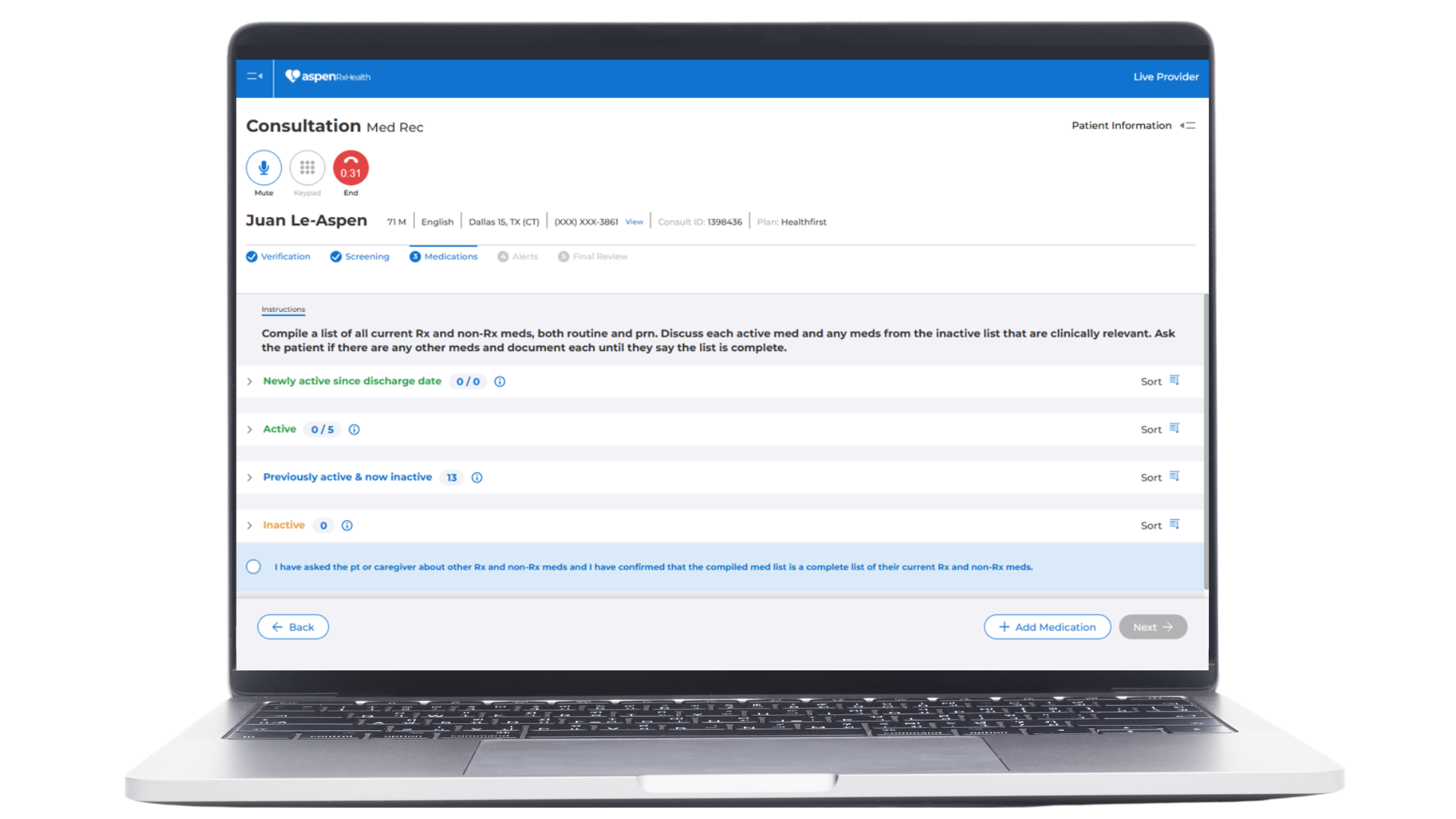
The product evolution is revealing. Aspen’s 2025 explanation explicitly discusses mobile-only limitations. Reading a medication history, navigating a record, and documenting an intervention benefit from a usable workspace. The published account describes expanded access and functionality; it does not establish a dramatic failed-app episode. The lesson is quieter: the device that makes work portable may eventually need company.
Capital, capacity, and a carefully read number
There was money behind the idea. Aspen announced a $9 million Series A in 2018 led by Flare Capital Partners, with an unnamed national strategic partner. Its January 2021 Series B added $23 million, led by Bessemer Venture Partners, with participation from Takeda Digital Ventures, dRx Capital, McKesson Ventures, Humana, and Flare.
Those two announcements add up to $32 million. The Series B was intended to support growth and expansion into areas including specialty pharmacy support and medication reconciliation. Funding explains the resources available to build a model; it does not, by itself, tell us how well any patient was served.
Two disclosed rounds. $32 million combined.
A more operational number appears in a September 2022 company-published case study. An unnamed prescription drug plan reported reaching 91% of its annual comprehensive medication review completion goal in the first quarter. That is progress toward a goal, rather than a claim that 91% of every eligible member received a review. The distinction matters.
The same account describes tailored outreach, scripts, eligibility work, and reporting. It gives a buyer something concrete to examine: how a program was put into operation. It remains one selected client account, not a universal forecast or a controlled demonstration of medical cost savings.
Flexibility has terms and conditions
For participating pharmacists, Aspen’s public FAQ describes independent contractor work, payment for completed consultations, and a one-time $75 credentialing fee. Enterprise customers are directed to sales for the commercial arrangement. These are different sides of the business, with different economics.
The community also gets support for the business of being a clinician. In February 2024, Aspen announced a coaching program covering clinical education, financial planning, business skills, and personal fulfillment. Its premise was practical: some pharmacists were operating as entrepreneurs for the first time. Autonomy can require a new set of habits, even when the clinical expertise is already there.
A pharmacist’s schedule can be flexible while the work remains constrained by patient availability and professional rules. The current FAQ specifically says a pharmacist licensed only in Nevada cannot complete consultations on the platform. Network size is therefore a poor substitute for asking how much suitable capacity exists for a particular population.

The business also has recognizable alternatives. Health plans can run their own programs, and providers such as MedWiseRx offer remote clinical pharmacy and medication-review services. Aspen’s particular combination is the distributed pharmacist community, matching, and the option to put a customer’s own team on the platform.
That combination works best when the organization has reachable members, usable information, appropriately licensed clinicians, and a way to act on their findings. An unanswered phone cannot support a medication review. A discovered problem still needs follow-through. In the inhaler example, the consequential step was coordination with the prescribers.
The interesting promise is ordinary enough to survive inspection. A trained professional gets time to compare the medicines, ask the questions, and explain the plan. Aspen has built a business around arranging that time. Somewhere, a pharmacist opens a record. Somewhere else, a phone rings.