A robot can look invincible for ninety seconds. The floor is clear, the lighting cooperative, the spectators politely outside its path. Then the machine goes to work and meets the untidy imagination of the physical world: a dropped carton, a stubborn drawer, a surface with the manners of an ice rink. The demo ends. Operations begin.
Ary Indarapu has built his young career around that second scene. He is the co-founder and CEO of Avea Robotics, a San Francisco company developing Sentinel, software that lets a human operator remotely monitor and control a robot when autonomous behavior reaches an edge case. The connection is designed to be low latency. The aim is immediate and practical: get the machine moving again.
There are founders who arrive at robotics by dreaming of a general-purpose machine. Indarapu arrived through systems. As a teenager in Carmel, Indiana, he was the information technology lead for TechHOUNDS, FIRST Robotics Competition Team 868. His team built scouting software to study what rival robots could do reliably. They also worked on a fantasy robotics game meant to pull more students into the sport. Even then, he was measuring the gap between an impressive robot and a repeatable performance.
The education of an operator
At the University of Illinois Urbana-Champaign, Indarapu studied computer engineering. The degree supplied plenty of theory, but his public trail is crowded with things made, explained, or taught. He co-authored a 2022 workshop paper that examined artifacts and security risks across eight hubs for pre-trained machine-learning models. The subject was software rather than metal, yet the concern feels familiar: a clever component is only as dependable as the system carrying it.
In 2023, he began publishing small technical essays. The menu was cheerfully broad: asynchronous processes in AWS, how the internet works, convolutional neural networks, the prospects of an AI-powered financial index, and a three-part tour of infinities of different sizes. His author biography said he enjoyed breaking down topics he learned. It is an engineer's version of keeping a commonplace book, except the commonplaces include Cantor's diagonal argument.
By 2024 he was helping teach safe autonomy at Illinois and finishing a senior design project for independently controlled irrigation plants. In 2025, he served as a teaching assistant for the university's artificial intelligence course. The sequence joined hardware, autonomy, machine learning, and the patient craft of making a difficult idea legible to somebody else.
OFF-DUTY DATA, 2020: Asked for his favorite school activity outside robotics, Indarapu chose tennis. Even systems thinkers occasionally prefer a court with painted lines.
The expensive pause
The problem that became Avea was less philosophical. Robots fail in the field. “Failure” can sound dramatic, but often it is merely awkward: the policy is uncertain, the gripper misses, the path is blocked, or the machine cannot classify what sits in front of it. A person on site can intervene. A fleet spread across factories and warehouses cannot afford one specialist leaning beside every chassis, waiting for the rare troublesome minute.
That pause has a price. A robot standing still is not producing the return promised in its spreadsheet. Staff kept on standby make deployment harder to scale. The autonomy team, meanwhile, loses a valuable encounter with the very edge case its model needs to understand. Avea's wager is that teleoperation can turn the pause into a handoff: the human sees the scene, takes control, resolves it, and lets the robot resume.
The useful loop is operational, not theatrical: every intervention can restore uptime and reveal a case the autonomous system did not handle.
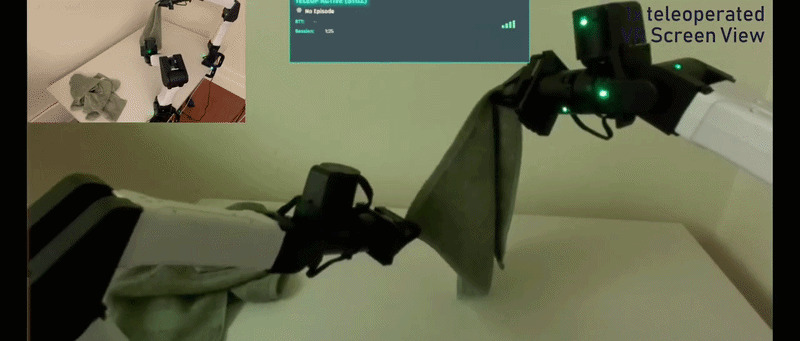
Sentinel uses virtual reality controls and integrates with an existing robot stack. Avea later added an operator dashboard for people who would rather not spend an entire shift inside a headset. Indarapu has described a smooth handoff from autonomous policy to teleoperation. He has also shared a remote session spanning roughly 2,000 miles in which Avea doubled video quality without adding latency. The details matter because remote control turns miserable when sight and movement disagree by even a fraction too much.
A customer across an ocean
Indarapu and his co-founder, Vikram Vadrevu, finished their Illinois degrees and moved to San Francisco in the summer of 2025. Vadrevu, Avea's CTO, brought aerospace and embedded-software experience. Together they had spent enough college hours building robots to discover that they could move quickly. They went all in.
The first customer did not wander into a campus lab. The founders flew to Japan and landed the account after a few months. Indarapu has called that the point when the company began to feel real. Avea then added three customers after its public launch, with robots being teleoperated across logistics, manufacturing, and home use cases. A young industrial startup could hardly ask for a tidier confirmation: different settings, same awkward need for a human to step in.
In 2024, before the move, Avea won a $5,000 Global Impact Award at Illinois' Cozad New Venture Challenge and a smaller prize attached to one use case. Indarapu was also a finalist at Research Park's Founders Week student startup competition. Those campus markers did not prove the business. The flight to Japan did more. Awards confer permission to continue; invoices confer a schedule.
The dignity of the fallback
Teleoperation is sometimes described as a fallback, a word that can make a human operator sound like an apology. Avea treats the handoff as infrastructure. The distinction is useful. Elevators have emergency brakes. Databases keep replicas. Airliners employ pilots while autopilot handles long stretches of flight. Mature systems are not embarrassed by recovery paths; they are defined by how deliberately those paths are built.
Indarapu's own record supports that temperament. The teenager studying consistency in a robotics match became the researcher studying vulnerabilities in model distribution, then the teacher explaining AI, then the founder worrying about uptime. None of those roles requires a taste for spectacle. All reward attention to what happens between the highlight moments.
There is a second argument inside Avea's product. A robot model cannot learn much from remaining sheltered in a laboratory. Real deployment produces the odd corners, surprising objects, and inconvenient physics that a training set failed to imagine. Indarapu puts it bluntly: “Robotic AI models will never get better if they just sit in the lab.” Human intervention keeps the fleet useful today while helping expose the work needed tomorrow.
This is not a promise of instant autonomy, nor is it a retreat from autonomy. It is an operating rhythm. Deploy. Observe. Intervene when necessary. Improve. Repeat until the extraordinary becomes routine and the routine becomes nearly invisible.
After the applause
By 2026, Avea was part of Y Combinator's Spring batch. Its launch page reported $18,000 in monthly recurring revenue and work on nearly 30 robot deployments. The numbers describe a company at the beginning, not a finished category. They also give Indarapu's thesis the weight of actual machinery: somewhere, a robot met an awkward moment and a remote operator helped it continue.
Indarapu's stated mission is to get robots out of the lab and into the field. That ambition is large, but his method remains agreeably specific. Make the video clearer. Keep the latency low. Let the operator sit comfortably. Hand control back smoothly. Talk to more robotics companies. The work resembles editing a sentence until no word gets in the reader's way.
He has also begun carrying that operational argument into the wider robotics conversation. At a 2026 seminar in Palo Alto, Indarapu moderated a panel on scaling robot capabilities across different environments. The assignment suited him. Scaling is the point at which a laboratory success must acquire schedules, controls, support, and recovery. It is where a machine stops being an exhibit and becomes a colleague with a very peculiar employee handbook.
The robot of popular imagination is gloriously independent. The robot of an actual shift may be more interesting: capable, fallible, connected to a person who can help, and designed by people humble enough to expect trouble. Indarapu is building for that machine. The applause can wait. There is a carton in the aisle.