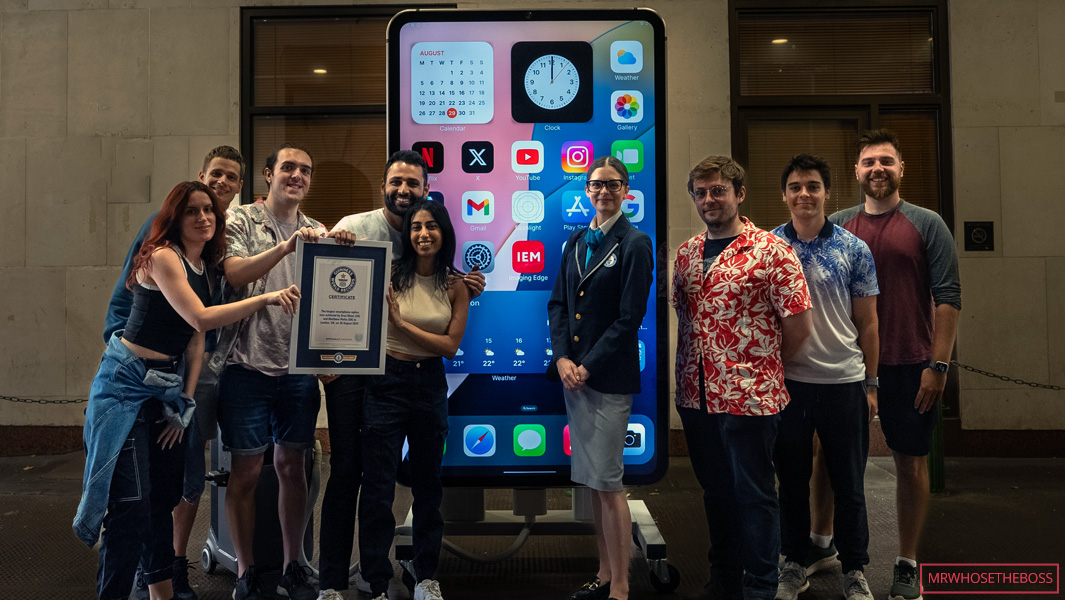
The largest phone in Arun Maini's possession lives in his basement. At 2.054 metres tall, it is an inconvenient piece of consumer electronics: a working, scaled-up iPhone 15 Pro Max that can take pictures, make calls and run apps. Most people need a pocket for their phone. Maini needs a room. The device earned him and fellow creator Matthew Perks a Guinness World Record in 2024, after Maini's YouTube channel passed Apple's in subscribers. It also makes a curious bookend to the much smaller phone that began the whole enterprise.
That first handset was an Android device his older brother gave him when he was 14. Maini was growing up in Nottingham and found himself fascinated by what he could make the thing do. He customized it, altered its performance and became the person friends asked about phones. He made a video to share what he had learned. The channel name, Mrwhosetheboss, came from a teenager with no expectation that the name would need to last. It lasted.
By late September 2026, the main channel had about 22.9 million subscribers. It had taken 15 years, a degree in economics, a declined consulting offer and a great many uploads to get there. The oversized iPhone is the most photogenic artifact of that journey. The smaller, less theatrical objects matter just as much: an early phone, a homemade plastic pyramid and the notes from viewers who told Maini what to try next.
The phone his brother gave him
Maini has described having a difficult time at school. At home, the Android phone gave him a puzzle with a screen. He learned to customize and overclock it, then explained his discoveries online. He has said he did not post the first video expecting to make a second. Even a few hundred subscribers seemed beyond the scale of his plans. In 2011, being a professional YouTuber was hardly a career route to present to a guidance counselor with a straight face.
His curiosity was practical. The channel's early years were intermittent because new devices cost money and manufacturers were not yet sending him review units. He filmed products he already owned or could borrow. That constraint shaped the work. A phone could be interesting because of what it could do in an ordinary owner's hands. The lessons were there for anyone holding a similar handset, and the boy delivering them was discovering that explaining a thing can be nearly as absorbing as taking it apart.
There was an earlier commercial experiment, too. As a young teenager, Maini bought Beyblades in small lots and resold them on eBay, eventually handling shipments of hundreds. His account was banned after he unwittingly bought and resold a stolen phone. The trading operation ended; the interest in phones did not. A business devoted to spinning plastic toys gave way to a channel devoted to the rectangles everyone carried around.
A pyramid on a phone screen
The breakthrough arrived in August 2015. Maini made a tutorial showing viewers how to place a little transparent pyramid on a smartphone screen to create the illusion of a 3D hologram. He put it online while at a party. Later that night, he saw more views than usual; by morning, the response had become impossible to ignore. At a time when an ordinary upload might draw three to five thousand views, he said this one reached 300,000 overnight. It went on to collect millions.
The channel rose from about 35,000 subscribers to 70,000 in a week, according to Maini's account. He had been keeping charts of its progress on his wall, and now one upload had outrun many previous videos combined. The project was wonderfully modest: a smartphone, a few pieces of clear material and a clever use of reflected light. There was no product launch to attend, no embargo to observe, no expensive sample to return. Anyone with the right scraps could try it.
“I never uploaded my first video with any intention of making a second.”Arun Maini, in a 2020 interview
A viral hit can make a young channel visible. It cannot write the next upload. Maini was still an economics student at the University of Warwick, splitting his days between academic work and video production. He has recalled rising two hours early to shoot footage in a park, then editing later. His university years moved the channel from roughly 9,000 subscribers at the start to about 300,000 by graduation. He left with first-class honours. The timetable sounds like a carefully engineered compromise, though the machinery was mostly a student with a camera and a stubborn alarm.
The job offer on the table
Economics pointed toward consulting. Maini interned at PwC during university and received a job offer. In a later interview, he remembered sitting in meetings while drawing ideas for videos he wanted to make when he got home. The conventional career had structure, a salary and a name people recognized. YouTube offered a growing audience and the freedom to work on a question that kept interrupting his office hours: how could the next video be better?
He turned down the offer after graduating in 2017. The decision was a gamble, but it was a considered one. He had already made hundreds of videos, learned what viewers responded to and proved that a channel could grow while he kept up his studies. His advice to younger creators later remained cautious: start in spare time, see whether the work itself appeals to you, and pay attention to feedback. This is the unglamorous part of the origin story. The day after a big video, somebody still has to choose the subject, shoot the footage and make the edit.
Maini seems unusually interested in that process. He has described reading comments for useful criticism and then trying the changes in future videos. It is a simple loop: publish, listen, revise, repeat. The visible result is a format that can move between a careful phone comparison and an absurdly expensive gadget experiment without asking the audience to learn a new presenter. In 2021 and 2022, the Streamy Awards recognized the channel in the Technology category. His online operation grew as the videos did.
A name that stayed, a room that changed
For years, Maini filmed in an attic that doubled as his bedroom. He later wondered whether the name Mrwhosetheboss looked too casual when invitations to serious technology events arrived. He kept it. In a 2025 interview, he said there was something personable about its imperfection. That is a fair reading of a username which still sounds like a dare from a school corridor, though it now sits above a substantial media operation.
By then he was speaking from a London home that also served as the channel's headquarters. He described a full-time team of 12, with his wife, Dhrisha Mehta, serving as general manager. Family members sometimes appeared in the videos. One later video featured a gift for the older brother who had given him that first phone. It is a pleasing reversal, and unusually tidy for real life: a tech channel that can repay its own beginning on camera.
The widening scope of the channel is evident in its subjects. Smartphones still anchor it, but Maini also tries unfamiliar gadgets, explores the claims behind products and turns technical comparisons into stories that people outside the enthusiast world can follow. He has shared the screen with other technology creators, including Marques Brownlee, and signed with Night Media in 2021. The changes brought more people, more production and bigger experiments, while the channel kept its conversational host at the center.
The promise that became two metres tall
Maini had told viewers he would build the largest iPhone if his subscriber count passed Apple's YouTube channel. When it did in 2024, he worked with Matthew Perks, the inventive maker behind DIYPerks, on a scaled-up iPhone 15 Pro Max. The build took more than three months. Guinness required a functional device, so the team made one that could scroll, call, play video, use apps and take selfies. It was more than 12 times the size of the original. The record was certified on 29 August in London.
The build connected two parts of Maini's childhood. One was the phone his brother gave him. The other was the Guinness book he used to read at the library. As he later put it, he had spent hours looking through those records. Now he had one, shared with Perks. The iPhone went into his basement, where it occupies considerably more space than its daily usefulness might justify. That is part of the joke. A phone normally disappears into a pocket; this one makes a whole career visible from across the room.
By 2026, Maini was still publishing reviews and experiments for an audience approaching 23 million subscribers. The products will change quickly. The most durable thing in his work may be a habit learned when there was no team, no prize and no access to the latest handset: find something curious in the device in front of you, then make it understandable to someone else. It began with a phone small enough for a teenager's hand. The one in the basement is harder to hold, and rather easier to remember.