The room did not have the usual comforts of corporate persuasion. It was a living room in Provo, Utah, occupied by two founders, a whiteboard, and pizza. Eric Rea and Dennis Steele had a young product for helping local businesses gather online reviews. What they did not yet have was a conventional office, a sign on the building, or software ready for the strain they hoped to put upon it. They invited Arthur Weagel, then working at Adobe, to hear the pitch.
There are moments in a career when the visible evidence argues for staying put. Adobe was established. Podium was two people explaining a future over dinner. Weagel took the less decorated option. When Rea asked him years later why he had come, the answer was not a market analysis or a meditation on equity. It was the energy. Weagel believed in the founders and believed they would do everything they could to make the company succeed.
This is how some technical careers turn: not because certainty appears, but because somebody knows which uncertainty looks alive. Weagel joined in September 2014 as Podium's first engineering hire. The co-founders had already sold enough of their early review product to attract a $500,000 seed investment. His assignment was both simple to say and difficult to finish - remake their prototype as sustainable software.
“Honestly, it was the energy. It was you guys. I knew that it was going to be good.”Arthur Weagel, recalling why he joined Podium
Before the whiteboard, there were scoreboards
Weagel's record before Podium has the tidy appearance of preparation, although careers never feel so well arranged while one is living them. In 2004, as a student at Cibola High School in Albuquerque, he was one of five winners in a Sandia National Laboratories essay contest. The students wrote about technical questions in science, mathematics, and engineering. For Weagel, it was an early public marker: technical ideas were worth not only understanding, but explaining.
At Brigham Young University, he studied information systems at the Marriott School of Business, eventually earning bachelor's and master's degrees. Information systems is an apt home for someone who would later become a software architect. It sits at the seam where programs meet organizations, where a correct piece of code still has to survive customers, deadlines, budgets, and all the inventive ways people use a tool differently from its designer's intentions.
In April 2011, that seam became competitive. Six BYU students traveled to Orlando for the Association of Information Technology Professionals' national collegiate conference. More than 60 colleges and universities participated. The BYU group faced a 17-hour test across several contests, each demanding a fresh kind of technical thought. Weagel placed first in systems analysis and design, first in database design, second in Java, and earned an honorable mention in Visual Studio application development.
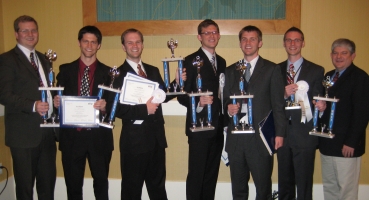
His description of the competition was more revealing than the trophy arithmetic. It tested how much a student already knew and how much that student could learn on the spot, he said. Success required combining previous knowledge with the ability to learn quickly, then producing a solution in little time. One classmate had to pick up a new language feature within four hours. Everyone, Weagel observed, had to do some version of that.
It is an excellent definition of applied engineering and a rather good warning against the cult of the expert. Expertise is useful; reality is impolite enough to keep introducing new material. The architect's advantage is not omniscience. It is the ability to bring shape to a problem while learning what the problem actually is.
“You need to combine your previous knowledge with the ability to learn quickly to come up with a solution in a short period of time.”Arthur Weagel at BYU, 2011
A career along the seams
After school, Weagel's route kept crossing the boundary between technical systems and institutional needs. He worked as a software developer at Sandia National Laboratories, the same institution that had recognized his high-school essay years earlier. His work there included a distributed system for nuclear-risk simulation code. He took part in GE Aero Energy's Information Management Leadership Program. Then came Adobe, where he worked in demand-generation enablement from 2012 until the Podium meeting in 2014.
The titles range across software, information management, and marketing operations. The connective tissue is translation. A system is never merely its code. It is also the people who ask things of it, the data moving through it, the work it replaces, and the work it unexpectedly creates. By the time Weagel arrived in the living room, he had experience with systems whose consequences extended well beyond a screen.
The prototype and the promise
Rea and Steele's original observation was grounded in ordinary frustration. A local business could serve hundreds of contented customers and still be defined online by the handful moved to write after something went badly. Their software made it easier to invite the quiet majority to describe its experience. The idea was plain enough. The difficulty lay in making it work repeatedly, for real businesses, without requiring those businesses to become software companies themselves.
A prototype wins permission to continue. A platform has to endure continuation. It must accept more customers, more data, more engineers, more features, and more peculiar edge cases without turning every addition into an archaeological dig. Weagel's revamped product gave Podium a base from which it could add people gradually while keeping engineering unusually prominent. In those early years, Rea said the company deliberately maintained more engineers than salespeople.
The company widened its scope. Reviews led toward customer interaction across text, email, and social channels. Later came payments, lead management, and automation. The current vocabulary is AI agents for local businesses. Weagel's public biography is admirably short: founding engineer at Podium, building AI-powered tools for local businesses. Behind that compact sentence sits more than a decade of technical continuity while the nouns around the product kept changing.
Continuity is not stasis. The software that survives a company from seed stage through expansion cannot simply remain as it was. Nor can the architect confuse preservation with quality. Some pieces deserve to last; others deserve a respectful funeral. The job is to know which is which before everyone else is forced to know.
The first engineer stays
Founding engineers occupy a curious position in startup folklore. They arrive after the original idea but before almost everything that makes the company recognizable. They are early enough to inherit improvisation and remain long enough, if they choose, to answer for it. Their contribution is not a single revelation. It is a sequence of judgments made when evidence is scarce and consequences are delayed.
Weagel's public footprint is smaller than the company architecture associated with his role. There is no grand personal manifesto to decorate the gaps, and none is needed. The documented moments are unusually consistent. A teenager explains a technical problem. A student learns across four disciplines under a clock. An engineer leaves an established company because he trusts the energy in a living room. A founding hire remains through successive versions of what the business is trying to become.
The amusing detail is the pizza, because pizza is what ambitious people order when they would prefer dinner not interrupt ambition. The serious detail is the judgment. Rea and Steele needed someone capable of turning enthusiasm into infrastructure. Weagel needed to decide whether their enthusiasm could survive contact with difficulty. Each side was evaluating the other, though only one had bothered to bring a whiteboard.
Today, from the Salt Lake City area, Weagel carries the title Founding Engineer & Chief Software Architect. The company he joined before it had a sign now sells a broad business-communication platform. The early review problem has become a much larger question about how local companies find, answer, schedule, and retain customers. Architecture, in this setting, is less a monument than a promise: tomorrow's product should remain possible after today's product ships.
A career can be read through promotions, funding rounds, and increasingly imposing titles. Weagel's is more legible through rooms. A high-school essay room in Albuquerque. A 17-hour competition hall in Orlando. A living room in Provo with pizza cooling beside a whiteboard. Each offered an incomplete problem and a short supply of certainty. Each rewarded the same habit: learn quickly, see the system, and make the next move possible.