A clearing membership sounds like something that belongs in a filing cabinet. In Arthur Fan’s career, it belongs near the beginning of the story. In July 2012, he was running BOCI Global Commodities (UK), which had become the first Chinese investment bank to gain clearing membership of the London Metal Exchange. The institution was entering a market with a history stretching back more than a century. Fan’s job was to help make that entry work.
There is a modest pleasure in the contrast. Commodities suggest ships, warehouses and large quantities of metal. The route into trading them also involves permissions, capital, systems and people who understand the rules. A membership is a small phrase with a considerable amount of organisation behind it. Fan would return to that territory, in different institutions and different markets, over the following decade.
A place at the table
His education took him through computer science at the University of Hong Kong and an MBA at Oxford. Before BOCI, his employers included SAP in Hong Kong, Arthur Andersen Business Consulting, BearingPoint and Sumitomo Corporation Equity Asia. The sequence crossed technology, consulting and investment. By November 2006, he had joined BOC International as an executive director.
At BOCI, the work moved from organisational planning into commodities. He became acting global head of commodities in 2013, then global head. Along the way, he founded and ran the UK commodities subsidiary. These were jobs inside an established banking group, with the additional task of building a business that could operate across borders.
The distinction matters when reading his later career. Founding a subsidiary carries a different set of responsibilities from founding an independent company. There is a parent institution, an existing strategy and a set of obligations to fit into. Fan’s early achievement combined those institutional responsibilities with entry into an international trading venue. London offered a practical test of whether the new operation could belong.
BOCI’s UK commodities business gains LME clearing membership, with Fan as CEO.
Seventy people, several rulebooks
On 10 January 2022, Fan joined Marex in a newly created role overseeing Asia-Pacific. He would be based in Singapore and report to group chief executive Ian Lowitt. The regional business then had more than 70 employees across Hong Kong, Singapore and Australia. China and Australia were singled out in his growth brief.
A new regional title can look wonderfully tidy. The places it covers have their own currencies, exchanges and requirements. For an executive responsible for growth, the useful question becomes specific very quickly: what can a client do here, and what needs to be built before that becomes possible?
In October 2023, Marex joined Singapore Exchange’s derivatives market as a trading and clearing member. That gave the regional expansion a concrete expression. SGX welcomed a firm whose clearing clients included banks, hedge funds, asset managers, companies and trading groups. The service sat behind a range of different investment and commercial decisions.
The same month also brought participation on the Australian Securities Exchange. Marex reported that its APAC net revenue had grown 89% in the first half of 2023 against the same period a year earlier. Exchange memberships and revenue growth measure different things, but together they show the regional brief becoming an operating business.
Fan’s own description of Singapore was less technical. Responding to a photograph of the local team in company merchandise, he wrote: “Singapore is our APAC HQ, great city and great team!” It is an unusually compact regional report. Headquarters identified; colleagues appreciated; city endorsed.
The ribbon and the machinery
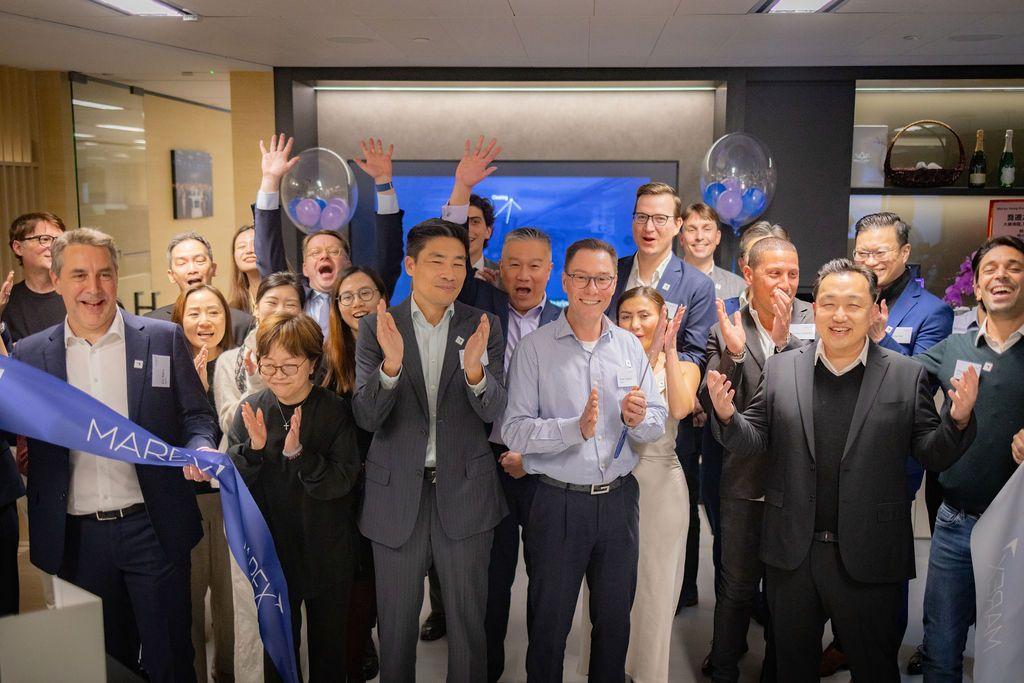
In January 2025, Marex celebrated its new Hong Kong office with a ribbon cutting, a lion dance and cocktails. Colleagues were brought together in the ICBC Tower on Garden Road. Fan thanked the clients and guests who attended. For once, the business of expansion supplied a photograph with a little more life than a map dotted with office locations.
The machinery continued to develop that August. Marex began offering direct connectivity to 24 Chinese futures and options products across the Shanghai International Energy Exchange, Dalian Commodity Exchange and Zhengzhou Commodity Exchange. The products covered agriculture, energy, metals and freight, following approval for Marex to act as an Overseas Intermediary.
For corporate clients and exporters, the offering addressed demand for ways to manage longer-term risk and understand domestic commodity prices. It was a specific addition to what the firm could provide. Fan linked the launch to continued investment in Asian market access, including during uncertain conditions.
The sequence gives the office celebration some context. A room brings people together; connectivity gives their clients something additional to use. Both require local work. In Fan’s career, the formal milestone and the less photogenic arrangements behind it keep appearing together.
What is worth buying?
By 2025, Fan was discussing how acquisitions fitted into the regional plan. He described a search for businesses that would add capabilities and work with Marex’s existing infrastructure. The word synergy has survived enough corporate presentations to deserve a comfortable retirement. Here, it comes with a practical question: what does the combined operation let clients do?
“We are looking for synergy and to create strategic value.”
Arthur Fan · on acquisitions, 2025
Marex’s purchase of TD Cowen’s prime services business in December 2023 had expanded its offering to hedge funds and asset managers. The regional opportunity included serving clients across several product lines. Fan also described a willingness to choose between acquisitions and organic development according to the market being entered.
Australia and New Zealand occupied a visible place in his thinking. In an October 2024 interview, he identified both as markets with further room for growth. The ambitions included Australian carbon markets and additional competition in ASX clearing. His role required choices about services as well as geography: being present in a country is the beginning of a commercial question.
A larger APAC contribution
The financial results provide a sense of scale. Marex reported APAC revenue of $176 million for 2025, compared with $131 million for 2024. These are regional company figures, earned by teams across the operation. They show how much larger the business had become while avoiding the tempting fiction that one executive personally generates every dollar attached to a title.
An electricity contract is a local affair
Fan’s account of serving investment managers puts weight on local knowledge alongside global reach. In a December 2024 interview, he described a region affected by changes in trade, politics, regulation and supply chains. The client challenge involved adapting across markets with different structures and economic conditions.
His list of longer-term opportunities included digital assets, green finance and artificial intelligence. He connected sustainability investment with commodities such as copper and nickel. The range suited a business spanning financial products and physical commodity markets: a technological development can eventually become a question about metal, electricity or how to manage a price exposure.
New Zealand provided a particularly concrete example in May 2026. Its Electricity Authority selected Marex’s local business to provide an over-the-counter trading platform supporting a standardised super-peak electricity contract. The offering also covered base-load and peak-load contracts, alongside customised electricity products.
The stated aims included improving transparency, liquidity and confidence in the market. Marex’s New Zealand office had opened in July 2024. Less than two years later, the local operation had been selected for a piece of market infrastructure. Fan described the development as part of the firm’s broader expansion of services across APAC.
An electricity contract brings the regional story back to a manageable size. It has a particular market, counterparties and trading requirements. Whatever the breadth of the group’s network, this service has to answer a local need. A regional strategy earns its keep through details of that kind.
The next door is already open
In March 2026, Fan was discussing plans for a Japan office. By June, Marex had launched Tokyo operations through Marex Securities Japan. Tokyo became the seventh office in its Asia-Pacific network, joining its presence in Singapore, Hong Kong, Australia and New Zealand.
The initial focus was structured products issued by the group and over-the-counter derivatives. Possible clearing memberships at the Tokyo Commodity Exchange and Osaka Exchange were being explored. Those prospective memberships remained distinct from the services available at launch. Entering a market gives a business a starting point and another set of tasks.
Fan described the Japanese entry in terms of serving both global clients seeking access and clients within Japan. That two-way purpose is familiar from the rest of his career. A new location must connect to the wider firm while giving people nearby a reason to use it.
In July 2026, Marex agreed to buy Singapore-based clearing business Bright Point International. The announced transaction was expected to add around $800 million in client balances and more than 70 employees, subject to regulatory approval. Completion was expected in late 2026 or early 2027. It was another proposed addition to the regional operation, with the work of completion still ahead.
The thread running from BOCI’s London membership to Marex’s Asian network is quite specific. Fan has repeatedly worked on the arrangements that make an institution useful in another market. There are teams to assemble, permissions to obtain and services to connect. Occasionally, there is a ribbon to cut. The rest of the time, the test is whether a client can get through the door.