When Cairui Fu sat for a company portrait, the photographer had a complaint: he kept smiling. Fu went home and checked the family photographs. There he was as a child, smiling. There he was with his schoolmates, smiling again. He concluded that optimism was simply his natural expression. For a founder whose early capital had to be borrowed, it was a useful expression to own.
Known as Arnold Fu in English and A Nuo online, the Hujiang founder had spent years doing something that looks rather awkward on a business plan: running a learning website without charging its users. The forum began in 2001. Commercial operations followed in 2006. Between those dates lay the part of his career that helps explain the rest. People kept arriving to learn, and he kept finding ways to leave the door open.
An English student discovers another language
Fu came from Lianyungang in Jiangsu and entered the University of Shanghai for Science and Technology in 1998. He studied English, eventually earning qualifications in English with a finance and investment focus and in English linguistics. His enthusiasm for computers developed alongside that education. He taught himself to build web pages and took on website work while still a student. The English student had acquired a second working language, one that browsers could read.
In his third university year, he created Hujiang Yulin, an online language-learning forum. It offered a place to exchange material and discuss studying. Its audience soon extended beyond his classmates. Fu met users away from the keyboard and listened to people who had already left campus but still needed foreign-language skills. They wanted the learning atmosphere a university supplied, without having the time or circumstances to return to one.
That observation gave the website a direction. Listening exercises and translation material followed the requests. The useful question was close at hand: what were the people on the forum trying to do? A service built around those answers could grow one request at a time.
The first assignment: borrow the money
The free years still had expenses. Servers and bandwidth required payment; goodwill had yet to become an accepted currency at the hosting company. Fu used earnings from his web work to support the site. Keeping it alive also kept a group together: schoolmates, friends and users who liked the work enough to contribute before there was much financial reward.
By the start of commercial operations, the community had roughly 200,000 registered users. Fu and his founding team began with RMB80,000. The team numbered eight. Part of the money came through their personal networks, including a loan from a schoolmate’s father. The numbers were small enough to be remembered individually, unlike the funding announcements that would come later.
Fu’s account of assembling the company contained an admirably practical first task for the new shareholders: go home and borrow money. He would do the same. Sharing ownership was followed immediately by sharing the problem. The company began in residential premises in Shanghai, with considerably more demand for learning than cash to meet it.
Shanghai was part of the bargain
At one early financial pinch, an investor offered US$1 million on condition that the team move to another city. Fu and his colleagues discussed it and chose Shanghai. He had come there to study; his first experiences of its subway and taxis were part of his attachment to the place. A city can acquire a surprising amount of negotiating power through a person’s youth.
The investor ultimately backed them without requiring the move. That episode makes the early business less tidy than a story of inevitable progress. The team needed money and still had a preference strong enough to risk losing it. Shanghai remained the setting as Hujiang moved from a residential office into the technology district of Zhangjiang.
A forum learns to charge tuition
Hujiang’s early commercial experiments included advertising and education-related products. A website that helped people find learning material was discovering how to pay for the people and machinery behind it. In 2009, the launch of Hujiang’s online school gave the enterprise a more direct relationship with education: it could sell instruction as well as gather an audience around it.
By 2015, its business included paid courses, learning products and services for corporate customers. Its language offering had spread beyond English. Fu was also discussing shorter lessons, three to five minutes long, as a way to let more people try online learning. The format fitted a familiar audience: people with a reason to study and imperfect stretches of time in which to do it.
“Starting Hujiang was never about setting up a company,” Fu said in 2015, translated from Chinese. By then Hujiang had announced a RMB1 billion Series D financing round. The remark belonged to a founder whose company had become substantial, yet who still explained its existence through the original learning demand. The tension between those two ways of looking at it would matter.
“Starting Hujiang was never about setting up a company.”Arnold Fu · 2015 · translated from Chinese
The classroom leaves the desk
A learning website designed for a desktop computer faced another adjustment when its audience began carrying the internet in a pocket. Fu described a three-year transition towards mobile education. By the end of 2017, Hujiang reported 170 million users, including more than 140 million mobile users. These were historical audience figures, spanning the platform rather than a count of paying students.
“We adapt to users, rather than making users adapt to us,” he explained in 2018, translated from Chinese. The principle was consistent with the forum years. The implementation was considerably more complicated. Courses, learning tools and interaction had to fit the circumstances in which people now lived.
The attraction of mobile learning is easy to describe: study can happen away from a particular room and a particular machine. Making it pleasant enough to repeat is the harder assignment. Fu’s career repeatedly returned to that gap between opening access and making the experience work once someone arrived.
A second-hand computer can have a second career
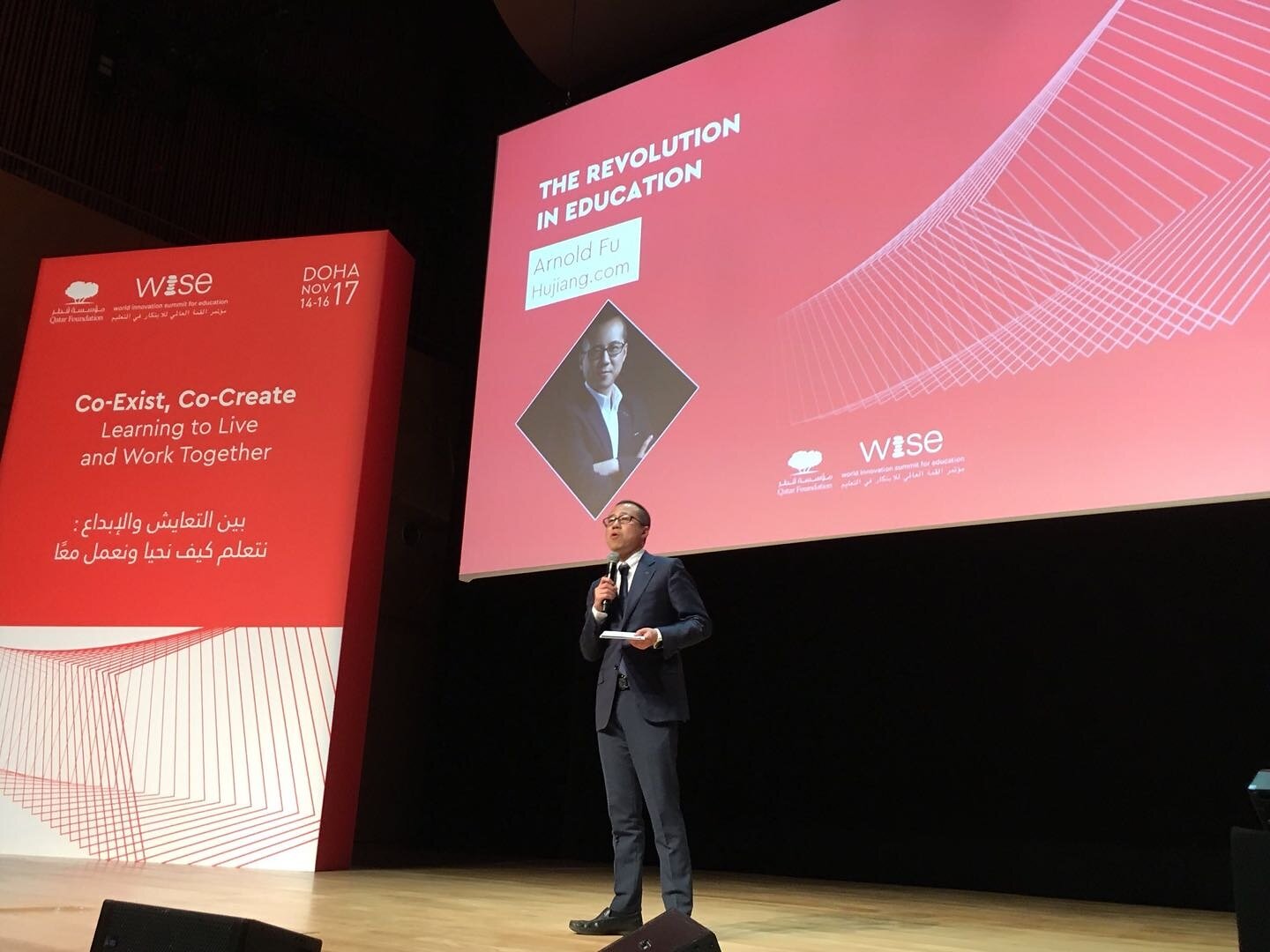
At WISE in Doha in 2017, Fu spoke about Hu+, Hujiang’s rural education initiative. The ingredients were refreshingly tangible: internet connections, second-hand computers, lessons contributed by teachers in cities and CCtalk, the company’s interactive teaching software. The ambition was to let a school’s location have less influence over the teaching its pupils could encounter.
He described the project’s role as connecting the people contributing resources with those receiving them. In his November 2017 presentation, he put its reach at more than 2,000 rural schools and over one million students. Those were the programme figures he gave at the time. They describe the reach of the initiative, rather than a measured improvement in examination results.
The idea took Fu’s original experience beyond language learners looking for material. A classroom could remain in its village while a lesson travelled to it. There was something fitting about a company born from shared resources giving used equipment a place in its educational ambitions. The computer did not need to be new for the opportunity to be new to its pupil.
- 01City teachers
Contributed lessons - 02CCtalk + internet
Interactive delivery - 03Rural classrooms
Local pupils, remote resources
The student returns with a microphone
Fu’s education work brought him into international company. In 2016, he appeared in the Makers and Shakers of Education Technology Index assembled by EdTechXGlobal with WISE. In 2017, he served on the WISE Awards jury. The forum founder was now evaluating other people’s attempts to solve educational problems.
He also returned to his own university. At an alumni entrepreneurship forum in June 2015, he spoke about the importance of people gathering around a venture: classmates, older graduates and investors. He described character as fundamental to entrepreneurship. The advice fitted the borrowed starting capital and the colleagues who had worked on Hujiang before it became a conventional employer.
In 2018, the traffic ran the other way when CCtalk hosted six Harvard Business School students in Shanghai for a week through FIELD Global Immersion. Their assignment concerned better services for newly registered independent teachers. They conducted research, interviewed local people and presented proposals. Beneath the international programme’s formal name sat a question Fu had been asking for years: how can the service be more useful to the person who has just joined?

Growth sends an invoice
A large audience and a working educational idea still left a business to finance. In 2017, Hujiang’s revenue reached about RMB555 million, while its annual loss reached about RMB537 million. Its own branded courses supplied more than 99 percent of that year’s revenue; CCtalk’s platform business was still developing. The economics of a course provider and the ambition of an open teaching platform were moving at different speeds.
Fu had acknowledged some of the pressures years earlier. Speaking in 2014, he discussed the cost of attracting teaching professionals away from established institutions and competing with internet companies for technical staff. Money raised could purchase less than a founder had expected. Educational conviction did not settle a salary bill.
Hujiang applied for a Hong Kong listing in July 2018 and passed its listing hearing that November, but the listing process subsequently stalled. Fu stepped down as chairman and legal representative in November 2019. At that point he remained a director and general manager. A later corporate account records his departure from the director filing in November 2020; the operating company was renamed Shanghai Xingzang Technology (Group) in 2022.
The question that outlasts the forum
The appeal of Fu’s story is partly its awkwardness. A free community produced a business. A student of English became a builder of online classrooms. A founder who wanted education to travel also had to persuade teachers, engineers, users and investors to travel in roughly the same direction. Their destinations were not always identical.
His early habit of listening gives the story its most human scale. Before the funding rounds and the international stages, there were people outside a university asking for help learning. The forum gave them somewhere to ask. Everything that followed made that simple exchange more ambitious and more expensive. The useful thing to remember is how little ceremony the beginning required: someone needed a lesson, and someone else was paying attention.