Five years is a long time to leave the cash register unplugged. In 2001, Cairui Fu was a university junior in Shanghai when he started an online community for people learning English. Hujiang began as a free place to learn from one another. Only in 2006 did he turn it into a commercial operation, with eight founding team members and 80,000 yuan. Some of that money came from the father of a schoolmate. The financing was distinctly closer to the kitchen table than the boardroom.
The order matters. Before there was a company to pitch, there were people using something Fu had made. Before there was a business model, there was a habit of coming back. The first five years gave the venture a history that a newly incorporated company usually lacks. They also left Fu with a difficult obligation: finding a way to keep a useful thing alive.
He is also known as Arnold, or A Nuo in Chinese. Born in Lianyungang, Jiangsu, in 1979, he studied English at the University of Shanghai for Science and Technology. The educational enterprise grew out of that university life. Even its name carried a campus connection: Hujiang recalled the university’s historical predecessor. A name borrowed from an institution of learning proved a durable reminder of the original purpose.
- 2001Free learning forum
- 2006Commercial operations
- 2009Online-school business
- 2015Hu+ rural education initiative
A click, and a mother’s permission
Fu’s account of discovering Google at college has the enthusiasm of someone finding an unlocked door. Searching made independent learning feel possible. He could follow a question instead of waiting for a book, a timetable or a classroom to catch up. “I could find out anything I wanted with a click,” he said in 2015.
Teachers and friends encouraged him to take the safer route after graduation and earn a salary. His mother offered a rather broader career policy: he could do what he liked, provided it was legal. As parental guidance goes, it left an unusually generous amount of room for a business plan.
Fu also remembered encouraging messages from people on campus. A rough website could still be valuable enough for somebody to ask its maker to keep going. That sort of encouragement has a different texture from applause at a launch. It comes from the person who would notice if the service disappeared.
There is a practical distinction between wanting freedom to learn and building a service that gives others that freedom. The first can be satisfied in an afternoon. The second creates responsibilities that persist long after the novelty of a search engine has worn off. Fu chose to stay with the second problem.
The invoice arrives
Turning the community into a company did not settle the question of how it would earn its keep. Rent, computers and basic costs quickly consumed the initial capital. Advertising brought in money, but educational traffic had limits in a market where entertainment could attract far more attention. Hujiang also tried selling materials and electronic dictionaries. Paid online courses eventually supplied a more direct relationship between the service and the person buying it.
Each experiment answered a different question. Would advertisers pay to reach learners? Would learners buy the equipment and materials around education? Would they pay the platform for teaching itself? These are adjacent businesses, but the incentives differ. Attention pays one bill; a course that someone wants to complete pays another.
Fu’s working method during the difficult years was close to the users. In a 2014 speech, he recalled late nights spent understanding what concerned them and what they wanted. He admitted that he and his colleagues struggled to articulate a polished commercial model. A founder surrounded by details can seem unimpressive beside a founder armed with market forecasts. Details have the advantage of belonging to actual people.
He credited investors by name, including Zhao Guibin and Sui Yingpeng. Their importance in his telling came from supporting the people and understanding education while the company was still working out its shape. The story has room for persistence, but it also has room for help.
A billion yuan cannot teach a lesson
On October 28, 2015, Hujiang announced a Series D financing of one billion yuan. Its valuation exceeded one billion US dollars. Those figures marked a change in the size of the venture, though Fu continued to describe its beginning as something other than an attempt to establish a company.
His stated priorities were product quality and the learner’s experience, including that of people who did not pay. In the same period, he described opening the platform to partners beyond Hujiang’s strongest area, languages. The ambition was to let other educators use its technology, products and audience.
There is a tempting way to tell this stretch of his life: put the smallest funding figure beside the largest one and let the zeros provide the plot. That leaves out the hard part. An investment can buy time, infrastructure and staff. It cannot finish a student’s homework or explain a confusing lesson on its own. The service still has to earn its place in somebody’s day.
The contrast is useful because Fu’s ambitions involved two different forms of scale. A company could grow through financing. Teaching could spread through people who knew something worth sharing. Connecting those two forms of growth required choices about what Hujiang should produce itself and what it should help others provide.
More teachers than one company can employ
By 2015, the platform offered a striking example in Su Nannan, a teacher with a chemical-engineering background who had developed an English-learning method. He began with a free class and then sold a vocabulary course. More than 400 paying students generated over 300,000 yuan in 20 days. Here was a teacher finding an audience through the same place where learners found a teacher.
Fu wanted to support many such independent educators. His idea of an education platform depended on making it easier for third parties to teach, rather than expecting one company’s own courses to satisfy every learner. A language learner preparing for an exam, a professional studying after work and a child discovering drawing ask for different things. A single syllabus would make awkward company for them.
That variety explains the appeal of a platform. It also explains its difficulty. An open door is only the beginning. Teachers need ways to present courses, communicate with students and sustain their work. Learners need enough structure to judge what they are choosing. Giving everybody a place to gather creates a new set of editorial and operational duties.
By 2018, Fu described Hujiang’s successive phases as commercial exploration, an online school, a move to mobile and then a platform. He regarded it as an education technology company. The repeated changes suggest an ambition that kept its subject while revising its machinery.
The classroom travels
The move to mobile put a new setting around the old learning problem. During a 2016 television interview at the World Internet Conference, Fu said that more than 100 million of Hujiang’s 130 million users were on mobile devices. These were figures from that moment, describing the reach the company reported then.
A classroom tied to a building has an obvious boundary. A lesson on a phone can accompany a learner beyond it. That changes where study can happen, although it leaves the student with the familiar task of paying attention. Portability can remove a journey; it cannot remove the work.
For Fu, access also had a geographical meaning. He discussed CCtalk, Hujiang’s interactive education platform, as a way for rural teachers and students to share educational resources with their urban counterparts. The aspiration was concrete: make a lesson available where the teacher could not readily travel.
This is where the appeal of online education becomes less abstract. Consider the difference between being told that excellent teaching exists somewhere and having a way to join it. The value lies in the connection actually working, at the right time, for the people who need it. A platform’s promise is tested at the receiving end.
An art lesson with a long reach
In April 2018, painter Yang Songshou taught an online workshop attended by thousands of rural students. Fu described the event in an essay about Hu+, the education charity initiative Hujiang launched in October 2015. An accompanying exhibition displayed more than 400 children’s paintings and drawings, selected from more than 2,000 submissions.
The pictures gave the project a visible output. Students had something to show, and the display placed their work before people outside their schools. A network that transports a lesson can also transport the response to it. That is a more interesting use of bandwidth than another presentation about bandwidth.
Fu argued that software alone would not solve unequal access. Educational resources and teacher training had to be distributed more fairly. Hu+ worked with organizations including YouChange and Beijing Normal University on a teacher development initiative launched in 2017. The local teacher remained central to the approach.
His ambition, in that essay, extended beyond certificates: learning could open a career and a choice of where to live and work. It is an expansive aspiration, but the route he described was specific. Connect teachers. Offer training. Share lessons. Give the people already in the classroom more to work with.
“Everybody has an equal right to education.”
Cairui Fu, 2018
The student becomes a host
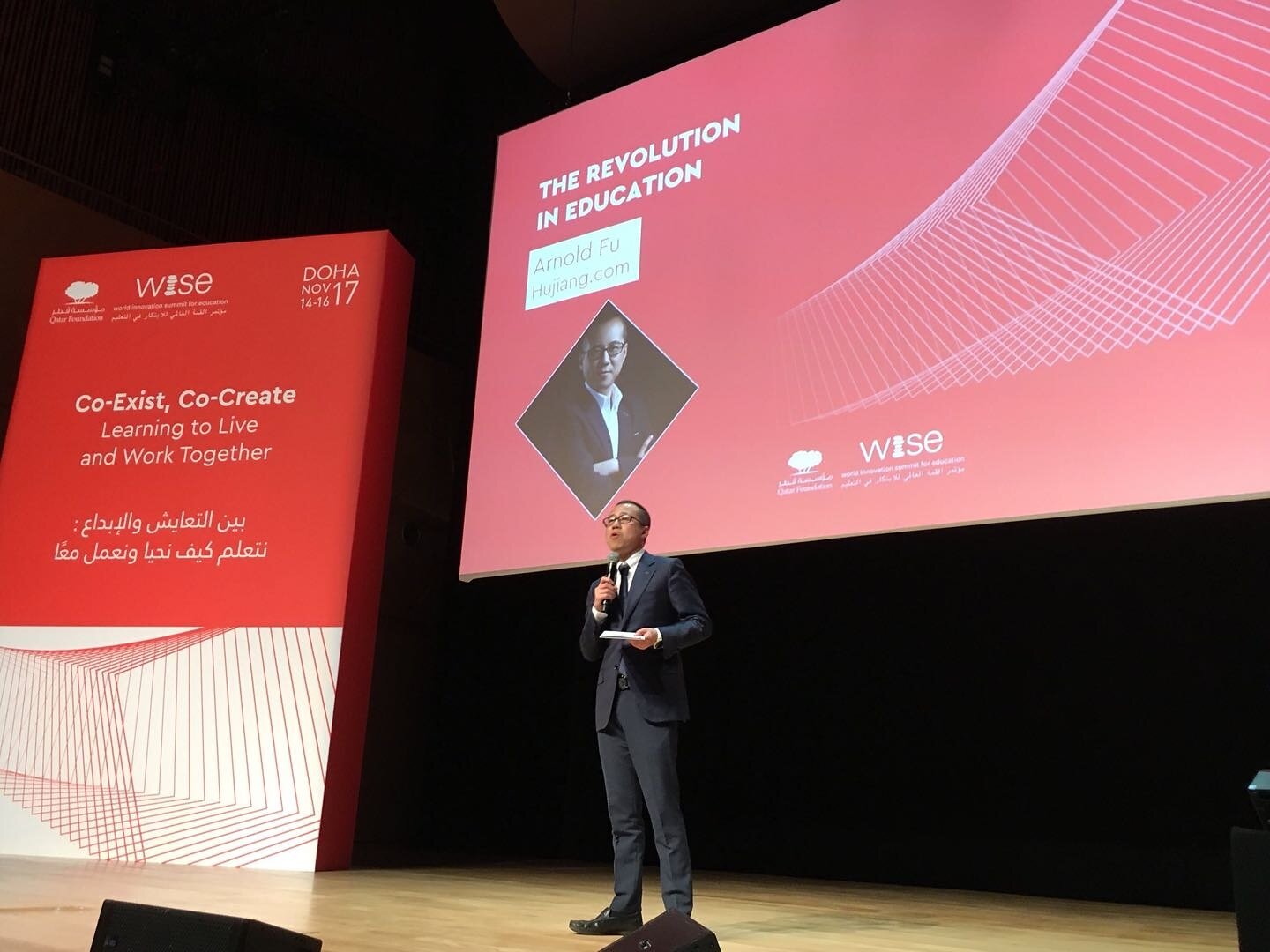
International recognition brought Fu into another educational circle. In 2016, he was included in the Makers and Shakers of Education Technology Index produced by EdTechXGlobal with WISE. In 2017, he joined the WISE Awards jury in Doha. A project started by a student had become part of a conversation among education organizations across borders.
In 2018, CCtalk hosted six Harvard Business School students in Shanghai as a FIELD Global Immersion partner. They researched ways to improve services for newly registered independent teachers, interviewed local people and presented proposals. The subject was fittingly ordinary: how to make the experience better for someone just arriving on the platform.
The university student who had started a learning forum was now helping visiting university students learn from a business. The circle is pleasing, without requiring a grand moral. Education sometimes consists of bringing an unfamiliar question to people who have lived with it for years.
Fu welcomed the opportunity for students to gain understanding beyond classroom discussion. The collaboration also placed the company’s everyday operations under a fresh set of eyes. An institution with a celebrated name still had to ask about the experience of a newly registered teacher. Prestige, on this occasion, had some practical homework.

After the growth charts
Fu’s story continued beyond the years of expansion. In November 2019, Hujiang’s operating company changed its registered leadership: he stepped down as chairman and legal representative, with contemporaneous reporting saying he remained a director and general manager. Later accounts also described the chairman’s role passing to Song Xiangwei.
The financial aftermath belongs in the picture. Shanghai Sanmao’s 2025 half-year report records a share-repurchase arbitration involving Fu and other Hujiang core shareholders. It describes a 2019 award supporting the investor’s claim and subsequent enforcement proceedings. These are investment and ownership matters, distinct from the classroom ambitions that made the venture recognizable.
The early free community and the later financial obligations sit uneasily together. That discomfort is part of a complete business story. A useful educational purpose does not settle the terms on which a company accepts money. Growth creates commitments alongside possibilities, and those commitments can last beyond a founder’s tenure in a particular office.
Fu’s career offers something more substantial than a neat rise from a small sum to a large valuation. He spent years finding a commercial form for a place where people wanted to learn. He then tried to put its tools within reach of teachers whose students lived elsewhere. The enduring question is the one implicit in that first free forum: how do you keep the door open, and pay for the room?
Follow the conversation
- Hujiang website
- Cairui Fu on LinkedIn
- Hujiang on X (company account)
- Hujiang on Facebook (company account)
- Fu’s essay on education access
- 2014 entrepreneurship speech
- 2015 profile
- 2015 financing and interview
- 2018 interview
- Fu at WISE, 2017
- Harvard collaboration
- Television interview: ICS, 2013
- November 2019 leadership change
- 2024 company retrospective
- 2025 investment disclosure, p. 99