A commercial building is a machine with amnesia. It burns electricity at two in the morning, reheats air it cooled an hour earlier, and files the evidence across meters, leases, invoices and half-maintained spreadsheets. Then, once a year, somebody asks the sustainability team for a clean carbon number and a credible plan to make it smaller.
arbnco built software for that awkward moment. The Glasgow company gathers energy data, benchmarks properties, spots waste, models retrofit options and turns the result into a portfolio action list. The buyers are not homeowners admiring a thermostat app. They are real estate investment managers, REITs, utilities, corporate occupiers and facilities teams responsible for hundreds or thousands of assets.
In July 2026, energy-data specialist IMSERV acquired arbnco for an undisclosed price. The logic is cleaner than most merger copy: IMSERV has the pipes and meter data; arbnco has the models that explain what the buildings are doing and what an owner might do next. The combined promise is a path from the meter to a decision about cost, carbon and compliance.
The jobSell the decision, not another dashboard
arbnco's current offer is arranged as a four-level climb. First comes data access and carbon reporting. Second comes tenant consent, because a landlord may own the walls while the tenant controls the meter account. Third is a decarbonisation strategy: benchmarks, performance analytics and a ranked plan. Fourth is action planning through calibrated building models, digital audits and costed retrofit recommendations.
Energy access, coverage and carbon reporting.
Tenant engagement and a digital permission portal.
Benchmarking, analytics and portfolio priorities.
Simulation, digital audits and retrofit actions.
That sequence is the clever part. Carbon software often assumes the data already exists. Engineering consultancies often begin with an expensive site visit. arbnco tries to screen the portfolio first, so specialists spend time on buildings where investigation can change a capital decision. Its published arbn Insight material described load disaggregation, occupancy-pattern analysis, weather response and UK benchmarks drawn from more than 8,000 buildings.
What failed firstThe spreadsheet's fantasy of complete data
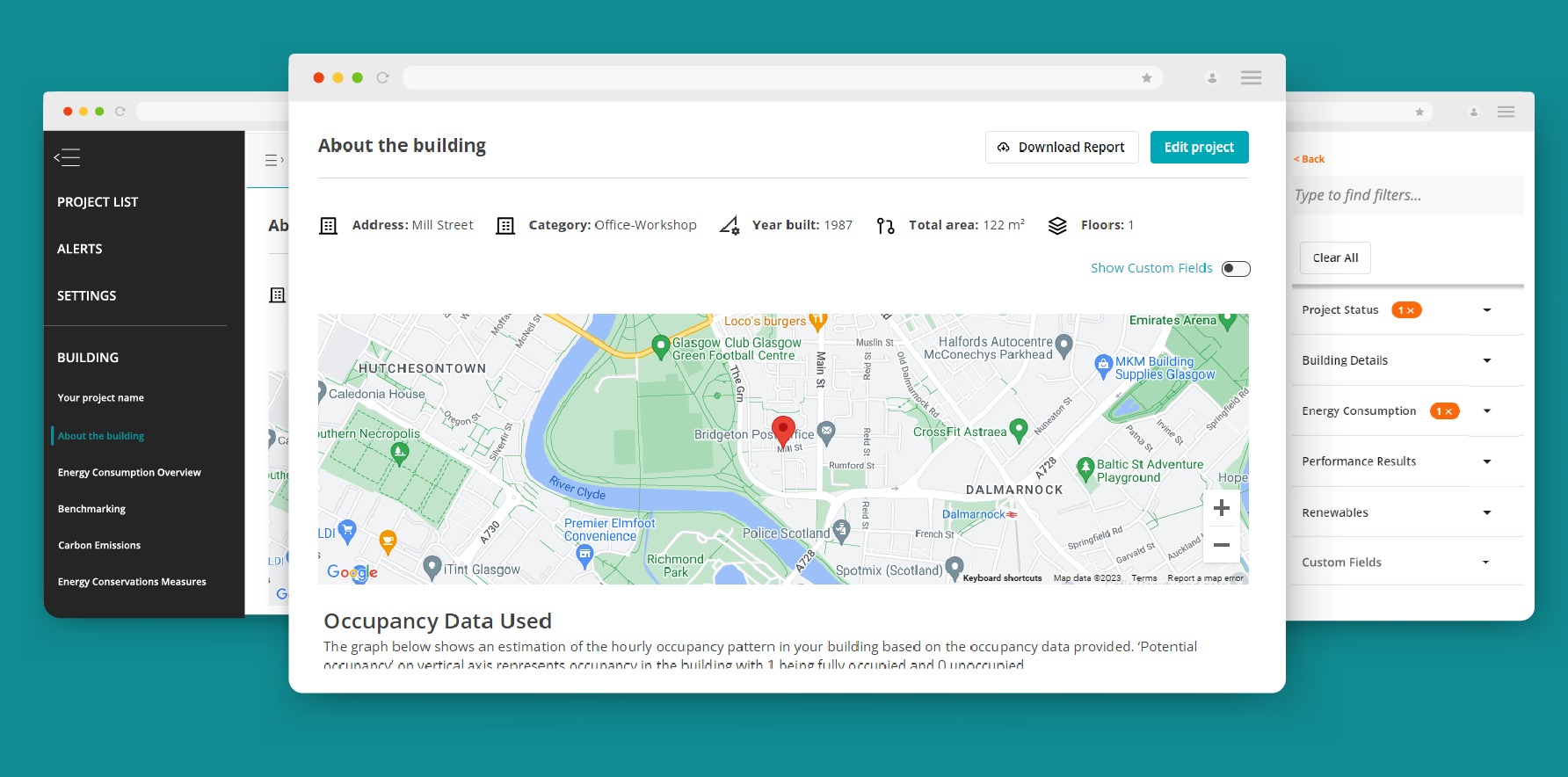
The first failure in a portfolio plan is usually not a heat pump. It is the assumption that every meter maps neatly to a building and every tenant will promptly sign a letter of authority. arbnco's later product language became unusually specific about this: energy-data coverage, tenant-controlled consumption, one-click consent and supplier-specific access. The company was selling relief from administrative drag before it sold the glamorous digital twin.
That emphasis appears to have sharpened with experience. arbnco's public history is broad: energy analytics, EPC risk, indoor-air sensing, occupant feedback, utility programmes and building simulation. Its arbn well sensor network won a CIBSE wellbeing innovation award in 2020 and was trialled in homes with Energy Systems Catapult after receiving almost £300,000 in Innovate UK funding. By 2024 and 2025, however, the commercial message had settled around the recurring enterprise bottleneck: acquire reliable data, secure consent, report it, then decide where to spend.
“Robust data should be at the heart of our decision making.”Maureen Eisbrenner, co-founder and CEO, speaking during COP26

This does not mean the earlier work failed. It means the company found the wedge that customers encounter before any simulation can matter. Sensors are useful. A whole portfolio's electricity data, permission trail and investment queue can become infrastructure.
Proof in portfoliosA healthcare estate, not a lab demo
Assura offers the clearest example. The healthcare-property company wanted EPC B or better across an estate of roughly 600 premises. Existing EPCs covered about half the portfolio. arbnco and energy consultancy Murton and Co collated what existed, assessed the remaining stock and produced retrofit improvement strategies with estimated costs for the entire estate.
The point was not that software eliminated surveyors. It made the surveyors' attention scarce and deliberate. A portfolio owner could see which assets carried regulatory risk, what interventions might move a rating and where a deeper visit was justified. That is a more finance-friendly object than a general pledge to “decarbonise the estate.”
Other public work shows the same platform travelling sideways. Schneider Electric used arbnco sensors and an Arc integration at its 11,000-square-metre Technopole in Grenoble, automating indoor-air and comfort data that otherwise required manual collection. CGI said it used arbnco software at UK sites to monitor energy performance and model the cost and carbon savings of renewable projects. British Gas Business began using the company's Level 3 platform in 2026 to package building-specific insight for commercial customers.

The economicsWhat it cost - and who pays
arbnco did not publish standard pricing, and the acquisition consideration remains private. The business model is enterprise B2B: software access, data services, portfolio analysis and associated implementation or consulting. A customer buys coverage and decisions across many properties; a utility can use the platform to offer insights and energy services to its own commercial accounts. arbn well also used a rental structure for its sensor equipment.
The development bill was shared with public innovation programmes. The DEEP platform for small and medium-sized businesses received a £641,000 phase-two contract in 2020. The indoor-air platform received almost £300,000 in 2021. Innovate UK reported supporting five arbnco projects from 2017 onward. Those figures are not the price of the company. They are evidence of how arbnco financed experiments whose commercial payoff was uncertain.
The chart is conceptual, not a revenue breakdown. It captures the market position: meter companies provide trusted readings; carbon-accounting systems organise disclosures; consultants design projects; building-management systems operate equipment. arbnco sits across the middle, joining access and reporting to portfolio modelling. Competitors range from spreadsheets and manual audits to platforms such as Deepki, Measurabl, IBM Envizi, EnergyCAP and Schneider Electric's EcoStruxure.
The craftBuilding physics wearing a software badge
The company's expertise is a hybrid. Software engineers can build a portfolio interface, but they need building engineers to know why an office's Monday load shape looks wrong. Data scientists can find correlations, but property specialists must translate them into an EPC risk, a photovoltaic option or a credible capital measure. arbnco's public projects repeatedly paired those disciplines with outside institutions: Energy Systems Catapult for business-model and Living Lab work, Arc for performance certification, utilities for distribution and energy consultancies for detailed delivery.
That mix also explains the culture visible from the outside. This was not a company that discovered a single feature and polished it for a decade. It ran funded experiments, put sensors into occupied buildings, worked in homes and schools, integrated with other platforms and kept narrowing the commercial proposition. The route was expensive in attention, but it accumulated domain knowledge that a generic ESG dashboard would struggle to imitate.
Within the market, arbnco is neither the final contractor nor merely the carbon ledger. It is decision-support infrastructure for the stage between disclosure and construction. That position matters because owners often know their total emissions before they know which five projects belong in next year's budget. The software is useful when it shortens that distance.
The acquisitionWhy the meter company changed the ending
IMSERV's purchase changed arbnco from an independent software vendor into part of a larger energy-data stack. It also answered a persistent go-to-market question. Analytics is only as credible as its inputs, while raw meter data is only as valuable as the decision it changes. Joining the two can reduce integration work and give customers one accountable supplier.
There is risk in the neatness. Integrations can slow product teams. Customers may prefer independent analytics that can ingest data from many providers. A model can rank opportunities but cannot discover a stuck damper, an undocumented extension or a tenant who ignores every email without some real-world follow-through. IMSERV said it would work with customers during integration, a quiet acknowledgment that the combined proposition still has to survive procurement, permissions and buildings themselves.
What a founder can copy
- Start with the missing input. If customers cannot get reliable data, reporting features are decoration.
- Turn one service workflow into a product ladder. Access leads to consent, analysis and then a higher-value action plan.
- Screen before you inspect. Use software to rank where scarce expert time can change the outcome.
- Make the output budget-ready. A costed shortlist travels farther inside a company than a colourful score.
- Partner with whoever owns distribution or data. arbnco worked through utilities, research bodies and property advisers before joining IMSERV.
The boundaryWhen the model stops working
Good conditions
Large portfolios, repeatable property types, accessible interval data, clear compliance pressure and a customer with capital to act on the ranking.
Bad conditions
One-off buildings, unreliable asset records, missing consent, unusual operations, no retrofit budget or a buyer who treats reporting as the finish line.
The strongest use case is a portfolio with too many plausible projects and too little time. The weakest is a customer seeking certainty from thin data. Building simulation is an aid to judgment, not a warranty. Cost estimates age, tariffs move, occupancy changes and site conditions refuse to read the spreadsheet.
Still, arbnco found a durable piece of climate work: make old buildings legible enough for institutions to choose. The acquisition suggests that this interpretive layer is more valuable when connected directly to the energy-data supply chain. Fourteen years after incorporation, the company did not make buildings confess. It made their alibis easier to check.