The first thing to fail in multicultural advertising is often the noun. “Audience” sounds tidy. Asian America is not. It contains a grandmother reading a Korean newspaper, a college student scrolling NextShark, a recent arrival using WeChat, and a fourth-generation customer who does not speak an Asian language at all. Put them in one demographic box and you have not found a market. You have misplaced several.
APartnership, a small New York advertising agency founded in 1999, has built its business around that untidiness. It helps brands, government agencies, and nonprofits reach Asian American consumers through research, creative work, community relations, and media planning and buying. The plain version is that it makes campaigns. The more useful version is that it identifies the distance between a message being translated and a message being believed.
01 / The original correction
Translation was the assignment. Understanding was the opportunity.
Founder Jeannie Yuen arrived in New York in 1994 after agency jobs at Saatchi & Saatchi in Hong Kong and DDB Needham, where she had responsibility across Greater China. Her first American work in the category came at LLT and then Mosaica, the Asian American arm of Young & Rubicam. Clients, she later recalled, tended to use specialist agencies for translation. The words changed language. The strategic premise stayed put.
That was the frustration that changed her mind about what an Asian American agency could be. Yuen started APartnership to help marketers make the business case, devise the strategy, and build a lasting relationship with the audience. The company was incorporated in December 1999. More than a quarter-century later, Jinnie Kim runs it as chief executive, and Yuen serves on its board.
Its current pitch is precise: advertising, research and strategy, community relations, and media. This puts APartnership between the cultural boutiques and the multicultural units of large networks. It does not offer a new ad-tech platform or a self-serve product. It sells judgment, production, access, and execution, normally through project or retainer fees. Its alternatives include firms such as IW Group, Intertrend, Admerasia, and Plan C, along with general-market agencies that promise cultural adaptation.
There is no public rate card. Historical New York vendor records list a $45,000 city health-marketing contract in 2005 and two engagements valued at $2 million each in 2014. Those numbers describe old public work, not today’s price. A useful buyer should ask for a scope built around languages, production, community partners, and paid media, because each expands the job differently.
02 / The evidence
Nineteen partners can be a media plan.
A campaign for the Washington State Department of Health shows the operating system. By 2023, much of the country had moved on from COVID-19. Some Asian communities in Washington had not. Language barriers, technical literacy, income, disability, misinformation, and the simple fragmentation of communities by ethnicity and religion still stood between people and basic health information.
Buying more impressions would not repair the trust gap. APartnership built a network of 19 local Asian community organizations and media partners. From April 2023 through May 2024, that network communicated in 13 languages through radio, articles, email, social posts, seminars, festivals, and clinics. More than 3,000 people who otherwise faced access barriers were helped to receive a vaccination.
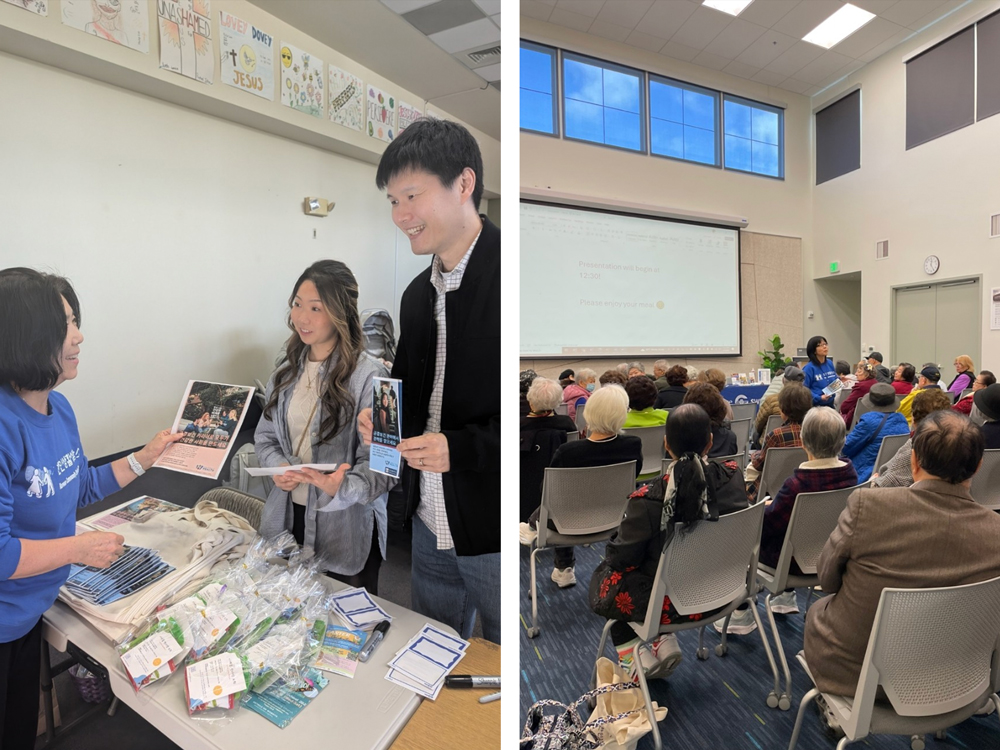
The important move was not merely using thirteen languages. It was giving the message a local address. Korean seniors encountered information through Radio Hankook. Hmong residents found resources through a community association at a Lao summer festival. The campaign did not ask one spokesperson to represent Asian America. It assembled a distribution system from organizations that already knew whom they were speaking to.
03 / Beyond awareness
The message needs somewhere to send you.
The agency’s later Workforce Pathways campaign for the same state department made the method more ambitious. The problem was a shortage of trusted public-health professionals who understood local culture and language. APartnership created brochures, posters, video, and social posts in six languages; bought targeted placements on YouTube and in-language newspapers; and reported nearly 600,000 people reached in print and more than 1.2 million online.

Then it added the part awareness campaigns often forget: an action after the action. Five trusted Asian organizations hosted workshops and panels. Community members could find scholarships, internships, mentorship, and training across Chinese, Korean, Vietnamese, Filipino, and Lao communities. A poster created attention; the partnership created a path.
The same logic appears in other work. For Covered California, the agency helped place health-insurance conversations inside industries where Asian immigrants commonly work and employer coverage is often absent, then made culturally adjusted versions in Mandarin, Cantonese, Korean, and Vietnamese. For a California fentanyl campaign, straightforward English, Chinese, and Korean creative was paired with NextShark for younger audiences, Chinese digital platforms for older audiences, and university groups using WeChat. The medium changed because the relationship changed.
04 / Ownership as a brief
Everybody owns an equal piece of the consequence.
APartnership says it is the only Asian American ad agency organized as a cooperative and that every employee owns an equal share, regardless of title. For a firm of roughly 19 people, the claim is more than employer branding. The name becomes a governance choice: wins are shared, and so is the cost of weak work.
That structure also sharpens the contrast with its competitors. A holding-company network can offer global scale, an immense media operation, and every specialty on demand. APartnership’s advantage is narrower. It can notice that “Chinese” contains different written forms, dialects, platforms, migration histories, and generational habits. It can call community organizations before the brief is finished. It can treat culture as production infrastructure rather than decorative research.
The company says clients often stay more than a decade. Its public portfolio includes the California and Washington health departments, Covered California, Bank of America, Humana, Chevrolet, Vitasoy, the US Postal Service, Gilead, and Never Alone Animal Rescue. It also reports four ANA Multicultural Excellence Awards and three Asian American Advertising Federation Creative Agency of the Year wins. Revenue is not publicly confirmed; third-party supplied data estimates about $5.66 million annually.
05 / What to borrow
Make the segment smaller until the behavior makes sense.
The copyable part is not “hire nineteen partners” or “translate into thirteen languages.” Those are outputs. The transferable move is to keep segmenting until the barriers, messenger, and next action are specific. An audience described only by ethnicity is not yet a usable audience. Add age, generation, language preference, geography, media habit, and the institution a person already trusts. Now a strategy can begin.
Confusion, stigma, access, trust, and awareness are different problems. Do not solve the easiest one by default.
Community partners are not free distribution. Include their time, expertise, events, and follow-through in the scope.
Language alone is insufficient. Setting, props, spokesperson, platform, and call to action also carry cultural meaning.
Reach matters, but a clinic visit, enrollment, workshop, internship, or adoption tells you whether the route worked.
There is a condition attached. This approach works when the organization is willing to share authorship, pay community partners, and let an insight change the creative plan. It works less well when leadership wants one universal asset, a fast translation at the end, or a community endorsement without community influence. Cultural fluency cannot rescue a product people do not need, and local trust cannot compensate for an inaccessible service.
The charming proof is a recent campaign far from public health. Never Alone Animal Rescue brings dogs from South Korea to American homes. APartnership reframed those animals as “K-pups” and launched the work on Giving Tuesday 2025, borrowing the insider energy of K-pop and K-drama fandom. It is a small idea with a serious mechanism: begin where attention already gathers, speak in the codes people enjoy, and attach that feeling to a real next step.
That is where APartnership fits in the market. It is not trying to make every ad. It is useful when a brand or public agency knows Asian Americans matter but does not yet understand which Asian Americans, what matters to them, or why they should listen. The agency’s answer is almost suspiciously literal. Find the right partners. Give them a stake. Build the message together.