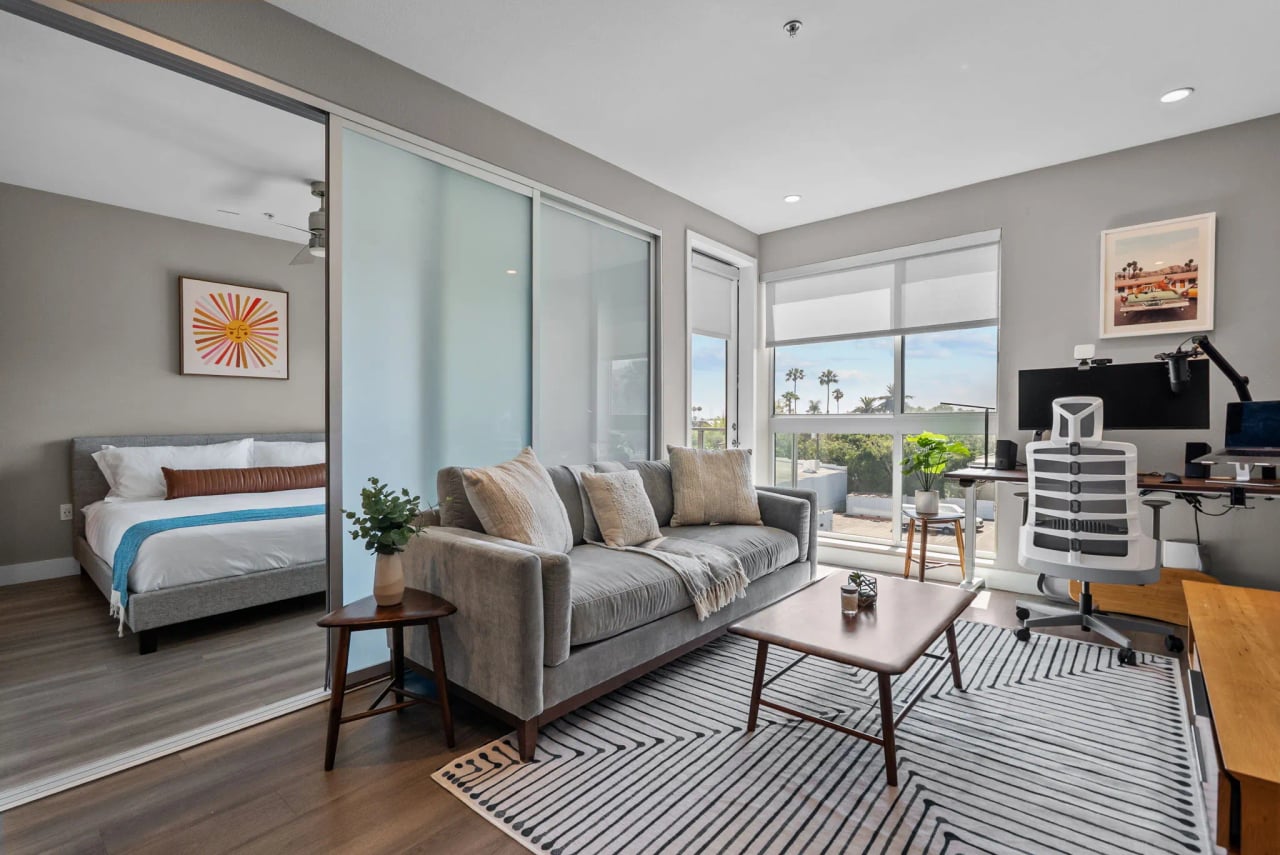
It is a Tuesday in Tokyo. A software engineer from Berlin opens her laptop on a desk in Ebisu Garden Place. She has been here three weeks. She will be here three more. Her apartment came with the desk. Her contract did not come with a year on it. Welcome to the product Anyplace is quietly building.
Who they are, right now
Anyplace rents furnished apartments by the month. That is the whole pitch, and it is louder than it sounds. The company runs a portfolio of move-in-ready units across San Francisco, Los Angeles, New York, Miami, and - as of 2025 - Tokyo. Every unit ships with a desk, a chair, fast Wi-Fi, and a minimum stay measured in weeks rather than years. There is no broker. There is no twelve-month lease. There is, mercifully, no IKEA assembly weekend.
The headquarters is on Mission Street in San Francisco. The customer is rarely in San Francisco. That tension - the company is local, the customer is anywhere - is the entire business.
Live Anyplace. Work Anywhere.- Anyplace's own tagline, doing the heavy lifting
The problem they saw
Housing was built around a 20th-century commute. You signed a year-long lease near an office; the office anchored the rent; the rent anchored the city. Remote work knocked the anchor loose, and the entire system started drifting.
Existing options were poor. Airbnb monthly stays are charming until you try to take a Zoom call at the dining table. Hotels are expensive and built for nights, not weeks. Corporate housing exists, but it is famously joyless and rarely available to a single freelancer who just needs a two-month landing pad in Brooklyn. Long-term leases require credit checks, deposits, brokers, furniture, and an emotional commitment that nobody who works remotely actually wants to make.
Into that gap, Anyplace walked. Carrying a desk.
The 12-month lease did not die when offices emptied. It just stopped making sense for everyone who used to fill them.- The thesis, summarized
The founder's bet
Steve Satoru Naito moved from Japan to Silicon Valley in 2015 with, by his own telling, five thousand dollars and a stubborn streak. He spent a year interviewing more than 100 tech operators and posting the conversations on a blog. It was an unconventional onboarding strategy. It worked.
He started Anyplace in 2017. Initially it was an online marketplace - the press at the time politely called it "Airbnb for monthly stays" - but the model evolved. By 2021 the company had read the room: remote work was not a pandemic moment, it was a permanent reorganization of where people lived. Anyplace stopped marketing to nomads on holiday and started designing for people who had to be productive on Wednesday.
The bet was specific. Not that travel would explode. Not that hotels would die. The bet was that a small, growing population of people - engineers, consultants, executives, founders, contractors - would happily pay a premium to live somewhere new for 30 to 180 days, provided the apartment did not actively sabotage their job.
The bet, on a napkin
Hypothesis: Remote workers will pay a premium for a furnished apartment with a real workspace and a flexible contract.
Falsification test: Run the units. Watch the occupancy.
Result so far: Reportedly around 90% occupancy in flagship NYC and LA buildings.
The product
The product is an apartment. This is unfashionable in a software era, and Anyplace seems unbothered. The unit is the whole experience.
What is in the unit: a furnished living space; a dedicated workspace (a desk wide enough for an external monitor, a chair that does not aspire to be a stool, lamps that point); residential-grade fast internet; kitchenware; linens; the inventory of small objects nobody enjoys packing. What is not in the unit: a security deposit the size of a used car, a credit-check ordeal, a year of obligation, or a futon pretending to be a couch.
There is a mobile app on the App Store for browsing and booking. There is a website that takes the booking. There is a support team that answers when something is wrong - 200+ verified reviews suggest, with the usual caveats, that they answer reasonably promptly.
Most short-term rentals quietly skip the desk. Anyplace quietly skipped the twelve-month lease. Both choices are louder than they look.- A small but telling design decision
A short history of getting unstuck
The proof
A business of this kind lives or dies by two numbers: who is in the units, and how often. Anyplace's reported figures point in a single direction. Flagship buildings in New York and Los Angeles run around 90% occupancy, which in the hospitality world is what you call a working machine.
Total funding has crossed roughly $34 million. The cap table is unusually well-suited to the thesis: Jason Calacanis bet early through the LAUNCH Fund. Daiwa House Group - one of Japan's largest residential developers - joined for the Series B extension, which is the kind of strategic check that does not just fund a round but also opens doors in Tokyo. Steve Chen, who helped build YouTube, came in alongside.
Anyplace funding rounds
Customers are not tourists. They are relocating engineers, consultants between projects, executives parachuting in for a quarter, and corporate teams running on-site sprints. The kind of person who books a place is the kind of person who reads the Wi-Fi speed before they read the photos.
The mission
Strip away the seed decks and the funding announcements, and the mission lands in one sentence: housing should flex around how people actually work. That is a sentence that would have been unremarkable to say in 1995. In housing, it is still vaguely radical.
Anyplace's role in that mission is unfashionably modest. The company is not trying to replace cities. It is not trying to abolish leases. It is trying to make the next two months somebody can spend in Miami feel less like an act of furniture-store endurance and more like a Tuesday.
Remote work did not invent the desire to live somewhere new for a while. It just removed the last excuse not to.- Why this company exists
Why it matters tomorrow
The work-from-anywhere economy is being built out of pieces most people do not notice. Payroll systems for distributed teams. Tax software for multi-state employees. Coworking memberships that are actually flexible. And somewhere in that boring infrastructure stack, Anyplace is the piece that handles where you sleep.
There is a real risk in this market - well-funded competitors like Blueground, Sonder, Landing, and Kasa are all chasing similar customers, and the long tail of Airbnb monthly listings keeps getting more capable. The differentiator is not marketing. It is the unglamorous discipline of operating a portfolio of physical apartments to a consistent standard, in cities where rent and labor are punishing, at a price the customer agrees to. That is not a moat. That is craft.
If Anyplace gets the next few years right, the company becomes part of the answer to a question more people are asking each year: where should I live for a while? The answer the company is patiently building is: anyplace you want, for as long as you want, with the desk already there.
Steve Naito moved from Japan to Silicon Valley with $5,000 and spent a year interviewing 100+ tech figures to build a network.
The "A" in the Anyplace logo is drawn to hint at movement and traveling the globe - an Easter egg in plain sight.
Every unit, every city, every booking ships with a real desk. It is the company's most undersold marketing line.
Back to Tokyo. The engineer from Berlin closes her laptop. Her stay ends in three weeks. She has not unpacked a single piece of IKEA. She has not signed a lease. She has not, technically, moved. And yet, for the better part of two months, she has lived somewhere new, gotten her work done, and treated the whole thing as ordinary. That last part - the ordinariness - is exactly the thing Anyplace is selling.