There are family businesses, and then there are family businesses old enough to have changed professions. Vigilante began in Brooklyn in 1927, when brothers Mike and Frank Vigilante worked mainly as general contractors. In the 1950s, the family bought a plumbing company and narrowed its attention to the hidden machinery of New York life: pipes, boilers, water and heat. Air conditioning arrived in the early 1990s. By then, Anthony Vigilante had already joined the enterprise that carried his surname.
He had brought something slightly unexpected to the shop: a business education. From 1984 to 1988, Vigilante studied finance at Pace University's Lubin School of Business, with a minor in the psychology of business and industry. His public professional history places him in the owner and chief executive role from 1987. The degree did not spare him the technical demands of the trade. He went on to become a New York City Licensed Master Plumber, license number 1728, alongside credentials in backflow testing and fire suppression.
The pairing is the clue to his career. A service company needs to know two kinds of pressure. There is the pressure inside a system, which must be measured and made safe. Then there is the pressure on the organization: a winter schedule, a worried customer, a technician who needs a decision, a price that must be explained before the wrench comes out. One can be read on a gauge. The other appears on a telephone.
A surname is a promise with overhead
A family name above the door can open a conversation. It cannot finish a repair. Anthony and his brother Salvatore took stewardship of a company whose age was both an asset and a daily test. Customers may admire continuity, but they call about the present tense. The water is here. The heat is off now. The appointment is today.
The brothers' answer was not to preserve the company like a museum piece. The service mix widened. Plumbing and heating were joined by air conditioning, drain and sewer work, water filtration and fire-protection services. The company adopted upfront, flat-rate pricing and emphasized trained, screened technicians. Its service map spread across New York City's boroughs while its address remained 195 Douglass Street in Brooklyn.
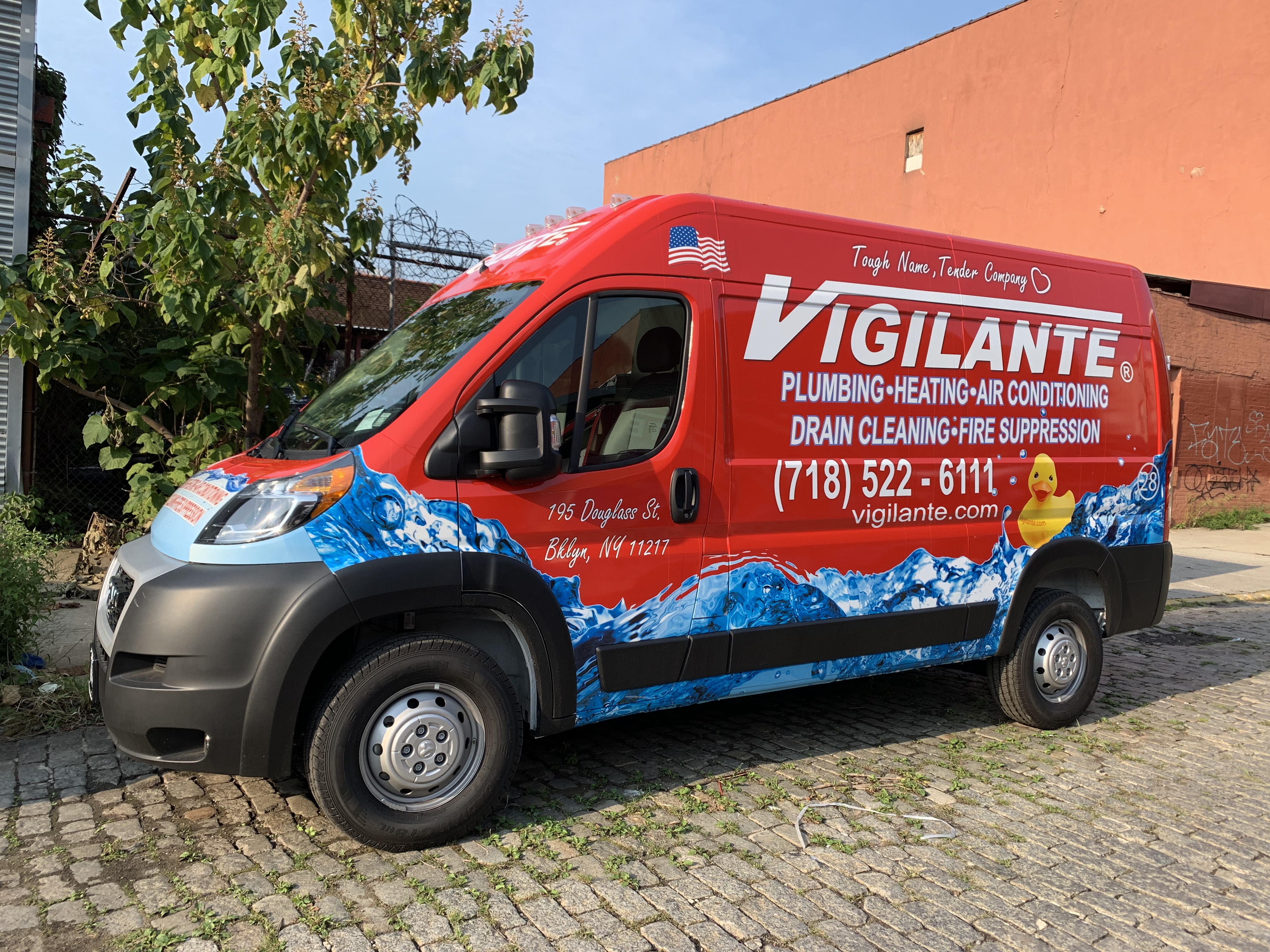
The brand found a neat joke inside an imposing name. “Tough name, tender company” became the line, and a rubber duck appeared on the truck. It is shrewd without straining. Home service begins with somebody admitting that a private space is not working properly. A little warmth is useful before anyone opens the basement door.
The plumber at the management seminar
Vigilante did not treat practical experience as a reason to stop studying. In 1997, he was elected to the board of Contractors 2000, the business-practices group later known as Nexstar Network. Years later, at a Nexstar meeting, he listened to a session about leadership, goals and feedback. His takeaway was specific: use real consequences, but build an environment where employees want to perform rather than merely comply.
He said he would use a ratio of four positive observations to one negative one. Anger and criticism, he argued, had no value in communication; constructive consequences did. It is an operator's formulation. The point of feedback is not to produce a dramatic managerial moment. It is to produce better work on the next call.
“Instead of getting angry and criticizing which has no value in communication I will be using constructive and positive consequences.”Anthony Vigilante, 2011
The lesson had a technical neatness. Describe the behavior. Explain the effect. Agree on the next action. Follow up. In a loose metaphor, it resembles fault-finding in a mechanical system: locate the trouble, understand what it changes downstream, then repair the actual failure instead of scolding the radiator.
A ratio is not a personality test. It is a reminder that people need to know which behaviors to repeat, not only which ones to stop.
Trade associations gave him another classroom. He served on the board of the Master Plumbers Council of the City of New York and was listed as its vice president in 2020. The council's current directory identifies him as a master-plumber member, CEO and holder of multiple relevant licenses. In 2023, his name appeared on New York City's Construction Codes Revision Administrative Enforcement Advisory Committee. These are not glamorous assignments. They are where a trade becomes a profession: codes, enforcement, training and the unending argument between what is convenient and what is safe.
His council listing reads almost like a map of everything that can go wrong behind a Brooklyn wall. Boiler and burner repair. Gas lines. Sewer lines. Water lines. Pumps, sprinklers, backflow devices and meters. It covers commercial buildings and private homes, repair and installation, inspection and violation correction. The breadth explains why a modern home-services company cannot rely on one heroic mechanic carrying every answer in his head. It needs licenses, dispatch, specialties, checklists and the humility to send the right technician.
The administrative side is visible in the promises Vigilante makes before a visit. Prices are presented upfront. Technicians arrive in uniform. The company says it background-checks its field staff. Service spans Brooklyn, Manhattan, Queens, Staten Island and, through the company website, the Bronx. These details sound ordinary only because the service industry has spent decades teaching customers to expect them. Anthony's participation in contractor networks placed him inside that professionalization as it unfolded.
One of his memories from that wider network concerned George Brazil, an influential contractor known for treating plumbing as a serious, teachable business. When Vigilante was wrestling with company problems, he asked Brazil for advice over a meal. The response was frank enough to sting, yet Anthony later praised the intelligence behind it and the hours Brazil would devote to helping peers. He remembered an innovator pushing the trade to become respectable and profitable. The anecdote catches Anthony doing what durable operators often do: bringing a real problem to someone who will not flatter it.
When the slogan received an invoice
In February 2021, a Vigilante technician named Vincent Rizzo arrived at a Brooklyn home and found a resident who had been without heat and hot water during freezing weather. The boiler was around 40 years old; the water heater had failed too. Replacing the equipment would ordinarily have cost roughly $12,000.
Rizzo called his bosses. The response was immediate: help, at no charge. The company assembled the equipment and installed it before Valentine's Day weekend. On television, Anthony explained the decision in the plain vocabulary of obligation. “We are a family business,” he said, “and we feel sometimes you have to give something back, sometimes you have to do something for people.”
“People should pay it forward, do something for somebody else when you get a chance to.”Anthony Vigilante, 2021
The episode matters because company values are otherwise terribly easy to print. Here, the phrase “tender company” acquired a cost in equipment, labor and schedule. It also revealed the value of a technician trusted to escalate what he saw. Rizzo recognized that an ordinary service script was inadequate. Management recognized that quickly enough to matter.
The winter call also echoed the lesson Anthony had admired in Brazil: direct about the problem, generous about the response. A repair company lives by charging for repair. It also lives inside a neighborhood, where occasionally the right invoice is zero.
Maintenance as a business philosophy
Entrepreneurial culture adores creation and tends to yawn at maintenance. Brooklyn has other ideas. Its old housing stock insists that somebody care about what was built before. A boiler needs inspection. A backflow device needs testing. A drain gathers yesterday one small piece at a time. Ignore enough small things and the building eventually edits your calendar.
Anthony Vigilante's career has the same rhythm. He did not found the company, and his achievement cannot be summarized by a launch date. He received a working institution and kept revising it: more services, formal credentials, leadership training, a recognizable brand, public participation in the trade. The family history is the headline. The maintenance is the plot.
There are lighter details. A trade directory says he enjoys singing and working out, and follows the Yankees. They suit the portrait in an oddly Brooklyn way: a voice, a routine, a team whose history is never allowed to excuse the current season.
In 2027, Vigilante Plumbing reaches the centennial implied by its 1927 founding. A hundred years makes a fine number for the side of a truck. It also creates tomorrow morning's obligation. Somewhere in the city, a pipe will leak, a furnace will refuse and a customer will call a familiar name. History may persuade that person to dial. The answer still has to be useful.