Anthony Kossatz enters Digistore24’s founding story with a practical problem: the bills still need paying. The platform has launched, the money is tight, and the future has yet to develop its reassuring habit of looking inevitable. Sven Platte’s recollection puts Kossatz in the finance role, finding a way to keep the business operating. Before there can be a story about scale, there must be enough cash for the next chapter.
It is a useful place to meet him. Online commerce tends to introduce its founders through big numbers and photographs taken after things have worked. An unpaid bill has rather less public-relations potential. Yet the early CFO’s task sits close to the central question of any young company: how long can an idea afford to wait for its customers?
Today Kossatz is co-founder and CEO of Digistore24 GmbH. His career connects the German online-sales business with software, investment oversight and a local entrepreneurs’ association. Hildesheim supplies the geographical thread. The early financial squeeze supplies the opening scene.
The bills came before the billions
Digistore24 launched in 2012. Platte had been working toward a platform that would remove some of the technical difficulty of selling online. Christian Neise was the technology partner. Developing the solution took two and a half years; by launch, Platte’s funds were running short. Kossatz, described as the CFO in that early period, helped keep the bills paid.
That detail gives the partnership a tangible shape. A product needs someone to build it, someone to find a market and someone to attend to the money while those two activities catch up with each other. The founders’ later titles can make the arrangement look tidier than the conditions in which it began.
There is no need to decorate the episode with a dramatic last-minute rescue. The ordinary work is sufficiently consequential. A business that keeps operating has another chance to improve its product, make a sale and pay the people doing the work. Kossatz’s place in the account is at that junction between ambition and the bank balance.
An online sales platform first had to keep its own business going.
A company with two names
The legal beginning is specific. In April 2012, Kossatz and Platte were named managing directors of DigiBK24 GmbH in Hildesheim. The company’s purpose covered an internet platform, digital-product trading and payment processing within its stated regulatory limits. In June 2014, the name became Digistore24 GmbH.
The change is a small reminder that a familiar company name can arrive after the company itself. Kossatz’s connection reaches back through both versions. His present role follows an involvement established at registration, rather than an executive appointment made after the business had become recognizable.
There was another company in the same founding period. Area 51 GmbH was registered in April 2012 with both Kossatz and Platte as managing directors. Its stated activities included holding company interests and operating an internet platform. The name sounds ready for a conspiracy documentary; the registered business was considerably more terrestrial.
These entries give his career a firm chronology. They also show a working relationship with Platte extending across more than one legal entity. In a founder story, the dates do useful work: they establish who was there when the organizational scaffolding was going up.
- 2012Managing director at the registration of DigiBK24 GmbH
- 2014The company becomes Digistore24 GmbH
- 2019Managing director appointment at Scrum Masters GmbH
What sits behind the buy button
The GmbH in Kossatz’s title matters. Digistore24’s leadership separates his role from that of group CEO Sven Platte and Francis Wolff, who leads Digistore24 Inc., MSLW and LTD. Kossatz leads the German company. The group’s international presence does not turn those positions into interchangeable labels.
To understand the business he leads, follow a purchase. Under Digistore24’s reseller model, the product provider sells to Digistore24, which resells to the buyer in its own name. There are two contracts in the transaction. Digistore24 is the buyer’s contractual partner, taking responsibility for payment processing, invoicing, returns and buyer support.
For someone selling a course or an ebook, that arrangement moves a bundle of administrative work into the platform. For the platform’s management, it brings those obligations inside the business. The attractive simplicity of a purchase button depends on a rather busy organization behind it.
The commercial proposition is easy to appreciate. An entrepreneur may want to teach, write or build software. Few start with a consuming desire to organize invoice dispatch. A platform can make itself useful by taking that work seriously, every time a transaction passes through.
The company now reports that its platform has served two million digital entrepreneurs across 180 countries, generating $3 billion in total sales revenue. Those are Digistore24’s figures for the wider business. They describe the reach of the organization Kossatz helped establish, while his own title remains tied to its German entity.
“automate their business, so they can focus on growing their business”
Sven Platte, describing Digistore24’s purpose
The appeal in Platte’s formulation is time. Every process the platform handles is something a seller can spend less time administering. That promise gives the back office a place in the product itself: invoices, support and returns become part of what the customer is buying from the platform.
An evening at the vinothek
On February 20, 2020, Kossatz appeared in a different business setting: a H.U.T. members’ gathering at the cooks & wines vinothek in Hildesheim. The entrepreneurs’ association welcomed four new members that evening. He was one of them, alongside Florian Bader, Patrick Meier and Christoph Wilkending.
The gathering had the ordinary ingredients of an association meeting: organizational business, introductions and a group photograph. H.U.T. also recorded its continuing support for the university’s midsummer-night event. A local business network had its own calendar and commitments, alongside whatever was happening in online commerce.
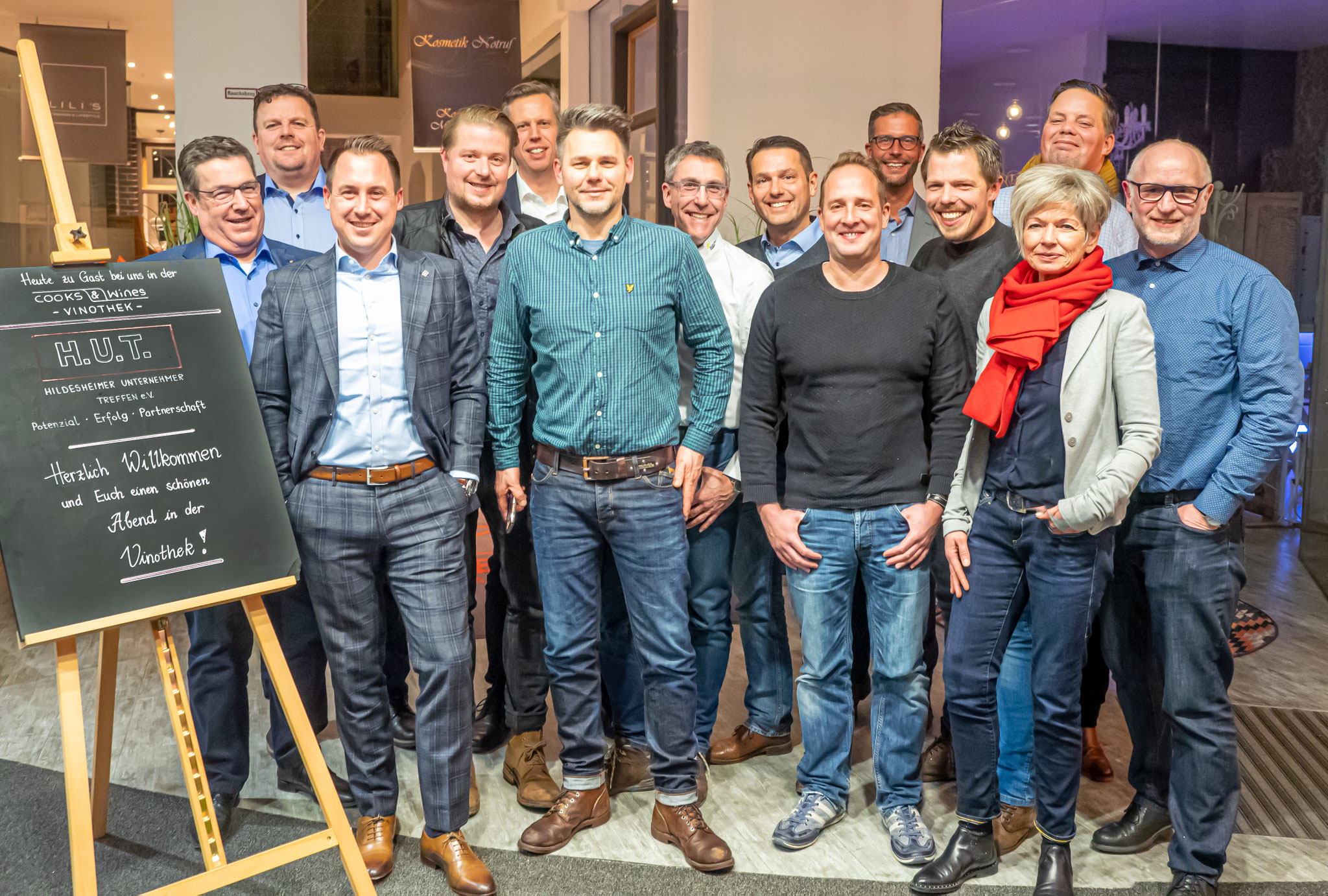
The photograph earns its place because it supplies a scale that company metrics cannot. Kossatz stands among other businesspeople at a local venue, part of a group rather than alone beneath a title. His professional life includes this membership as well as the companies beside his name.
Tony, episode one
In March 2023, Kossatz became the first guest on Hi, Wirtschaft! The introduction called him Tony and described him as a founder and owner of Digistore24. It placed him at the company’s Hildesheim base and attached two figures to 2022: around 170 employees and nearly €700 million in external sales volume.
Figures from the March 2023 episode introduction. Sales volume is a business activity measure; it is not personal earnings.
Keep the year attached. These numbers describe the business at a particular moment. External sales volume also has a particular meaning: the value moving through a marketplace differs from the revenue the platform retains. Neither figure can be converted into an estimate of its founder’s private fortune.
The episode offered almost an hour for a Hildesheim business to explain itself. Being guest number one makes a pleasing companion to the earlier registration dates. Here was another beginning, with Kossatz invited to describe a company that already had a decade behind it.
The name Tony belongs to that introduction, a small personal detail in a professional account. The setting matters too. A locally focused economics podcast made room for a business whose customers could be far beyond the city. Kossatz could speak from Hildesheim about activity that had long ceased to be confined to it.
A seat on the other side of the table
His appointments extend beyond Digistore24. In March 2019, he became managing director of Scrum Masters GmbH, whose stated activities include developing, operating and marketing software, support services, coaching and training. The appointment adds another software-related company to his management record.
At Apaton Capital AG, the role changes. The Hannover investment company lists Kossatz on its supervisory board with chairman Prof. Dr. Christof Zwecker and Peter Binkowski. Mario Hose is the founder and CEO. An executive role and a supervisory board seat carry different responsibilities, and the distinction is part of the interest.
Apaton describes an investment approach focused on listed small and mid-sized companies, combining capital with continuing support. Kossatz’s seat places him in that company’s oversight structure. It broadens the organizational picture without making every investment decision his, or turning a board colleague into a founding partner.
The responsibilities that stay
Running the German reseller also means operating in a market shaped by public rules. Digistore24 GmbH’s lobbying disclosures identify Kossatz as its authorized managing director. They describe company advocacy around digital commerce and the regulation of digital knowledge products, including Germany’s distance-learning law. These are corporate positions and activities.
Consumer obligations have also brought scrutiny. A 2026 Hildesheim Regional Court judgment against Digistore24 GmbH addressed disclosure of the contracting party, clarity of total prices and withdrawal rights in coaching sales. The company disputed the claims. The court granted injunctions concerning the specified practices. Kossatz appears as the company’s managing director; the defendant is the company.
That episode belongs beside the growth story. A reseller takes on a relationship with the buyer, with duties that remain after the purchase is completed. The same arrangement that saves a product creator administrative work makes the platform answerable for how that work is done.
Kossatz’s career is held together by these continuing obligations: the early bills, the registered management roles, the customers on the other side of a transaction. The founding question was whether the business could keep going. Leading the GmbH means returning to the work that makes continuing possible, long after the first sale.