Anthony Geisler has already tried taking time off. After selling LA Boxing, he stepped away as his family prepared for its first child. Then a friend showed him a small Pilates business in San Diego. By 2015, he had bought it. The proposed intermission became another opening act. A decade later, after leaving the company he built around that acquisition, he returned with a venture whose name dispensed with suspense: Sequel Brands.
The name is unusually candid. A sequel needs something worth revisiting, a reason to continue, and a cast willing to come back. Geisler has assembled all three on paper. Whether the next instalment earns its audience is a harder question. His career includes the creation of Xponential Fitness, its public listing, a departure amid federal investigations, and a new company staffed by colleagues who know his methods. The plot has consequences beyond the person whose name appears on the programme.
The customer who bought the gym
Before he sold franchises, Geisler worked inside one. As a teenager at McDonald’s, he earned $4.25 an hour, initially refilling drinks and clearing tables. He later worked the counter and drive-through. He also worked in his mother’s cleaning business, and in 1999 became the first member of his family to graduate from college, at the University of Southern California. These are modest beginnings, though modesty would become an awkward fit for his preferred scale of business.
His route into boxing started as a customer. He joined LA Boxing and saw a business opportunity in the operation. In 2001, he bought the company’s two studios. He subsequently franchised the concept, building a network of almost 200 locations before selling to UFC Gym. The acquisition began with something he knew from the customer’s side, then changed the size of the question: could the experience work elsewhere, with someone else running it?
The attraction was personal as well as commercial. His father grew up in Philadelphia, and Geisler grew up watching Rocky, along with fights featuring Mike Tyson and Sugar Ray Leonard. He has joked about having a Rocky complex. Hollywood supplied the appetite; operating a franchise supplied a less cinematic assignment. A training montage can skip the leases. A studio owner cannot.
That distinction runs through his career. He is an entrepreneur who buys established concepts and tries to make them repeatable. The idea already has customers, instructors and a physical setting. His task is to turn those ingredients into something another owner can operate in another place. Success requires carrying enough of the original experience into the new address that the brand still means something.
“Seeing goals and challenges as a game to ‘win.’”
Anthony Geisler on what motivates him, 2022
A Pilates business, with room to grow
Club Pilates was founded by Allison Beardsley in 2007. Geisler’s acquisition in March 2015 brought him into a different discipline without requiring a different basic curiosity. Here was a small network with an existing product and a possible route to wider distribution. He became its CEO. The move also makes a useful correction to the compressed version of his biography: he acquired Club Pilates; Beardsley created it.
During his early tenure, the studios changed in ways that reached beyond the class itself. Membership pricing replaced paying by the class. Front-desk staffing helped keep doors open between sessions. The website was revamped and retail merchandise became part of the business. Even the colours changed, as Geisler sought to attract more men. The practical detail is revealing: expansion can begin with the unglamorous matter of what happens when somebody walks up to a locked door.
These decisions shifted attention from a collection of classes toward a continuing relationship with customers. A membership gives the operator a recurring payment and the customer a reason to return. It also makes the ordinary parts of the experience matter repeatedly. The desk, the booking process and the hours are encountered long after the excitement of the first visit has passed.
There was another continuing relationship to consider. Existing franchisees wanted additional studios. In some markets, available Club Pilates territories were already spoken for. Selling a different concept to an experienced owner became one reason to assemble a portfolio. The opportunity was shaped by people already in the network, asking what they could build next.
Club Pilates was the foundation. Xponential, founded in 2017, put multiple brands behind a shared franchise platform.
Putting several signs above one system
Geisler founded Xponential Fitness in 2017. That September, the business acquired CycleBar; StretchLab followed in November and Row House in December. Subsequent acquisitions brought in AKT, YogaSix, Pure Barre and other concepts. StretchLab belongs to this chapter of his biography. It was one of the brands on the platform he led, rather than the company he currently heads.
The proposition had an obvious appeal to an operator who wanted to expand: another category could offer another available territory. Behind different signs, a parent company could share experience in development, marketing, sales and franchise support. That would still leave each studio with its own daily work. A corporate platform cannot teach every class, greet every arrival or negotiate every local problem on an owner’s behalf.
- 2001Buys LA Boxing
- 2015Acquires Club Pilates
- 2017Founds Xponential
- 2021XPOF lists in New York
- 2024Resigns as CEO
- 2025Launches Sequel
Xponential listed on the New York Stock Exchange on July 23, 2021, under the ticker XPOF, raising $120 million in its trading debut. Geisler had moved from owning two boxing studios to leading a publicly traded portfolio. The progression changed both the audience for the business and the demands upon it. Franchisees were concerned with their locations; public investors were also assessing the company around those locations.
Recognition accompanied the expansion. He received an EY Entrepreneur Of The Year award in Orange County in 2019. Such a prize records how a career looked at a particular moment. The subsequent years require their own account. An award, an acquisition and an initial public offering are milestones, each useful and each incomplete as a description of what followed.
The break in the chronology
In May 2024, Xponential suspended Geisler amid federal investigations into the company. On May 17, it announced his resignation as chief executive. Brenda Morris continued as interim CEO. Any profile that still introduces him as Xponential’s current CEO misses the central change in his working life. The company continued; its founder began preparing another venture.
The issues surrounding the old business did not disappear with his departure. In March 2026, the Federal Trade Commission announced a $17 million settlement with Xponential over alleged franchise disclosure violations and deceptive practices. Its allegations concerned opening timelines, material information about executives, former franchisees’ details and disclosure documents. They included the claim that the company failed to disclose Geisler’s involvement and relevant litigation.
This was an action against Xponential and affiliated companies. Allegations should be read as allegations, and the settlement should be described on its own terms. Its significance to this career is nevertheless plain: the franchise support story must be assessed alongside what prospective owners were told before they committed. A founder’s ability to sell a future and an owner’s ability to evaluate it are closely connected.
The colleagues who came back
Sequel Brands made its public debut in May 2025 with four concepts: Pilates Addiction, iFlex Stretch Studios, beem Light Sauna and BODY20. Familiar names took the leadership seats. Sarah Luna, previously Xponential’s president, led Pilates Addiction. Former StretchLab president Verdine Baker led iFlex. Ryan Junk and Lindsay Junk also joined, bringing experience from Xponential and its brands.
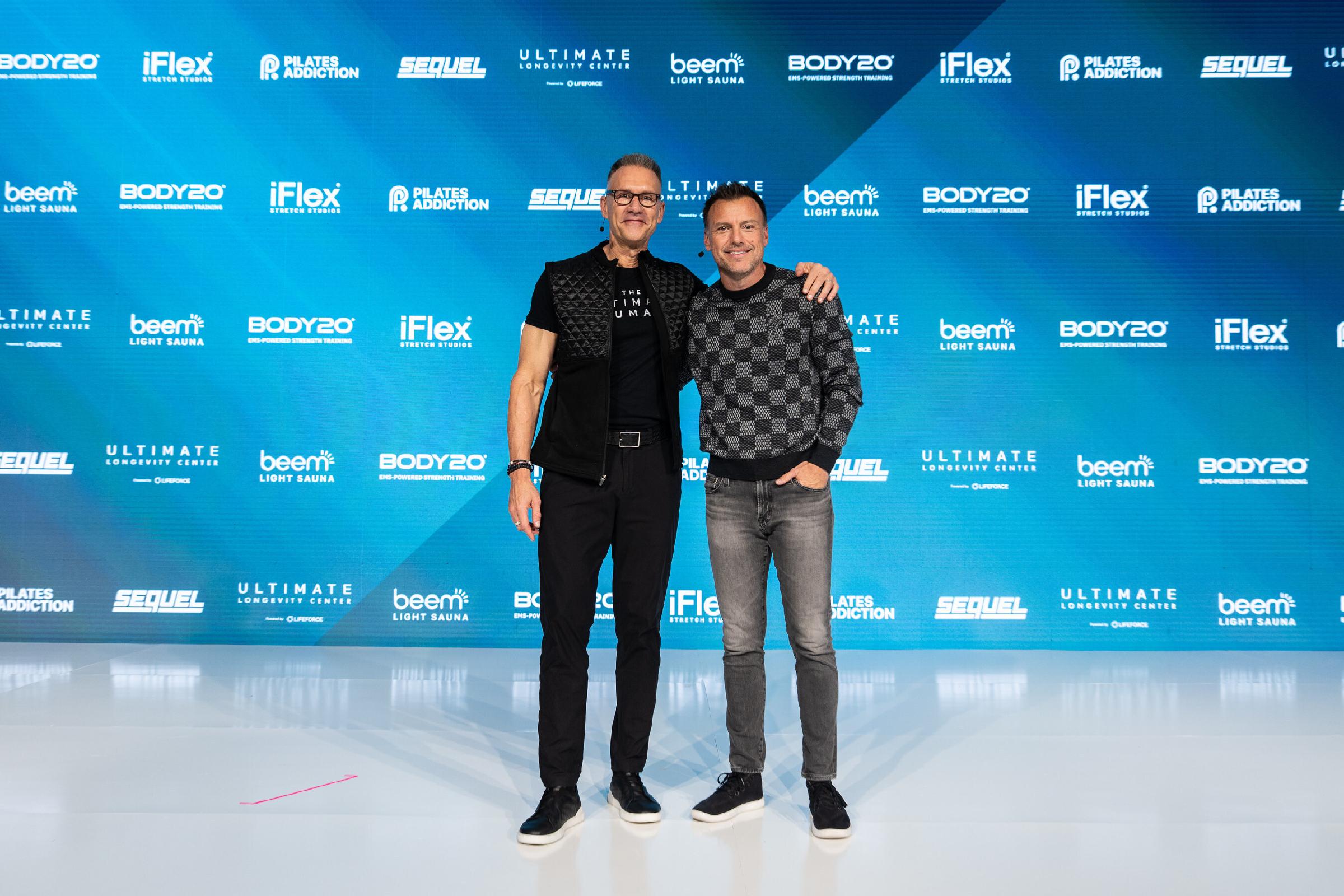
The returning team is one of the more revealing facts about Geisler. Luna described colleagues who had worked together for a decade and already knew one another’s roles, strengths and weaknesses. That familiarity shortened the introductions. It did not remove the work of launching and supporting the new brands. Her account of a small team and frequent studio visits gave the reunion a practical setting.
Pilates Addiction opened its first studio in West Hollywood in May 2025. Luna described a younger audience, a different atmosphere and a plan to establish consistent operations before repeating them across markets. Her ambition was to run alongside Club Pilates. For Geisler, the return to Pilates therefore involves a new brand with a different presentation, carried by people who had helped grow the earlier one.
By October 2026, Sequel’s website listed six brands and reported more than 350 Pilates Addiction territories sold. That figure measures franchise commitments, not open studios. The distinction matters whenever expansion becomes a headline. A sold territory begins a sequence of decisions and work; an operating location is further along that sequence. Both can be counted, but they answer different questions.
Another round, on different terms
In a February 2026 conversation, Geisler described Sequel as having no debt and being entirely owned by him. He linked the decision to build again to competition with himself and loyalty to a team that enjoys building. Those are his stated motives. The ownership arrangement also gives this venture a different starting point from the public company he left.
The work remains recognisable: choose concepts, recruit partners, support openings and see whether the experience travels. Sequel’s current owner-support offering includes real estate, construction, equipment, financial tools, technology and marketing. This is the machinery behind the signs. The company presents it as a shared system; owners will encounter it through particular problems that need particular answers.
Geisler’s story has now come back to the question raised by two boxing studios: what can be repeated, and what must be learned again? His second act carries experience, established relationships and unresolved questions from the first. The name promises continuation. The next part will be written in the studios, by the people who open them and the customers who decide to return.