A month is a long time to wait for a meeting if the meeting is how people discover they are helping the same person. For Tiffany Pang-Cadengo, a gathering of agencies in Yolo County exposed a problem small enough to describe and large enough to build a company around: people doing related work had to assemble in a room to exchange what they knew.
She was a software engineer. The agencies had information. The information had trouble travelling. That combination became the starting point for Outreach Grid, the company she co-founded with John Cadengo in 2016. Its work connects the people handling street outreach, shelter operations and housing navigation. Behind the platform sits a more personal question: what do you do when the city that raised you becomes harder for its residents to live in?
Pang-Cadengo grew up in San Francisco, went east to Yale, and returned to a hometown whose changes followed her to work. She became an early employee and software engineer at Instacart. Around her, technology was making everyday transactions easier. On the streets, more people were living without a home. The contrast was close enough to walk past every morning.
A hometown becomes a question
Her mother was a single immigrant parent. Pang-Cadengo’s later account of returning to San Francisco connects the arrival of startups with rising rents, food prices and living costs. She saw people falling through the cracks. There is something particular about watching this happen where you grew up: the place has already taught you what ordinary life looks like, so its alterations arrive with a memory attached.
She had learned programming through night school and smaller software projects. A career in engineering gave her a practical skill to bring to her concern. During 2015 and 2016, she started attending civic technology gatherings, including Code for America activities, looking for public problems engineers could help address. Those connections brought her to the Startup in Residence initiative associated with Mayor Ed Lee’s office.
The progression matters. She did not begin with a finished app and ask a city to find something to do with it. A civic program offered a route into an identified municipal challenge. Her account gives the decision a time horizon that startups rarely put in their pitch decks: she and Cadengo considered whether homelessness was a problem they wanted to work on for ten or twenty years.
“What is your twenty-year problem?”
The question behind Outreach Grid’s founding
Tokyo, before the term sheet
Years before that decision, Pang-Cadengo was a Yale undergraduate studying neuroscience. In 2011, a Friends of UTokyo award supported her participation in the University of Tokyo’s Global Summer Program. She also took part in its research internship program. Her studies carried her into rooms full of people whose experiences were unlike her own.
Tokyo was already familiar enough for a return visit. The previous summer, she had studied Japanese media through Yale’s program at Waseda University. The 2011 visit included Japanese language, nanoscience and a course on Japan’s place in the world. In her student reflection, she described discussions of politics and culture with students from other countries, and the pleasure of hearing how their histories shaped their perspectives.
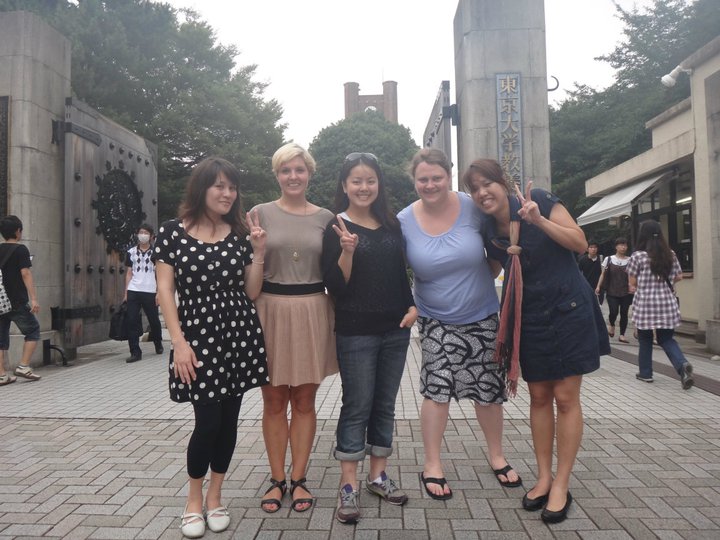
That summer acquired an unexpected second life. When she later reflected on starting a software company, she explained that connections made during the research program had led to some of its first investors. A student exchange had become part of a company’s beginnings. The useful encounter was several years ahead of the useful cheque.
There is a pleasing lack of straight lines here. Japanese media, an undergraduate research placement, software engineering and a municipal homelessness project belong to different calendar entries. Her story connects them through people. The Tokyo friendships lasted long enough to matter in a new setting; the civic technology gatherings led to a government program; the government program put her alongside workers who could explain the problem in detail.
The first version wore walking shoes
In summer 2016, Pang-Cadengo and Cadengo entered Startup in Residence through their software company, Appledore. Their partner was West Sacramento. The city’s police department wanted technical help with its homelessness work. The program ran for sixteen weeks, a short interval in which to learn the routines of public agencies and produce something those agencies could use.
The original request included a mobile application for providing vouchers for food, shelter and transportation. The initial implementation was more limited: mapping encampments and recording information. Broader sharing required agencies to resolve privacy and legal questions. Even a modest piece of software could arrive carrying a respectable amount of institutional luggage.
Pang-Cadengo’s account of development begins outdoors. The founders accompanied workers through summer heat, dry vegetation and railroad crossings. They watched people record information with pen and paper, then return to offices to reconcile files and coordinate with other agencies. Their own notes became the platform’s requirements. The first users supplied the vocabulary before the engineers supplied the interface.
They also made repeated visits and held weekly Skype meetings with city personnel, including outreach coordinator Mark Sawyer. That detail is wonderfully ordinary. A useful product could come from a map, a conversation, another question, and the next scheduled call. By demo day, they had a working platform. West Sacramento signed a contract to continue using it in January 2017.
A map has to reach the meeting room
For Sawyer, the early mapping capabilities helped translate field knowledge into a view other people could understand. An outreach coordinator could know where encampments were while officials several levels away still needed a picture. Outreach Grid gave information collected on the ground somewhere to accumulate, so the people making decisions could see what the workers were seeing.
Pang-Cadengo also connected that information to decisions about funding, grants and shelter capacity. Counting and mapping had consequences beyond the screen. A locality needed a usable account of who was outside and what resources were missing. The software addressed part of the journey between an encounter in the field and a decision in an office.
That is where the Yolo County meeting becomes revealing. Coordination was happening, but on a monthly schedule. A person’s circumstances could change while agencies waited to compare notes. Pang-Cadengo’s response put shared information nearer the moment of work. The design question became how to help people record and exchange what they learned while doing their jobs.
Seven organizations, one pilot
By October 2019, the work had reached San Antonio through the CivTechSA program. The city’s Department of Human Services wanted to understand encampment locations and the people living in them. Outreach Grid was three weeks into a pilot, with seven organizations using the application, including the police department’s San Antonio Fear Free Environment team.
The familiar paperwork problem had travelled with it. Some organizations kept their notes in Word documents or Excel spreadsheets. Bringing information together offered a way to coordinate, but the records still depended on users keeping them current. An application can organize yesterday’s news with exquisite efficiency; somebody must tell it what happened today.
At that point, Pang-Cadengo described deployments in thirteen Orange County cities, as well as communities in Montana, Tarrant County and Baltimore. Those are dated milestones, rather than a claim about today’s total. They show that the first municipal project had found counterparts elsewhere. Different places had their own challenges, and the platform was being adapted to accommodate them.
Her public explanation of that flexibility is grounded in community size and readiness. A smaller group could begin using the platform and expand later. This is a consequential choice for a founder selling to institutions: the customer has existing practices, partners and responsibilities. Adoption has to fit the community that will do the work.
The bed still has to exist
Pang-Cadengo was named to Forbes’ 2020 30 Under 30 list in Social Entrepreneurs. Outreach Grid later became a 2023 Ivory Prize finalist in Public Policy and Regulatory Reform. Both recognitions sit alongside a career spent connecting software development with public service. Neither changes the underlying assignment: help the people doing the work cooperate more effectively.
The shelter question makes that assignment tangible. The description of her 2023 House Party podcast appearance asks why reserving a hotel room can be so straightforward while a worker seeking shelter for someone may need to call eight or ten places. The comparison points to a specific obstacle. Availability is useful only when the person arranging a placement can discover it and act on it.
By January 2024, Pang-Cadengo was presenting Outreach Grid’s shelter reservation and regional coordination capabilities to the South Bay Cities Council of Governments’ Homeless Services Task Force. The meeting described use in North Orange County, at the HOPE Center, in Riverside and in San Antonio. In March, she appeared with her team in a bank’s customer video filmed at their Southern California headquarters.
Her ambition remains tied to the communities using the tools. “I wanted to do good for the community I was in,” she said. Outreach Grid’s practical promise lives in the handoff: the information another worker needs, the opening a shelter can offer, the next step someone can follow. Pang-Cadengo chose to spend her engineering career making those exchanges easier. The work begins where her first question began, with people who need a place to live and other people trying to help them get there.