A pair of boots can have two retirements. The first comes when its owner buys a replacement. The second comes when nobody can use it anymore. Anthony DiPaolo built a retail promotion in the space between those two events. At Work 'N Gear, customers could bring in old work boots, receive credit toward a new pair, and leave the usable ones for someone who needed them. The transaction ended at the register. The boots kept going.
That is a useful place to begin with DiPaolo, the businessman who acquired Work 'N Gear in 2002 and served as its president and chief executive. His career has included footwear sales, ownership of the Herman Survivors brand, store openings, online retail and borrowing to support a chain of shops. Yet the boot exchange makes the business intelligible without a spreadsheet. It connects something he knew how to sell with something he wanted to give.
There is also a pleasing lack of ceremony about it. A customer has a pair to spare. Another person needs a pair. The shop can help the two meet. A work boot, usually spared the indignity of a fashion manifesto, turns out to have a respectable second act.
Before the shops, the shoes
DiPaolo's early career took him to Mitsubishi, where he worked in footwear sales and product development, and later to Shoe Visions, a footwear business whose products reached American department stores and shoe chains. This was experience on the supplier side of the counter: developing a product, finding its market and getting it into somebody else's store.
In 1990, he acquired Herman Survivors from Stride Rite. The brand's sales subsequently rose from $8 million to $50 million, and he sold it to Walmart in 2001. Those figures describe the footwear business, rather than his personal wealth. They also give the next transaction some context. By the time he bought Work 'N Gear a year later, he had already owned and sold a boot brand.
Moving from a brand to a chain meant moving closer to the final customer. A supplier sells through a retailer. A shopkeeper has to persuade the person standing in the aisle, with a budget, a preferred size and a job to do tomorrow. For DiPaolo, the merchandise was familiar; the responsibilities now extended to the places where it was sold.
Changing the address, keeping the customer
DiPaolo's changes at Work 'N Gear included closing unprofitable locations and opening modernized stores in better locations. He also developed an online store. These were practical changes to how a customer could reach the merchandise: a different address, an additional entrance through the web, a revised network of shops.
By 2011, a new location in Niles, Illinois, was part of that effort. The company documented its progress in photographs and video. DiPaolo hired Boston interactive agency PGM to help with the business's digital presence. A regional retailer was taking its windows beyond the street.
The combination offers a way to read his approach. He was changing the means of reaching customers while continuing to sell work apparel and footwear. Buying a replacement boot is a concrete errand. Making that errand easier can involve a lease, a website or both. A useful retail idea still needs a convenient place to happen.
In this part of his career, the details resist the usual tidy story about the internet replacing everything. Shops were opening while the online business was developing. The physical and digital operations sat beside each other. DiPaolo's decisions addressed the store map as well as the screen.
A second shift for an old pair
The Boot Trade added another reason to visit. Customers exchanged old work boots for credit on replacements; donated pairs went to people experiencing homelessness. DiPaolo described an ambition to add coats, proposing a collection of coats for the same purpose. It was a proposed extension of the idea, expressed in 2011.
“we want to be able to offer a coat drive”
Anthony DiPaolo, 2011
On his personal biography, he described the program as supplying thousands of pairs each year across 12 states. It is a different unit of measurement from sales revenue. A dollar figure measures a business's transactions. A donated pair measures an object that has reached another wearer.
There are two kinds of value in the arrangement. The customer receives a reason to buy, and the donated item retains its usefulness. Neither requires an elaborate explanation. That simplicity is part of what makes the program memorable: it asks people to do something understandable with something they already own.
It also gives the retailer a role after the original sale. Usually, the old pair disappears from the business's view when the new box leaves the shop. Here, it returns. The store becomes a collection point, and a replacement purchase becomes a chance to pass an item along. DiPaolo's contribution was to put that possibility inside the shopping routine.
Forty shops, and coffee on the Cape
On July 29, 2016, Work 'N Gear announced the opening of its 40th store, in Hyannis, Massachusetts. The approximately 4,500-square-foot shop was in Capetown Plaza. Its assortment included apparel, footwear and accessories from brands such as Timberland PRO and Carhartt. The milestone had a distinctly local setting, on Cape Cod.
The three-day opening celebration offered goodie bags to the first 25 customers each day, mystery gift-card opportunities and prize drawings. One prize was a year of free coffee, valued at $1,000. Local radio stations PIXY 103 and Y101 FM were scheduled to appear. Forty stores is a corporate number; coffee and radio give it a neighborhood accent.
“We are excited to be in Hyannis,” DiPaolo said. The opening turned an expansion announcement into an invitation people could act on that weekend. A chain can count locations at headquarters. Each new location still has to introduce itself to the people nearby.
The occasion captures one side of his years in charge: the work of putting a specialist shop into a specific community. There was a floor area, an assortment, an opening time and a few reasons to come through the door. Even a business with dozens of stores grows one address at a time.
The less photogenic part of retail
Behind those shops stood financing. In March 2013, Salus Capital Partners provided Work 'N Gear with a $10 million senior secured credit facility to refinance existing debt and support general corporate purposes. DiPaolo welcomed a lender he considered responsive and familiar with the business.
Salus president Andrew Moser described growth through retail stores, stores within other stores and e-commerce. Those channels needed financial support as well as customers. The announcement showed DiPaolo dealing with the machinery that keeps merchandise moving, a quieter responsibility than cutting a ribbon.
On March 10, 2022, Eastern Bank announced $8 million in working-capital financing for Work 'N Gear. It identified DiPaolo as president and CEO and described a network of 39 locations in the Northeast and Midwest. His comments connected the banking relationship with regional customers, stores and community support.
The bank's advising team included Greg Buscone, Don Lewis and Dan Bolger. These names belong in the picture because a retail career is built through working relationships. A financing announcement makes visible some of the people outside the company whose work supports what happens inside its shops.
Borrowing also reminds us to read an expansion story carefully. A lending facility is capital for a business to use and repay. It is a different measure from revenue, profit or an owner's fortune. Here, it helps explain how DiPaolo's operating responsibilities reached beyond selecting products and opening doors.
Off the clock, out on the water
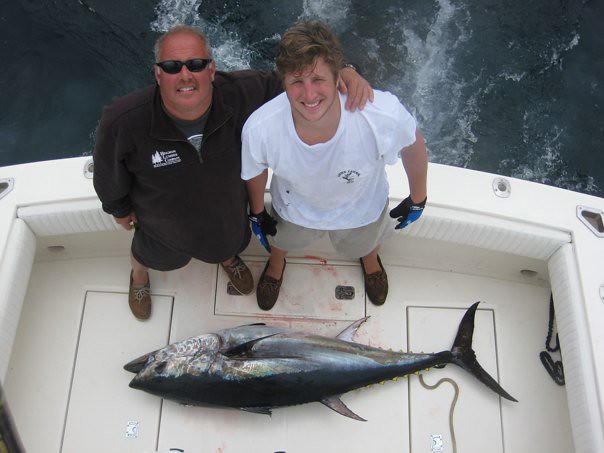
DiPaolo's interests away from retail are unusually easy to picture. A photograph on his personal Flickr account shows him on a boat beside another angler, with a tuna lying on the deck. Sunglasses, the wake behind them and the fish at their feet do most of the explaining. The accompanying description says he enjoys sport fishing with his sons, friends and wife, along with golf and skiing.
His personal biography also describes volunteering and coaching youth baseball in Cohasset, Massachusetts, and serving on the board of Roca, an organization working with at-risk young people. These activities place him in a community beyond the company's customer list. They are specific commitments, with organizations and a town attached.
South Shore Art Center publications listed him among its directors in 2015 and 2016. Its 2015 arts-festival program also named Gloria and Anthony DiPaolo among supporters. The connection adds art education and local cultural life to a public record otherwise dominated by boots and retail.
It is tempting to turn fishing into a lesson about executive patience, or baseball into a theory of management. The boat photograph asks for neither. It gives the reader a person with a pastime, a companion and a rather substantial catch. Sometimes a fish earns its place in a business profile simply by being a fish.
The business carries on
Work 'N Gear's later chapter belongs to a different leadership account. In October 2025, the company announced financing from Black Feather Capital for a court-supervised restructuring. Larry Nusbaum was identified as president. The plan described 26 stores and renewed attention to footwear, workwear, e-commerce and sales to businesses.
That announcement came after two unprofitable years. It changes the shape of the company story without erasing DiPaolo's earlier work. Store openings, lending arrangements and community programs remain dated events in his career. The chain's next decisions belong to the people making them.
DiPaolo's most accessible idea still fits in a shopping bag: bring back a usable pair, buy its replacement, let someone else wear the old one. Across a career involving brands, shops and banks, the Boot Trade gives a familiar object another destination. The receipt records one transaction. The next wearer supplies the rest of the story.