The most important thing Anomaly ever made was not an advertisement. It was permission. Permission for a strategist to say the product was wrong, for a designer to propose a store instead of a spot, and for a team to spend less time on a job without earning less money. In an industry trained to sell people by the hour, the New York company decided in 2004 that time was a terrible product. It would charge for the problem, share in performance when sensible, and occasionally own a piece of the thing it created.
That sounds tidy now. It was not tidy then. Traditional agencies were built as collections of departments, each with a revenue target and a familiar output: media plans over here, commercials over there. Anomaly's founders - including Carl Johnson, Jason DeLand, Mike Byrne, Johnny Vulkan and Justin Barocas - assembled people from advertising, product development, design, technology and licensing around one question: what would actually move the business?
01 / The original provocationStop selling the meter
Anomaly's model rests on three connected choices. First, it does not use timesheets. A client pays a fee for the assignment rather than buying an inventory of labor hours; compensation can also rise with results. Second, the agency uses one bottom line, intended to prevent disciplines or offices from protecting their own little kingdoms. Third, it invests in intellectual property and new ventures so its people experience the risks they routinely recommend to clients.
The Anomaly loop - incentives before output
Value fee + possible performance upside + selective ownership. The point is not novelty. The point is removing the financial reward for taking longer or defending a department.
The economics matter more than the manifesto. Hourly billing rewards volume and makes speed look like a discount. A fixed fee turns speed into margin. Performance pay can align the agency with the client's outcome, provided both sides agree on the measurement and on what the agency can control. Equity or shared IP adds a longer bet. Anomaly's proposition was to be premium-priced and still excellent value - expensive for judgment, cheaper than paying for motion.
We want to be the most premium-priced agency you ever hire and the best value you've ever had.Carl Johnson, co-founder
02 / When the answer became an objectA beer brand loses hockey - then gains a living-room siren
The Budweiser Red Light is the cleanest demonstration. Molson held the National Hockey League sponsorship rights in Canada, which made conventional hockey advertising awkward for Budweiser. Anomaly treated the constraint as useful. Its team designed and prototyped a Wi-Fi-connected replica of the red lamp behind a hockey net. Owners selected a favorite team; when that team scored, the light flashed in the living room or bar.
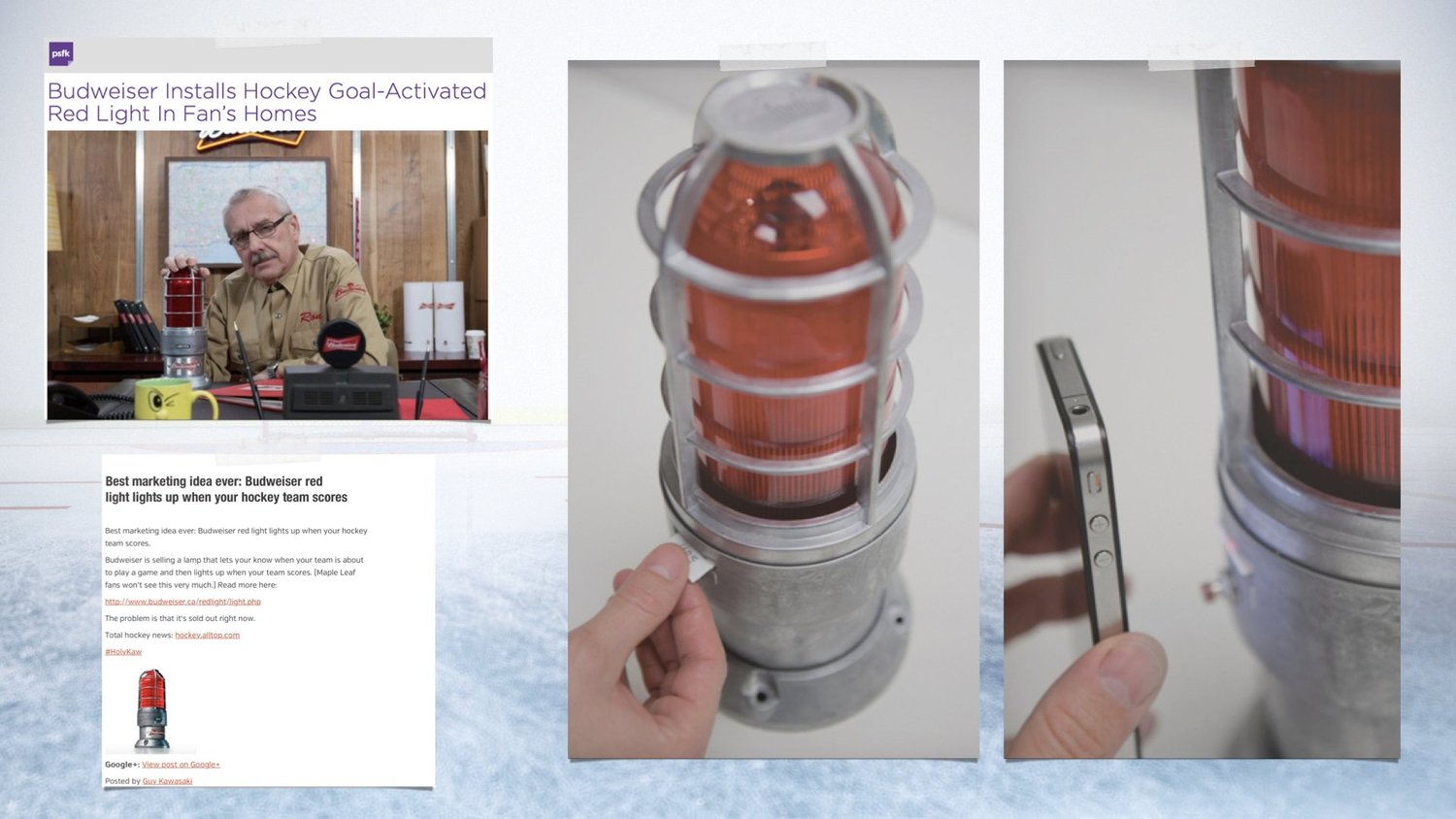
This was media disguised as furniture, product development disguised as fandom and a retail object that generated its own publicity. It did not require the agency to pretend it owned the game. It gave the brand a useful role in a ritual already happening. That is the distinction Anomaly has spent two decades selling: do not interrupt culture if you can build a tool that participates in it.
The same breadth appears elsewhere. Anomaly helped create and co-own dosist, a medicinal-cannabis brand later recognized by Time's invention list. It designed MELÉ, a skincare brand focused on melanin-rich skin. It made Avec Eric, an Emmy-winning food and travel series with chef Eric Ripert. Its portfolio includes documentaries, digital platforms, connected products, identity systems and, yes, a great many advertisements for companies such as Google, Diageo, Amazon, Visa, Chevrolet and Starbucks.
03 / The scar tissueThe first product bets did not politely succeed
An owned-idea model has a cost that is easy to omit from the case study. Anomaly used a substantial share of profits to fund experiments. Founder Jason DeLand later described an early mobile-payment system with unusual economy: the company got crushed. Another partnership with an early YouTube personality also failed. The acquisition price when MDC Partners bought a 60 percent stake in 2011 was never disclosed, so any neat return calculation would be theater.
What failed first
Early owned-IP experiments, including a mobile-payment product, met the ordinary fate of risky new ventures. The agency had talent and an idea; neither guaranteed distribution, timing or product-market fit.
What changed their mind
The failures did not reverse the thesis. They refined it. Anomaly kept investing because the practice made its teams more credible with clients taking similar risks - while proving that ownership is exposure, not free upside.
This is the counterweight to the Red Light story. A multidisciplinary team can widen the answer set, but it does not repeal markets. Product ideas bring inventory, adoption, regulation, support and capital needs that campaign teams can underestimate. Shared upside also means shared downside. The model works when a firm can lose some bets without turning every project into a desperate hunt for a jackpot.
Nearly all innovation fails. But we decided to do it because it would make us a better company.Jason DeLand, co-founder
04 / The business todayA holding-company agency that still talks like a start-up
MDC's majority purchase financed deeper talent and international growth. A decade later, MDC combined with Stagwell, putting Anomaly inside a public marketing network alongside other creative, digital and research businesses. This creates a productive contradiction. Anomaly is not an independent shop, but it still sells a founder-built operating model: one bottom line, no timesheets, mixed disciplines and entrepreneurial bets.
The current evidence is commercial rather than philosophical. During 2024, Anomaly added 15 clients, including Starbucks, Chevrolet, Visa, Ferrero, Google Shopping and Lululemon. That run helped earn the agency the No. 3 position on Ad Age's 2025 A-List. Starbucks moved its U.S. creative work to Anomaly during a broader attempt to recover the coffeehouse's role as a place to gather. It is precisely the kind of assignment where the problem is larger than the advertising.
Fifteen new clients arrive, among them Starbucks, Chevrolet, Visa and Lululemon.
The agency ranks No. 3 on the Ad Age A-List and launches work for Amazon Ads and the Women's Super League.
Paris opens as office number seven, led by former BETC executives Mehdi Benali and Olivier Aumard.
Paris is a revealing expansion. Johnson said the choice was led by people and culture more than market size. The office opened in 2026 with CEO Mehdi Benali and chief creative officer Olivier Aumard, both from BETC, and a remit spanning French clients and the wider EMEA network. Scale, in this telling, should be the consequence of good leaders and good work rather than a target pasted into a spreadsheet.

05 / The operator's versionCopy the incentives, not the hockey lamp
The easiest mistake is to copy the outputs: make a gadget, call a content series IP, add a strategist to a brainstorm. The transferable part sits one layer down. Start by writing the business outcome without naming a format. Give one small cross-functional team authority over it. Remove departmental revenue fights. Price a defined result, then decide whether a measurable bonus or ownership component fairly reflects the risk. Reserve a capped pool of profit for experiments and expect most of it not to return.
The model also needs conditions. A client must share information, allow the team to challenge the brief and agree on who controls the outcome. Procurement must tolerate something other than hourly comparison. The agency needs enough cash to absorb failed bets, enough range to deliver unfamiliar answers and enough discipline to avoid turning every assignment into an invention contest. A regulated launch, a commodity production job or a campaign with no stable success metric may be better served by a conventional fee and a specialist shop.
There is another limit: integration becomes bureaucracy when everybody joins. “Surround the problem” works only if the circle stays selective. Anomaly's one-bottom-line idea can reduce turf wars, but it cannot replace a sharp decision-maker. Nor can performance pricing rescue a vague goal. If sales rise because distribution doubled, the agency did not earn all the glory; if supply collapses, it did not cause all the damage.
Anomaly fits in the market precisely because it slips between categories. A brand consultancy may diagnose the problem but not produce the campaign. A product studio may build the tool but not shape the cultural story. A production agency may execute efficiently but accept the format as given. Anomaly's offer is useful when the client knows the result it needs but has not decided what kind of thing will produce it.
That ambiguity is not magic, and the company's failures keep the story honest. It is a designed option value: more kinds of people, more possible answers, and incentives that do not automatically favor the longest route. Twenty-two years after launch, the name no longer reads like a boast. It reads like a standing instruction - remain unusual enough to notice when the brief is asking the wrong question.