Anne Green was supposed to become a professor, or at least the evidence pointed that way. She studied English at Vassar College, then went to New York University for graduate work in 19th-century American literature. She earned a master's degree and reached the all-but-dissertation stage of a Ph.D. Somewhere between the seminar room and the dissertation, however, a young communications agency kept making a persuasive counteroffer: real clients, unruly problems, deadlines with consequences, and mentors she trusted.
The agency was CooperKatz. Two former colleagues from Burson-Marsteller, where Green began her career in 1993, had founded it. She joined them in 1996 and spent the next 22 years helping to build the firm. The academic track eventually yielded to agency life, but the instincts behind it did not disappear. Green continued to study how people construct meaning, how language changes a room, and how a good question can make familiar material newly legible.
Her own compressed account of the detour is charmingly efficient: “Accidental business person, life-long learner.” It is also a better operating description than most executive biographies. The accident became a career. The learning became the method.
Chapter one
The startup became the classroom
At CooperKatz, Green moved through a long sequence of jobs: vice president, senior vice president, general manager, president and chief operating officer, then president and CEO. The list makes her ascent look clean. Small agency life rarely is. Titles trail the work; people sell, counsel, hire, fix, rehearse, calm, and improvise, sometimes before lunch. Green's years there taught her the business from enough angles that leadership arrived as an accumulation rather than a costume change.
She also kept one hand in the craft. Media training and presentation coaching gave the would-be teacher a room of her own. The curriculum was practical: how to say what matters, how to answer the question actually asked, how to carry authority without hiding behind jargon. Crisis counsel demanded another kind of close reading, one conducted with a clock running and reputations in play.
Recognition followed. PRWeek named Green to its 40 Under 40 in 2010, when she was 39. She appeared in the publication's Global Power Book in 2015, 2016, and 2017, and PR News included her among its Top Women in PR in 2015. Yet her public advice tends to return to temperament rather than trophies: “Lean into your curiosity and enthusiasm.” Curiosity, in her telling, produces better counsel because it keeps the counselor from arriving with a prewritten answer.
The hinge
First acquired, then acquiring
In 2018, G&S acquired CooperKatz. Green crossed the transaction from the acquired side, becoming a principal and the managing director of G&S's New York office. She carried responsibility for strategy, people, growth, and operations, while continuing to advise clients. It was a useful education in what a deal looks like after the announcement, when two histories must become one working culture.
Six years later, the view reversed. Green became G&S chief executive on January 1, 2024, the first woman to hold the role in the agency's history. That June, G&S acquired MorganMyers, a firm with deep agriculture and food expertise, and created G&S Integrated Marketing Communications Group above two agency brands. The combined group opened that chapter with more than 165 employees and annual revenue above $33 million. Its first anniversary announcement cited 13 percent revenue growth.
Those figures explain scale, not style. Green's preferred phrase is “high performance and highly human.” The conjunction matters. She does not frame results and empathy as rival camps forced into a truce. She treats trust, candor, and care as part of the machinery by which difficult work gets done. When her succession was announced, she called leadership a team sport and pointed toward the colleagues around her.
The 2024 acquisition gave that philosophy a demanding test. Green had to protect what made MorganMyers distinct while creating a useful group around it. The resulting structure kept G&S Business Communications and MorganMyers as separate market-facing brands. A holding company can easily become an org chart in search of a reason. Here, the stated logic was specialization with shared capabilities: preserve sector knowledge, expand the bench, and give clients access to more disciplines.
A career in five turns
- Starts at Burson-Marsteller after graduating from Vassar.
- Joins CooperKatz and begins a 22-year run building the agency.
- Moves to G&S when it acquires CooperKatz.
- Becomes CEO and helps establish the multi-agency GS IMCG platform.
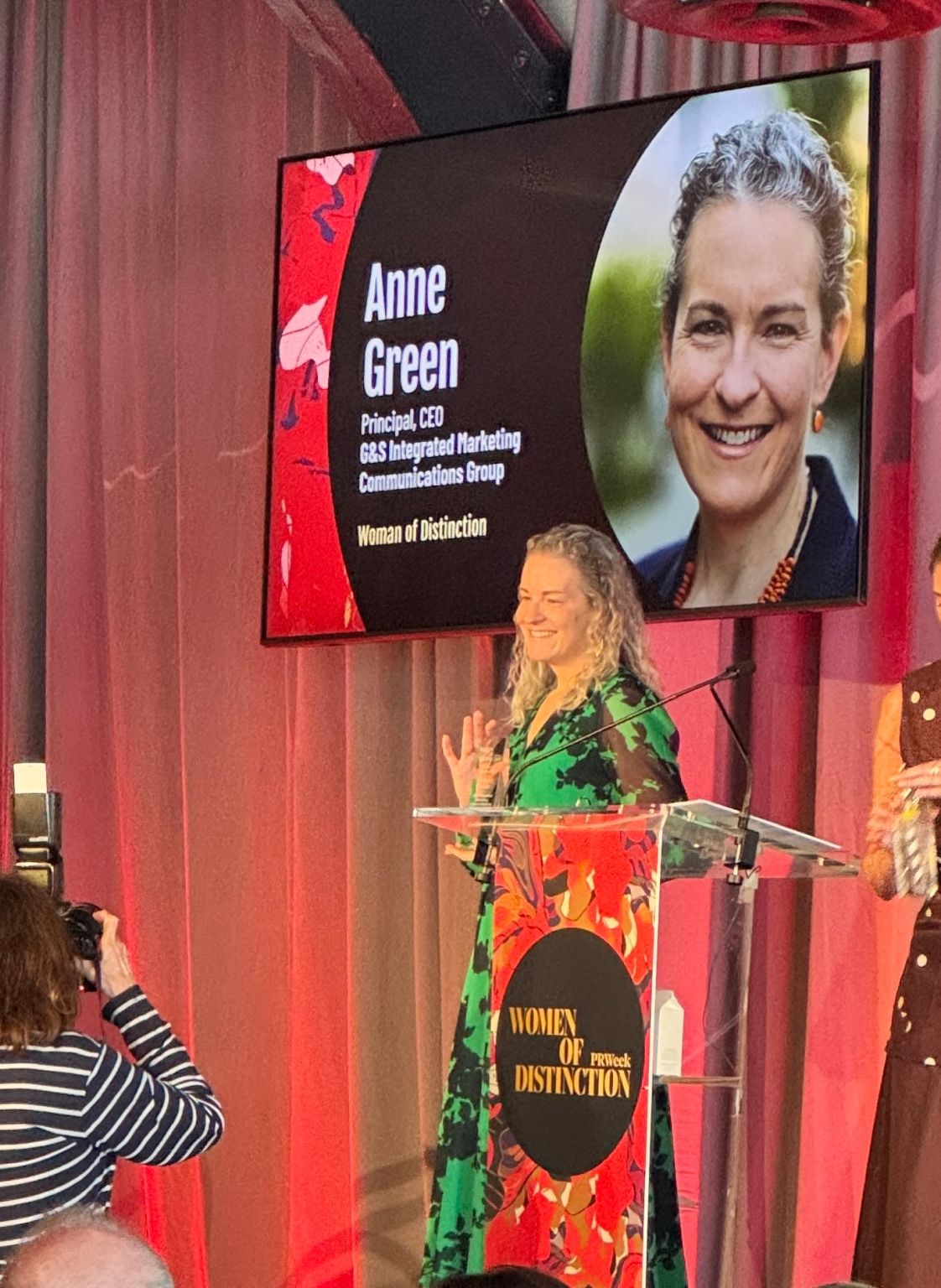
- Named a PRWeek Woman of Distinction and elected AAVC president.
Practice, in public
The media trainer takes the microphone
Green's podcast, Building Brand Gravity, makes her learning habit audible. With co-host Steve Halsey, she has interviewed executives, founders, researchers, professors, journalists, and communications leaders. The show reached its 50th episode in 2026. Rather than assemble a victory lap, the hosts looked for themes that had survived four years of conversation: trust earned before a crisis, narrative as an operating system, communications as a driver of business value, and the human being as architect in an AI-shaped workplace.
For Green, hosting also removes the protective glass between coach and performer. She has said that sitting for interviews and taking the host's chair makes her live the advice she gives other people. The expert becomes accountable to the same nerves, edits, follow-ups, and awkward transitions. After 50 episodes, her verdict was that curiosity and tenacity mattered most. Podcast directories are crowded with immaculate beginnings. Continuation is the rarer trick.
The show also reveals a social pleasure that corporate language often sands away. Green enjoys people. She likes the circulation of ideas, the moment a guest surprises a host, and the generous exchange that can happen even among competitors. Her enthusiasm occasionally arrives before polish, which is part of its credibility. She has recalled telling colleagues, more than once, that the latest recording was the best conversation yet.
“Curiosity and tenacity are required to make it to 50 episodes and beyond.”
The lesson doubles as a compact account of Green's career: sustained attention, applied repeatedly.
The next useful question
A human argument in an automated age
Artificial intelligence has given Green's old subjects a new urgency. She serves as executive sponsor of the G&S generative AI team and has helped shape industry guidance through the PR Council's Ethics Committee. Her position avoids both panic and theater. Tools matter. So do policy, experimentation, and the willingness to admit uncertainty. Human judgment remains responsible for deciding what the tool is for, which evidence deserves weight, and where an answer may cause harm.
That stance fits a leader trained in ambiguity. Green has spoken about learning to act without complete certainty: weigh the evidence, map several paths and outcomes, then find a way forward with partners and clients. The sentence could describe crisis counsel, an acquisition, a seminar discussion, or the arrival of a technology whose rules are still being written.
Her other institution is Vassar. Green has volunteered for the college across decades, from career advising and student mentoring to communications counsel, committee leadership, the Board of Trustees, and the board of the Alumnae/i Association. In 2026, she became AAVC president for a term running through 2030. She has described the alum network as a Venn diagram: circles of connection overlapping and extending outward. It is an image that suits her. Her professional world is also made of intersecting circles, with mentors becoming colleagues, colleagues becoming guests, and a former student returning as a guide.
The continuity is striking. Green first volunteered in Vassar's Career Advisor Program in 1994, barely a year after graduating. Much later she became an anchor mentor in Sophomore Career Connections, helping students see routes into communications that may not appear on a course catalog. Her election as AAVC president did not arrive as a ceremonial add-on to an executive résumé. It followed years of committee work, governance, mentoring, and the less glamorous labor by which institutions remember how to welcome people back.
The same pattern appears beyond campus. Green served on the PR Council board from 2017 through 2019 and later helped its Ethics Committee think through responsible generative AI. She joined the LifeWay Network board in 2015 and chaired it from 2019 through 2023. She remains active in the Page Society and represents G&S in the PROI global agency network. The names vary, but the function repeats: connect a professional community, strengthen its standards, and make experience available to people who have less of it. Service is where Green's idea of curiosity becomes reciprocal. She does not only ask what she can learn from a room. She asks what she can return to it.
There is music in the picture, too. Green studied vocal performance alongside English, has sung and performed since childhood, and is married to a professional drummer. She did not make the arts her profession, but voice, timing, rehearsal, and audience never quite left the work. Even her affection for teaching found a practical afterlife in coaching executives and mentoring students.
The temptation with an “accidental” career is to imagine a lucky turn followed by momentum. Green's record suggests something more deliberate. The original destination changed, but the animating interests survived: language, performance, learning, service, and the pleasure of connecting one idea to another. She left the Ph.D. behind. The classroom simply grew larger, acquired clients and a balance sheet, added microphones, and kept asking for the next useful question.