In the early 1980s, Anne E. Droste sold television to buildings that did not have cable. TelStar would put satellite dishes on Chicago hotels and Gold Coast high-rises; Droste would persuade the people inside to buy the programming. The arrangement now sounds like a small archaeological discovery: before the infinite menu, before the app, before a viewer could start a subscription in bed, somebody had to get a dish onto the roof and a service into the building.
That was the beginning of a career spent on television's hidden side. Viewers remember the programs. Droste worked on the access: the contracts, tiers, promotions and operator relationships that decided whether a program reached a living room at all. She moved from TelStar to SelecTV, then to Showtime, News Talk TV, Game Show Network, back to Showtime and later Universal Sports Network. Different genres, different owners, different technologies. The persistent question was wonderfully plain: how do we get one more household to watch?
A one-channel apprenticeship
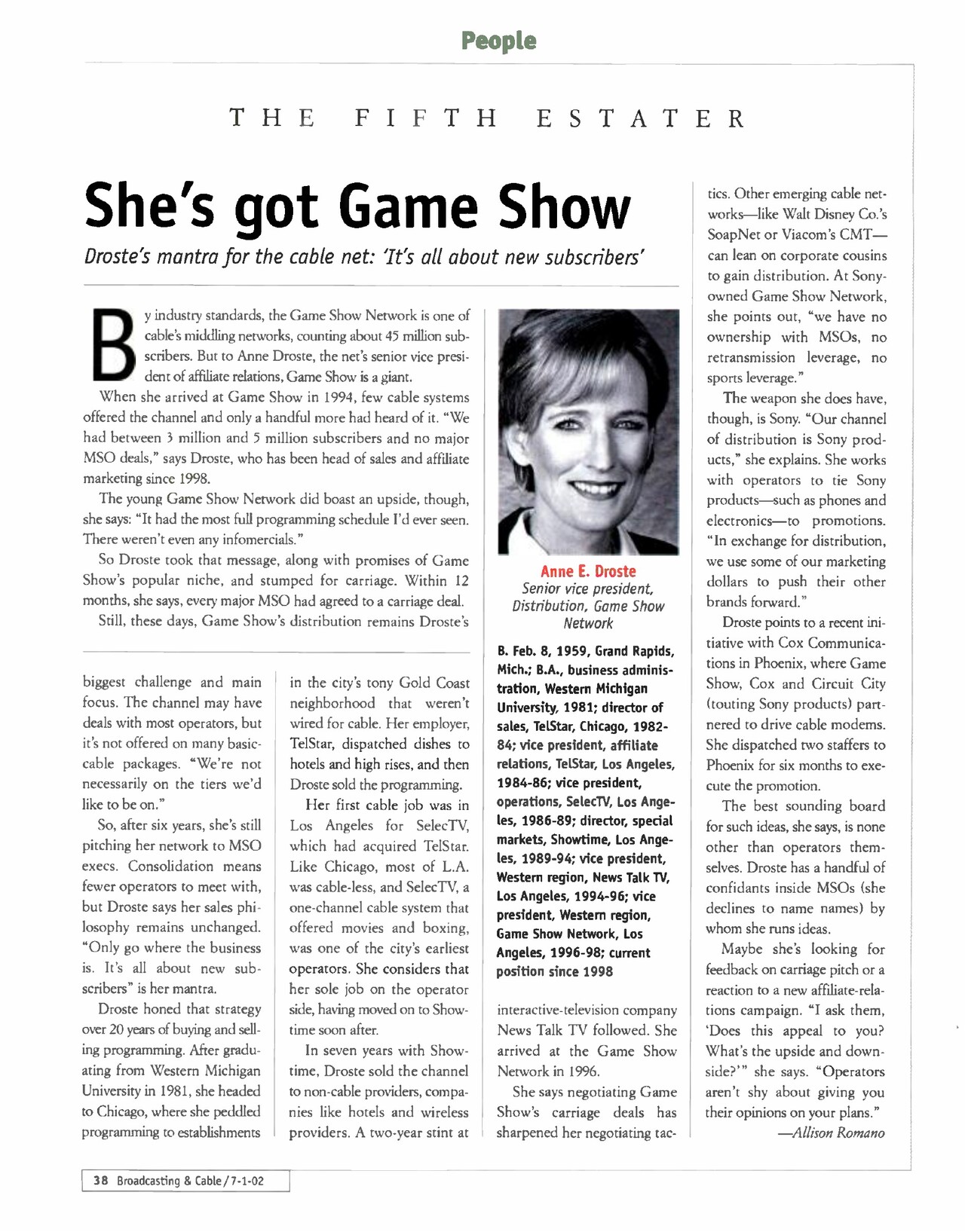
Droste was born in Grand Rapids, Michigan, in 1959 and graduated from Western Michigan University with a business administration degree in 1981. A year later she was in Chicago, selling to places that ordinary cable had not reached. TelStar took her to Los Angeles in 1984, and SelecTV followed in 1986.
SelecTV was early subscription television stripped to its essentials: one channel, movies and boxing. Droste later described it as her only job on the operator side. The distinction matters. Operators controlled the pipe; networks needed passage through it. Spending three years inside an operator gave her a view of the buyer's anxieties before she spent the next decades selling to them.
In 1989, she joined Showtime as director of special markets. The title covered customers outside conventional cable, including hotels and wireless providers. She was still finding audiences in the gaps of the existing system. When people imagine a media executive, they tend to picture a studio lot or a premiere. Droste's territory included hotel rooms, rooftop equipment and whatever distribution route could carry paid programming.
“Only go where the business is. It's all about new subscribers.”Anne E. Droste's sales mantra
The game with no obvious leverage
After two years at the interactive-television venture News Talk TV, Droste joined Game Show Network in 1996. She became head of sales and affiliate marketing in 1998. The network had a complete schedule and a familiar idea - television games - but limited distribution. In its early years, it counted only a few million homes and lacked major cable-operator agreements. A program could be ready for viewers and still remain functionally absent.
The larger networks arrived at negotiations carrying useful pressure. Some shared corporate families with cable systems. Others had broadcast stations or sports rights. Game Show Network, owned by Sony, had none of those traditional bargaining chips. Droste's answer was to look beyond the channel.
Sony made consumer electronics. Cable operators wanted people to buy broadband. Game Show Network could supply programming, promotions and marketing money. In Phoenix, the network joined Cox Communications and Circuit City in a campaign that used Sony products to help sell cable modems. Droste assigned two employees to the market for six months. It was distribution as local fieldwork, not a memo sent from headquarters.
Look past the product
The network lacked conventional leverage, but its owner had electronics, brand reach and promotional assets.
Start with the partner
The pitch connected carriage to an operator priority: adding broadband customers.
Put people on the ground
Two team members spent six months in Phoenix to execute one market partnership.
Use resistance as research
Droste asked trusted operator contacts what appealed, what did not and why.
Within a year, she said, every major multiple-system operator had agreed to carry the network. By 2002, Game Show Network was in about 45 million homes. The number is impressive, but the method is more portable: when the expected leverage is missing, list every asset around the product and ask which one solves the other side's actual problem.
Ask the gatekeeper
Droste's best sounding boards were not consultants safely removed from the transaction. They were people inside the cable companies she was trying to persuade. She kept a small circle of operator confidants and ran ideas past them. Would this carriage pitch appeal? Where was the upside? What was the downside?
It is an oddly generous posture for a salesperson. The gatekeeper is usually cast as the obstacle, a person to route around or overwhelm. Droste treated gatekeepers as practitioners with useful information. They understood their customers, systems and incentives. Asking them to stress-test an idea did not surrender the negotiation. It improved the offer before the formal conversation began.
There was a second advantage. Cable was a business of repeat encounters. A spectacular win that poisoned the relationship could age quickly. Droste said that even after painstaking, prolonged negotiations, many colleagues, employees and affiliates became close friends. Her favorite part of the job, she said, was the people she had the privilege to work with.
Distribution snapshots / U.S. homes
Reach is the part viewers rarely see being built
Back to premium television
In 2007, Showtime reorganized affiliate sales and named Droste senior vice president and general manager of its Western Zone. Her accounts included DirecTV, EchoStar, Charter, Suddenlink, the National Cable Television Cooperative, AT&T and Qwest. The assignment stretched across cable, satellite and telecommunications at a moment when the ways to receive television were multiplying.
It was also a return. Droste had already spent years at Showtime earlier in her career. Now she came back responsible for relationships with some of the largest distributors in the country, while helping launch Smithsonian Networks and a broadband game service. In 2014, a cable-industry profile credited her affiliate-sales leadership during a year when Showtime gained more than five million subscribers.
Programming for Chicago hotels and high-rises through TelStar.
Hotels and wireless systems become another route to the audience.
Affiliate sales turns a complete schedule into national carriage.
Major satellite, cable and telecom accounts sit in one portfolio.
Universal Sports reports distribution to 65 million homes.
A channel for every kind of audience
Droste later led distribution and marketing strategy for Universal Sports Network, a home for Olympic, endurance and action sports. By 2014, the channel reported availability in 65 million homes. Her career had moved from movies and boxing on a single subscription channel to premium drama, game shows, documentaries, children's programming and international sport.
The genres changed, but the craft stayed recognizable. Define why the programming matters. Understand the distributor's business. Build a promotion that works in the market, not merely in a presentation. Keep the relationship intact. Then repeat, because carriage is not a permanent state of nature.
Her public LinkedIn profile now identifies Droste Media Group in Los Angeles. The California business was registered in 2004 to advise media companies, with Droste listed as a member. The same profile records a WICT Leadership Award in 2015 and recognition among cable's 50 most powerful women in 2011 and 2012. Another profile from her Universal Sports period describes her as passionate about guiding emerging leaders through a changing industry.
“The most enjoyable aspect of my job is the people with whom I am privileged to work.”Anne E. Droste on a career in television
The business after the deal
There is a tidy temptation to turn Droste's record into a story about subscriber counts. The numbers are there: millions of homes for Game Show Network, millions more for Showtime, 65 million for Universal Sports. Yet her own remarks keep returning to people. The operator contacts who told her when an idea would fail. The employees sent to live with a promotion for half a year. The affiliates who stayed friends after the ink dried.
Even her answer to a travel question contains a useful split-screen. She liked any castle in Europe, she said, and her Michigan cottage in August with the entire family. One answer reaches for the grand and old; the other returns home. It is a personable footnote to a career built between Midwestern beginnings and Los Angeles media companies.
Streaming has made access feel weightless. Tap an icon, enter a card, watch. The old machinery can look quaint from this side of the interface. But the modern version of Droste's question survives in every app-store ranking, device bundle, platform agreement and recommendation row. Someone still decides what gets seen. Someone still has to persuade the person controlling the route.
Droste's career makes that invisible work visible. A channel needed more than shows. It needed a reason for the operator to care, a plan that could survive contact with a local market and a relationship strong enough to carry the next negotiation. The screen was the glamorous part. She worked on the distance between the screen and the audience.