Thirty seconds can feel surprisingly long when someone is trying to sell you something you will never buy. Television has made an institution of this experience. The programme brings together a crowd; the commercial addresses a particular customer; everyone else gets to practise patience. David Downey has spent a substantial part of his working life in the space between those two audiences.
As co-founder and co-chief executive of INVIDI Technologies, Downey works on addressable advertising: the ability to send different commercials to different households watching the same programme. The premise is almost impolitely straightforward. Neighbours can agree on a television show without agreeing on a car, a holiday or what deserves their money.
In January 2016, he explained the mismatch through familiar television: American Idol, The Voice and a Revlon commercial. A popular show could attract people outside the demographic the advertiser wanted. Downey’s business concerned what happened to the value of that commercial when the distribution system could make a more selective introduction.
It is a career built around the part of television that viewers often use to leave the room. There is a certain professional nerve in choosing the commercial break as your life’s work. There is also a practical business question hiding there: how much more useful could an existing slot become?
A cable operator’s education
Downey arrived at that question through the machinery of television. At Triax Communications, he was a senior vice president with responsibilities that included franchising, programming, marketing, sales, advertising and public relations. Those jobs touch the points where a television business meets its customers, its commercial partners and the communities it serves.
He also founded and ran AMN, a computer television network distributed through cable systems. Its deployment reached 5.5 million subscribers in 116 markets, including systems associated with Comcast, Charter, Adelphia and AT&T. Long before a discussion of coordinating advertisements across screens, there was the task of getting a network carried at all.
That background gives his later work a particular shape. A cable operator’s world contains agreements, equipment, programming and advertising inventory. An idea has to travel through all of them before it can arrive in a living room. The commercial proposition and the delivery system have to work together.
Consider the difference between describing a clever advertisement and arranging for the right household to receive it. The first is a matter of persuasion. The second adds distribution. Downey’s career has repeatedly returned to that second assignment, where the customer buying technology also has a television service to run.
AMN deployment, before INVIDI.
A distribution education measured in households.
Two minutes, and a larger map
Addressable television changes what can happen within an existing advertising interval. Instead of sending one commercial to every household, the system can select among messages using audience criteria. The programme continues to gather its audience. The advertising within the break becomes more particular.
The distinction matters because a television slot has a fixed duration. Thirty seconds cannot politely expand to accommodate another customer. Household selection offers a different way to use that same time. Advertisers can seek the audience they want, while distributors and broadcasters have a way to make more of the inventory they already control.
Downey was discussing the international consequences by December 2015. INVIDI was preparing to supply technology for Telenet and SBS Broadcasting in Belgium. He pointed to a commercial difference: American multichannel distributors commonly had about two minutes per hour available for their own advertising, while a broadcaster could work across a much broader schedule.
Crossing an ocean therefore meant more than changing the address on a presentation. The inventory, the customer’s role and the possibilities for deployment could change. Downey’s explanation paid attention to who controlled the commercial time. That is a useful detail in a field where discussion can become rather pleased with its own terminology.
In another interview in November 2016, he explored satellite switching: using satellite capacity to carry advertising feeds that could be selected during addressable moments. He discussed the possibility of extending the approach across an operator’s footprint, including opportunities in South America. The proposal addressed another distribution question: how to reach more homes through the systems already serving them.
The appeal of this work is easy to describe; each deployment has its own complications. A solution for cable equipment does not automatically settle the commercial or technical arrangements of another market. Downey’s public explanations kept moving between the advertising opportunity and the infrastructure required to reach it.
The viewer declines to learn the acronyms
By December 2018, INVIDI had acquired Ooyala’s advertising technology division, formerly Videoplaza. The purchase brought a digital video advertising platform, Pulse, and more than forty software engineers and account managers in the United States, United Kingdom, Sweden and India. It gave INVIDI additional capabilities beyond its established television advertising work.
The point was to connect campaigns across environments. A household might encounter a message on conventional television and then again through an internet video service. For an advertiser, those encounters raise related questions about reach and repetition. Separate delivery systems make a single campaign harder to coordinate.
In London the following December, Downey described INVIDI Edge as an interface linking linear television with OTT and mobile. He talked about controlling how often advertising appeared and the separation between exposures. The job had widened from selecting a household’s commercial to coordinating the commercial’s journey across screens.
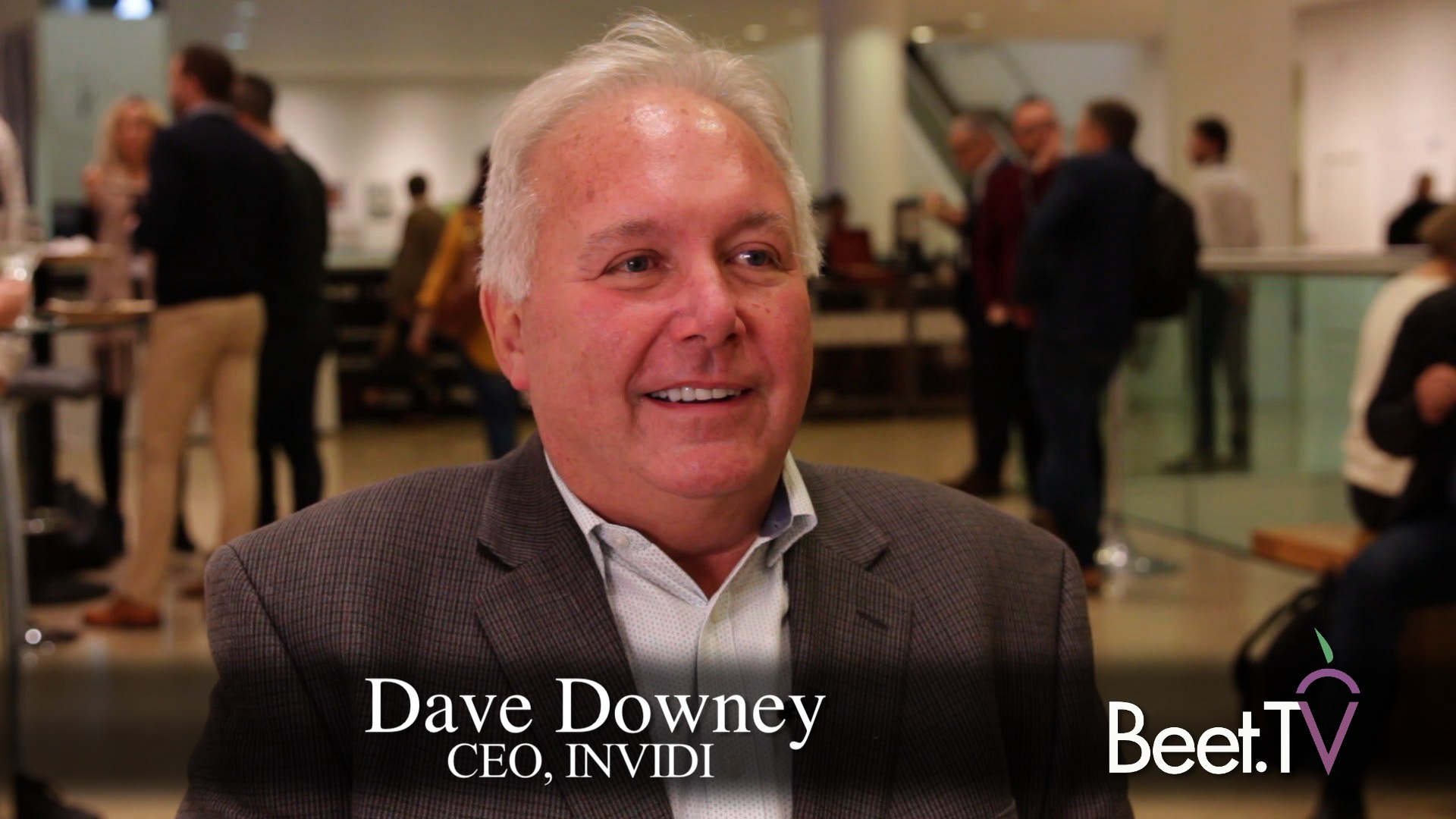
His explanation of the consumer was agreeably brief: “they just want to watch video.” The industry’s divisions between linear television, digital television and OTT did not describe the experience in the same way a viewer would. A sofa does not need a glossary.
That observation helps explain the attraction of a common interface. The audience moves between devices and services; an advertising campaign has to account for those movements. Bringing the systems together becomes part of the commercial task. Downey’s excitement in that interview centred on connecting the platforms.
“they just want to watch video.”
David Downey · December 2019
There is a useful restraint in that sentence. A viewer can be indifferent to the mechanism while the businesses supporting the programme need it to function precisely. Much of Downey’s working territory lies in that imbalance. The technology has to understand distinctions that the audience has little reason to study.
The company has company
Downey shares the chief executive role with Bruce Anderson, INVIDI’s global chief technology officer. Anderson’s background includes digital video systems and work at Sarnoff. The partnership places television business experience alongside a technical career spent dealing with how pictures and information move.
Their collaboration also appears in an unusually concrete form: a patent. Downey, Anderson and Daniel C. Wilson are listed as inventors on a United States patent issued in July 2017 for requesting information related to broadcast network content. It concerns another connection between viewing and response, extending the interaction beyond the broadcast itself.
The distinction is worth keeping at its proper scale. A named inventor credit describes participation in a particular invention. It also adds texture to the executive biography. Alongside the distribution agreements and product explanations sits a formal record of work with colleagues on how a viewer might request further information.
INVIDI received Technical Emmy awards in 2016 and 2021. Those honours belong to the company and the people doing the technical work. Downey’s own industry recognition includes induction into the Cable Television Pioneers class of 2012. The two kinds of recognition fit different parts of the story: a long career in the business, and engineering that makes the business possible.
- 2018Ooyala’s advertising technology division joins INVIDI.
- 2019Downey describes Edge connecting linear, OTT and mobile.
- 2025DIRECTV takes majority ownership; existing leadership continues.
In January 2025, INVIDI announced that DIRECTV had acquired majority ownership. The company would continue independently with its existing leadership team, jointly owned by DIRECTV, DISH and WPP. A longstanding client and investor was taking a larger ownership position in the advertising technology business.
For Downey’s story, the arrangement brings the distributor back into view. The company supplies systems to businesses that already have relationships with television households. Ownership and distribution are different subjects, but here they meet around the same commercial proposition: making a viewer’s advertising opportunity more useful to a buyer.
The box still has work to do
In July 2026, INVIDI announced a collaboration with Google to bring Programmatic Guaranteed advertising to unconnected set-top boxes. India was a focus of the announcement, with its extensive base of households using that equipment. The development addressed audiences that digital campaign buying had previously struggled to reach.
The announcement put another version of an old distribution problem on the table. A household does not disappear from television because its set-top box lacks an internet connection. Reaching it through newer advertising systems requires a route that accommodates the equipment already there.
That is a fitting place to find Downey’s company after years of household targeting, satellite proposals and coordination across screens. The devices and buying arrangements keep changing. The commercial interval remains familiar. Somewhere, a programme pauses, and an advertiser has a few seconds to make an introduction.
Downey’s career has followed the practical question inside that pause. Who should receive the message? How can it get there? For the viewer, the answer may register only as a commercial that happens to make sense. For someone who has worked across cable operations, networks and advertising software, there is an entire business in arranging that small coincidence.
Watch & explore
- INVIDI: leadership and company biography ↗
- David Downey on LinkedIn ↗
- London interview: advertising across screens, 2019 ↗
- Interview: the Belgian television opportunity, 2015 ↗
- Interview: satellite switching, 2016 ↗
- DIRECTV ownership announcement, 2025 ↗
- Google collaboration announcement, July 2026 ↗
- Broadcast information patent, 2017 (PDF) ↗