A startup community can begin with something as unromantic as a bank account. In Belo Horizonte, young businesses wanted access to Banco Inter’s fee-free digital banking. Around 200 startups brought their demands to the bank. The conversation widened. MRV and Localiza joined the effort that became Órbi Conecta. Anna Martins, its co-founder and first CEO, would spend the next several years giving those conversations somewhere to go.
There is a pleasing lack of grandeur in that beginning. Before the language of innovation arrived, there was a bill someone would rather avoid paying. Founders had a practical problem; an established company had a reason to listen. The connection already existed. What followed was the work of making it useful to more people.
The lawyer at the café table
Martins came to that work through law. She studied at the Federal University of Minas Gerais and developed a model of networked legal practice for startups. Her early professional world put her close to entrepreneurs trying to build businesses, rather than at a comfortable distance from their problems. A 2018 biography described someone who liked challenges and believed in working as a team.
Órbi’s own account of its beginnings places her at a meeting at Café com Letras, already working as a lawyer for several startups in San Pedro Valley. The community brought together entrepreneurs from Belo Horizonte, taking its name from the São Pedro neighbourhood. She joined a founding effort involving numerous local business builders. The organisation began operating in 2017.
The café matters because it gives the story its proper proportions. Órbi grew out of people who were already talking to one another. Martins helped turn that existing social energy into an organisation with responsibilities, partners and a place to meet. Coffee can get a meeting started. It rarely volunteers to handle the follow-up.
The early numbers were modest enough to be concrete. By April 2018, around 450 companies had passed through Órbi, and 15 contracts had been signed between companies and startups. Those figures describe an experiment beginning to produce transactions. For the person running the place, each contract also made the case for continuing the experiment.
The public programme gave those encounters a wider audience. For the ORBITAR I/O event in Belo Horizonte, Martins described an ambition to connect people and businesses around relevant social problems. The agenda moved through panels with names including Big Bang, Game Changer and Techboost, making room for speakers, corporate executives, startups and partners. Behind the theatrical titles was a fairly demanding job: getting people with different incentives to find something worth discussing together. A founder wants a customer. An established business wants a solution it can use. An event has to give both a reason to return after the lights come down.
A room with fewer walls
At Órbi, the furniture expressed a policy. The coworking space used shared tables rather than offices reserved for individual brands. Martins explained that partners were selected to preserve a variety of ideas and companies. Allowing one business to occupy too many places would undermine that mix. By 2021, more than 200 companies had called those tables home.
That is a revealing management detail. Shared space requires decisions about who gets in, how much room they receive and what kind of encounters the arrangement encourages. An open floor plan cannot make people collaborate. It can, however, make it easier to notice that the person beside you understands a problem you have been wrestling with alone.
“Queremos incentivar a troca de experiências entre pessoas de áreas diferentes.”
Anna Martins on sharing the workspace
“We want to encourage the exchange of experiences between people from different fields.” Translation from Portuguese.
Her description of Órbi in 2020 extended beyond its Lagoinha address. The hub had resident startups, corporate partners and a membership network that people could join remotely. The building offered coworking, meeting rooms and event space; the network could reach people who never entered it. That distinction gave Martins a much larger set of relationships to organise.
Shared space · Introductions · Learning
In August 2020, the On The Road programme connected that network with Florianópolis. Martins hosted a discussion with Origem.io co-founder André Hotta and MRV innovation executive Flávio Vidal. The wider week produced 11 virtual meetings involving nine B2B startups; four secured a follow-up meeting. These are small units of progress, but they are units a business can actually use.
When the empty seat is a skills problem
The next question concerned the people needed to build the technology. Companies could meet promising startups and still struggle to recruit developers. Someone hoping to enter the industry could see the vacancies and still lack a route towards them. Martins helped create Órbi Academy Techboost, bringing the same habit of connecting needs to the work of education.
In January 2021, Órbi and Digital Innovation One launched the programme with Inter, Localiza and MRV. The initial offer was 100,000 free online programming scholarships. Partner companies would create learning tracks around the languages their own operations needed. Participants who stood out could be considered for recruitment. The design placed prospective employers inside the learning process.
Take Blip subsequently joined, adding a planned 30,000 scholarships across a year and taking the programme’s announced offer to 130,000. Its first full-stack bootcamp included practical courses, coding challenges and project challenges. The launch brought company people and the education platform into the same conversation. A learner could encounter the work and the people behind the job description.
free online programming scholarships at Techboost’s launch
Scholarships offered, not a count of graduates or hires.One MRV round, announced in July 2021, offered 10,000 places in front-end training covering JavaScript and React, with tools including Redux and Hooks. Participants could build projects, develop algorithms and speak with MRV specialists. Completing a course and getting a job are different achievements; the programme created opportunities for selection rather than a promise of employment.
Another initiative with Inter opened 3,000 places in UX and UI development in 2021. It involved seven virtual sessions and was aimed at professionals with at least two years of experience. The range is worth noticing: helping someone enter programming and helping an experienced designer develop further require different doors. A useful education programme needs to know which door it is opening.
The founder who passed the keys
In December 2021, Martins handed Órbi’s leadership to Dany Carvalho. She had been CEO since its creation. At the handover, the organisation reported more than 3,000 connections during her tenure. Martins described starting from zero and reaching a fourth year with results three times those of the first. The announcement marked the end of her founding executive chapter.
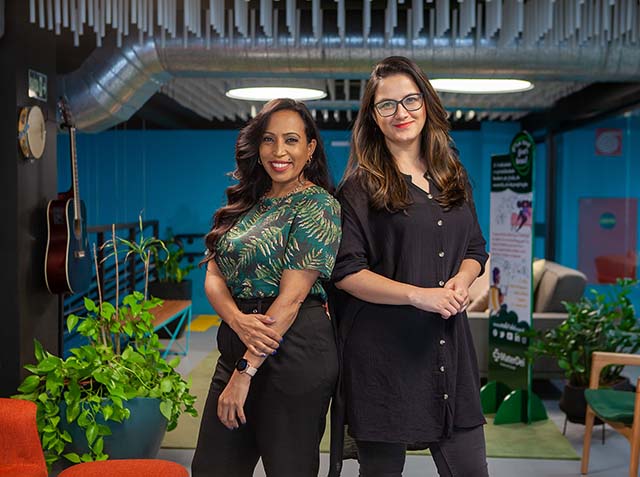
Carvalho’s route into the organisation had involved consulting for innovation hubs, including Órbi. Martins invited her to take on its executive leadership after one of those engagements. The relationship gives the succession a practical foundation: someone had done the work, and the founder had seen it. A leadership announcement is brief. Learning whom to trust takes longer.
There is a lighter glimpse of Martins in a February 2021 conversation with Marília Cordeiro, a friend from their Colégio Militar days. The podcast’s description records that Martins turned some of the interview back on her host. The guest did a little interviewing herself. It is a small, documented reversal, and a welcome departure from the immaculate one-way answers of the standard founder interview.
The difficult people part
In September 2020, Martins led a conversation with Patrimar’s Alex Veiga and Patrícia Veiga about the construction company’s past and future. Her presentation treated digital transformation as a question of mindset and culture, extending beyond learning to programme. The discussion put an established business’s identity alongside its plans to change. Technology was one participant in a more crowded conversation.
By Campus Party Brasília in March 2024, she was speaking directly about expectations. Her session addressed the expectations, needs and habits within entrepreneurial teams, and how managing them could support belonging and results. The event listed her as Relumi’s founder and as CRO at AI Networks Community. The subject suggests how much attention she gives to the human arrangements around technical work.
There is a useful impatience in choosing that topic for a technology gathering. A team can acquire a new tool quickly. Agreeing on what everyone expects from one another is slower, less photogenic work. Her proposed approach put those invisible demands on the agenda. Anyone who has left a meeting with five different interpretations of the decision can appreciate the appeal.
What to build after the meeting
Martins now leads Relumi, working alongside co-founder and COO Ricardo Barbosa. The consultancy combines futures thinking with revenue strategy, advisory work and business development. Its methods examine possible scenarios and changes in a company’s chain of value, then connect that thinking to decisions about growth. Her current work brings the language of the future into the less abstract business of choosing what to do next.
In her own introduction to Relumi, she also asked how a working culture could make room for people to feel whole and alive. Alongside the concern with sales and tangible value was a concern with belonging. It is an ambition consistent with the earlier shared tables: the arrangements of work influence the kind of life people can have inside it.
Her public activity in 2026 includes the Prêmio Inovativos and discussions of how artificial intelligence changes business value chains. The setting has changed since the startup café. The underlying question remains recognisable: who needs to be brought into the conversation, and what might become possible once they are there? Martins has built a career around attending to the answer after everyone has finished their coffee.