A school can give a student a report card, a timetable and a fairly impressive collection of instructions. Giving that student room to make a decision is a more delicate undertaking. Anjana Deva, principal of Crimson World School in Varanasi, has put that undertaking into a question: “What is right for YOU?”
She poses it to students considering their options after Class X. Her career-choice advice begins with strengths and interests, then moves through personality, passion and purpose. The order matters. Before a young person chooses a path, she asks them to pay attention to the person who will have to walk it.
There is a pleasing complication here. A principal occupies an office associated with answers: what to study, where to be, when to hand it in. Deva is using her public voice to return a question to the student. Read alongside the activities of the school she leads, that question offers a useful way into her work. The examination remains on the calendar. The child gets a say in what comes afterwards. It is a question with room for more than one answer.
A long apprenticeship in the school day
Deva’s working base is Varanasi, Uttar Pradesh. Her professional profile names Delhi University and records attendance from 1985 to 1988. The educational road that follows is better understood through her school appointments than through a collection of corporate statistics. Her work takes place among pupils, teachers and families.
Her published career record places her at The Aryan International School as vice principal from October 2002 to May 2010, followed by the CEO and principal role at Mount Litera Zee School, Varanasi, from June 2010 to April 2022. It lists her Crimson World School appointment from April 2022. These are substantial stretches of responsibility, rather than a succession of brief introductions.
The current CBSE school record names her as head of Crimson World School Varanasi and lists an M.A. qualification. It also records 30 years of teaching experience and 26 of administrative experience. Those figures overlap; they describe two kinds of work, rather than a sum to be added. Teaching and administration share a school day, even when they ask different things of the person doing them.
CBSE school record. The experience periods overlap.
The ambition behind the principal’s desk
In her principal’s message, Deva describes an earnest wish to lead an institution where human values belong inside education. She says that wish is taking shape at Crimson World School. Her account of education extends across academic study, the arts, sport, creativity, attitudes and the wider experience of living.
She names four qualities she wants children to carry into the world: resilience, collaboration, compassion and critical thinking. Together they make an interesting brief for a school leader. Collaboration requires attention to other people. Critical thinking requires permission to examine an answer. Compassion asks what a decision means for somebody else. These are demanding companions for a syllabus.
The message is also personal in its ownership of the aspiration. Deva writes as an educator who wanted to build a particular kind of institution. That gives the familiar language of school values a more concrete setting: a principal describing the purpose of the place she leads. The ambition is to educate a person whose abilities can travel beyond the classroom.
When the classroom acquired a screen
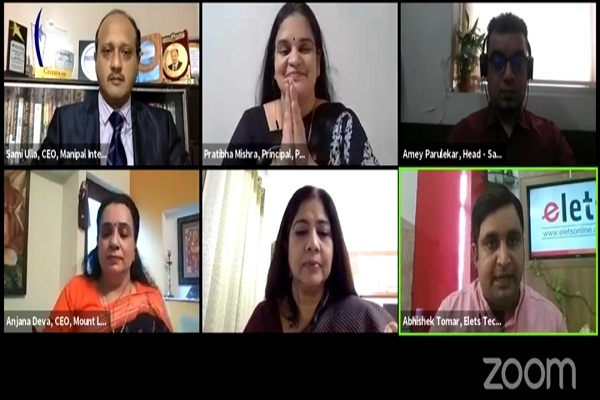
At a school technology summit in July 2020, Deva spoke as CEO of Mount Litera Zee School, Varanasi. She described the school beginning online classes on 2 April and identified the pre-primary stage as a particular challenge. Her remarks gave credit to teachers and to the patience of parents.
She also argued that hybrid learning would remain part of schooling, and that both schools and parents needed to become comfortable with technology. Her emphasis included mindset. A platform can be purchased; a family’s confidence in using it takes a different kind of work.
The photograph of that discussion has the ordinary furniture of an online meeting: six rectangles, participant labels and a dark strip below them. Deva appears in the lower-left panel. It is a modest visual record of school leadership being discussed through the same sort of screen on which lessons were taking place. The technology is visible. So are the people required to make it useful.
A badge, a flag and an obligation
On 9 September 2024, Crimson World School held its student council investiture for the 2024-25 session. The newly appointed members took their oaths under Deva’s lead. Swati Singh, a Zila Panchayat member, attended as chief guest.
The school flag went to head boy Samyak Srivastav and head girl Saanvi Agarwal. Badges were pinned, house captains received their flags, and the student leaders shared their mission and vision. The ceremony closed with a march past. Its vocabulary was responsibility as well as recognition.
School ceremonies can seem magnificently preoccupied with small pieces of metal. Yet the badge is only the visible part of the arrangement. An oath places an expectation beside an honour. Here, students were asked to speak about the values they would uphold. For a principal who includes collaboration in her educational aims, a council provides a setting in which pupils have roles to practise, commitments to make and other students to consider.
A result with a memory attached
Janhvi Kapoor’s public account of leaving Crimson World School provides another view of Deva’s role. Kapoor describes achieving 95.6 percent in her Class XII CBSE result and becoming the batch topper. She remembers a sticky note on her study table bearing a target of 96 percent.
The account reaches back to Class VIII, when she was working towards a place among the class’s top ten. Alongside thanks to her family, she remembers encouragement from the school’s CEO, Anjana Deva, from the time she entered its corridors. It is a student’s recollection of support over time.
A result statement supplies a number. A pupil’s memory supplies a relationship. The two belong together here without turning the pupil’s achievement into an adult’s trophy. Kapoor credits her own sustained work, and describes people who encouraged it. Deva’s place in that account is specific: a familiar school leader remembered for encouragement. The sticky note is the student’s. So is the achievement.
Summer homework makes room for a person
The 2026-27 Class XII commerce holiday assignment opens with a message signed by Deva. It asks parents to recognise differences in children’s strengths, interests and ways of learning. Its measure of potential includes growth and effort. One practical request is an uninterrupted hour of family time each day.
The work that follows includes an English presentation or collage, and an alternative ending to a story. Originality and creativity appear in the assessment criteria. The holiday still has assignments, of course. A school has not misplaced its notebooks. But the introductory message gives the work a wider purpose than keeping a student occupied.
The Class X holiday work for 2025-26 offers a related exercise: a portfolio with a self-description, plans and goals, and an account of a role model. These are small invitations to consider identity and influence. A page about the future self asks a pupil to imagine a life. A page about an influencer asks which example they are choosing to follow. Both make reflection something a student can actually sit down and do.
“What is right for YOU?”
Anjana Deva, on choosing a path after Class X
The wider conversation, and a local craft
Deva has also taken the discussion beyond her campus. In 2024, she participated in a World Conclave panel on technology leadership in global education, alongside Sunita Jain, Sambhav Jain and Isabel Swamy. Earlier, The Academic Insights included her, as CEO of Mount Litera Zee School Varanasi, in its list of 20 pragmatic women leaders in K12 education.
Closer to the pupils themselves, White Canvas India describes Crimson World School students developing Mritkala through its Young CEO programme. The initiative draws on the traditional art of Chunar and aims to create opportunities around local craftsmanship. The programme’s account identifies Deva among the school leadership pictured with the students.
The students’ work connects product development, branding and markets with an existing craft. Its appeal as an educational exercise is the number of questions it opens. Who makes the object? Who might buy it? What gives it value? A business pitch becomes an occasion to look at a community. Those are useful questions for young people practising how an idea might become something other people can use.
Leaving with a question of their own
At the Young CEO programme, students move from ideas towards products and presentations. At investiture, they accept public responsibilities. In a portfolio, they write about their future selves. The activities differ, but each provides a place for a young person to try out a decision before the stakes become larger.
This is a useful way to read Deva’s educational ambition. School supplies structure: deadlines, subjects, ceremonies, assignments. Within that structure, there can be room for a student to notice an interest, practise a responsibility or recognise somebody whose example matters. A timetable can make space for thought, even if it cannot do the thinking.
The adult’s task remains substantial. Choosing requires information, practice and the confidence to ask another question. Deva’s public career-choice advice leaves the choice with the young person. Her school’s documented activities give that advice a practical setting. When a student finally leaves the gate, the next answer will have to belong to them.