A cafeteria can look perfectly ordinary until someone asks whether it can be locked. At a Katonah-Lewisboro school board meeting in May 2013, John LaPlaca was concerned with precisely that question. Two elementary school cafeterias lacked walls or partitions that could close off the space. His firm's review proposed changes to buildings and visitor procedures. The problem was concrete, almost stubbornly so: a plan on paper could not supply a missing wall.
That small architectural detail offers a useful way into LaPlaca's working life. The founder and CEO of Altaris Consulting Group deals with the distance between an intention and something people can actually do. Schools want to be safe. Turning that desire into entrances, assignments, training and daily habits takes a different kind of attention. His public work keeps returning to the details that a broad declaration leaves behind.
At the same meeting, board members asked about priorities, cost, technology and school culture. LaPlaca cautioned against treating cameras as a preventative cure, given the difficulty of watching so many feeds. Those questions remain a useful frame for his career. Buying equipment is a decision with an invoice. Making a system work asks more of everyone involved.
A career with two calendars
LaPlaca's professional roots are in Yorktown, New York. The town's 2016 budget records his police department hire date as September 5, 1994. In July 2015, the town board appointed him police lieutenant, effective the following day. By the autumn of 2016, the board was approving a payment of unused time associated with his retirement. The dates describe a police career extending across roughly twenty-two years.
Altaris dates its beginnings to 2008. His consulting work was therefore already visible before the closing chapter of his police service. In 2013 he was addressing school boards as an Altaris managing partner; in 2015 he was being appointed lieutenant. The chronology has the untidiness of an actual working life. A business can begin while another career is still taking up space on the calendar.
The firm's founding premise was a workload problem. Through work with school administrators, LaPlaca recognized that responsibility for security often landed with people whose main job was education. Useful information existed in abundance. The time and expertise needed to organize it were harder to come by. Altaris developed a process intended to help districts carry the work through.
There is a quietly practical business idea here: help people finish what they already know matters. A long list of deficiencies can give a consultant a deliverable and leave a superintendent with another substantial job. LaPlaca's firm built its offering around the steps after the assessment, when recommendations have to compete for attention with the rest of a school district's day.
The question after the consultant leaves
In Scarsdale in 2018, the conversation became a debate about who would do the work. Board members were examining the case for a security director. They asked how that position would relate to Altaris, whether a school resource officer could fill the need, and how an additional expense should fit the budget. These were questions about responsibility as much as security.
LaPlaca explained that school resource officers and the people coordinating detailed security work had different functions. Officers could build relationships between students and the police. Emergency planning and training also required someone to handle tasks across buildings, with daily, monthly and annual obligations. Altaris might be available around the clock, but local coordination still needed a point person.
One board member pressed the issue of competing priorities: if this expense mattered so much, what other budget item should give way? That is the room in which LaPlaca's proposals have to function. A school board must weigh the proposal against other needs. Expertise has to survive questions about staffing, overlap and money.
His answer brought the discussion back to the labor involved. Someone has to coordinate the moving parts. A job title cannot, by itself, tell a district whether that work is covered. The episode gives his career a texture that a list of clients would miss: he has had to explain the practical boundaries of his service to people responsible for spending public funds.
At Haldane that December, superintendent Philip Benante introduced LaPlaca during a board workshop on school safety and facilities. LaPlaca presented his firm's services and took questions from the superintendent and trustees. It was another appearance in the ordinary machinery of district decision-making: an introduction, a proposal, questions. Such meetings make up a less theatrical part of a founder's career, but they show how a service enters a community. The people considering it need time to examine what is being offered.
A microphone in Bedford
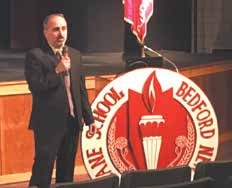
At a March 2018 forum at Fox Lane High School, LaPlaca appeared alongside school administrators and local law enforcement consultants to discuss Bedford's safety measures with parents. He pointed to a district relationship dating to 2013 and emphasized that Bedford had been working proactively. The event was a public conversation about work that was already underway.
The photograph captures a straightforward part of the job: standing before a school community with a microphone. Parents need an explanation of what is being done. Administrators have to describe changes. Consultants need to make the arrangements intelligible to people who encounter school buildings as families rather than as project plans.
That June, LaPlaca also joined a gathering at Lakeland-Copper Beech Middle School involving Senator Terrence Murphy, school officials and law enforcement. The coalition called for more school resource officers and additional support for districts investing in security technology. At the time, his work was described as reaching 200 schools in New York and Long Island. His working world extended from individual buildings to discussions about state support.
The front door is a group project
In Pleasantville, LaPlaca was a member of the Visitors Safety Task Force that helped review and revise school visitor protocols. The group included parents, school administrators, a facilities director, a teacher, a former student and other community members. Superintendent Tina DeSa announced the new arrangements in May 2023, with implementation the next day.
The changes were easy to describe: visitors would buzz at the main entrance, leave drop-off items in the vestibule, make appointments to meet staff and bring photo identification. Getting to that point had taken longer. The district had decided to update entrance technology the previous summer. The task force assembled in December. Equipment arrived in April, followed by configuration and implementation.
A buzzer is a small object with a surprisingly large supporting cast. In this case, the sequence included purchasing, review, delivery, protocols and communication with families. DeSa acknowledged that the new routine might be less convenient. LaPlaca's presence on the task force placed him inside that negotiation between an operating procedure and the people expected to use it.
Five words about technology
By January 2024, Altaris was working with about 75 districts across New York, New Jersey, Connecticut, Georgia and Los Angeles. At White Plains, an Altaris subcontractor, Jeremy Harrison, was embedded as a safety coordinator, working with district staff and local first responders. The arrangement put a person in the district to keep protocols and drills current and advise on the overall plan.
White Plains was also using artificial intelligence to help detect firearms through its existing camera system. LaPlaca supported another layer of detection while cautioning against complacency. His shortest explanation was memorable enough to stand on its own.
“Technology doesn't respond; humans do.”
John LaPlaca, January 2024
He also emphasized basic access controls, including knowing who held keys, keeping outside doors closed and locked, and considering after-hours activities and sporting events. The combination is revealing at the level of his public recommendations: new technology sits beside old questions about keys and doors. The building continues to need people who understand their responsibilities.
How a recommendation becomes a routine
Altaris organizes its published method around four stages: assessment, collaboration, project management and emergency planning. The sequence starts with finding opportunities, including changes that cost little or nothing. It then moves through agreement among decision-makers, implementation supported by a cloud-based project management system, and continuing training and plan revision. Each stage addresses a different reason a useful recommendation might stall.
A February 2025 presentation with Levittown schools put the firm's reach at more than 85 districts and more than 350 schools nationwide. It described coordinators checking in with administrators daily, holding weekly security discussions, arranging training and monitoring plans annually. It also described reassessing the district to review progress and identify new concerns.
The everyday cadence matters. Daily, weekly and annual tasks require different kinds of attention. A reassessment adds another obligation: looking again at a building and its arrangements after earlier recommendations have been addressed. The work has a rhythm that continues after a project is marked complete.
The recurring review is part of the story, too. A finished recommendation becomes a starting point for the next conversation about how the district operates.
That rhythm is a fitting place to leave LaPlaca's story. His public career connects police service, business ownership, boardroom questions and community meetings. Across those settings, the recurring subject is follow-through. The missing partition in a cafeteria, the person coordinating a district's plans, the visitor standing outside a locked entrance: each makes an abstract commitment tangible. Someone has to take the next step, and then remember to check it again.
Continue the conversation
- John LaPlaca on LinkedIn
- Altaris Consulting Group
- Podcast and interviews
- Video library
- Altaris on YouTube
- Altaris on Facebook
- Altaris on Twitter/X
- Altaris on LinkedIn
- Safer Schools blog
- Katonah-Lewisboro board discussion
- Scarsdale staffing discussion
- Bedford forum coverage
- Pleasantville visitor procedures
- Technology and school security
- Levittown district presentation
- ABC7 interview