The awkward thing about a large address book is that it cannot tell you who will pick up. Benoit Buridant built his working life around that gap. He arrived in the United States in 2009, trained in law and interested in starting businesses. By 2014, he was working full time on Frenchfounders, a club for French-speaking founders and executives. Its early promise was practical: put people with useful experience in reach of people who needed it. A new country supplies plenty of questions. Finding someone who has already answered one can spare a considerable amount of improvisation.
Buridant had noticed a community with energy and contacts, yet without a service that quite suited it. Existing French business clubs felt dated to him; LinkedIn felt broad and impersonal. There was room between those two experiences for something more deliberate. The membership would be selected. Introductions would have a purpose. People could meet in person and continue the relationship through a digital platform. The familiar business ritual of exchanging names would acquire a little more structure, and, ideally, a little less small talk.
His position today is co-founder and CEO of Frenchfounders, based in New York. The organization connects French-speaking leaders across countries and industries. Buridant's own story explains the choice of audience. He understood the experience of moving abroad, building a company, and learning how much local knowledge matters. His business would sell access to a community, but the useful unit inside that community was always smaller: one person who could help with one particular problem.
From Toulon to an American experiment
Born in Brest in 1985, Buridant grew up in Toulon. He studied law there before pursuing entrepreneurship in America. The move was intentional. He had visited the United States repeatedly and settled there at 23, drawn by the prospect of a greater challenge. “I always wanted to start my own business,” he said. The ambition preceded Frenchfounders; the club emerged from experience rather than from a lifelong plan to become a professional host.
French District, where he was an associate before leaving in 2013, served French-speaking residents and travelers in the United States. That work put him near a recurring set of questions about living and doing business abroad. It also gave him contacts. When Frenchfounders appeared, he could draw on relationships he had already made, alongside those of Vincent Deruelle, Eric Draghi and Philippe Finkelstein. Starting a business about networks with a network of your own is a helpful piece of preparation.
Buridant's account of American working culture was equally practical. He described a more iterative approach to building, a more direct working style and a greater appetite for risk. Those observations fit the sort of service he went on to develop: try a format, bring people together, learn whether the encounter was useful. A network is unusually exposed to its customers' judgment. A member who receives an irrelevant introduction does not need an elaborate dashboard to notice.
A club with a door policy
Frenchfounders was launched in 2014 with Deruelle. In the first months, Buridant described roughly a hundred members in places including New York, San Francisco, Los Angeles and Miami, with contacts extending to Canada and Brazil. The annual subscription then cost $599. Applicants needed to be founders, CEOs or executives playing a key role in a business. Membership had to offer something to the group as well as take something from it. The door policy was part of the proposition from the beginning.
The founders' early work included mapping the expatriate business community and organizing an initial gathering in a Chelsea loft. The account of that gathering is pleasingly domestic: about fifty people, with the founders handling shopping, service and memberships themselves. Before the international offices, someone had to do the groceries. That detail gives the enterprise a scale the later numbers can obscure. The first version of a global network could still be small enough for its founders to serve the drinks.
By July 2017, the company reported more than 2,000 members across 80 cities and 25 employees. Its offices included New York, San Francisco, Los Angeles, Paris, London, Shanghai and Hong Kong. The cities mattered because a business introduction is often a local problem wearing an international suit. An entrepreneur can understand a product thoroughly and still need someone who understands a particular market, a hiring decision or the way a commercial relationship begins there.
The people already had networks
In a 2019 interview about retail, Buridant made a revealing observation about the membership: these people already had large networks, traveled often and had little time. Frenchfounders was serving experienced people with crowded calendars. That changes the assignment. The value of an introduction depends on its relevance and timing. A conversation that might be useful next year can be an interruption this afternoon. For Buridant, organizing access meant paying attention to the question behind the request.
The club brought together executives from established businesses, startup founders and investors. A retail group, led at the time by Alain Bernard of Richemont's US business, gave members a place to discuss their sector. Around the National Retail Federation's New York gathering, Frenchfounders arranged conversations involving French and American retailers. Buridant talked about practical concerns such as payment experiences across online and physical shops. The network's language was shared; its commercial problems were varied.
The same principle was visible in other industries. In 2016, Buridant outlined a Smart Media event with Dailymotion, including talks from GlassView's James Brooks and Mediabong's Laurent Bury about digital video and attention. Its program ended with a cocktail. The order is instructive: give people something specific to discuss, then give them time to discuss it. An event has a better chance of producing a useful conversation when the conversation has already begun.
Toulon kept a place in the address book
International ambition did not erase Buridant's connection to southern France. In June 2017, he joined a video conversation from New York with businesspeople gathered in Avignon for the launch of a regional networking guide. He discussed entering the American market, the strengths of French entrepreneurs and the development of French Tech. The event's account described his willingness to help local entrepreneurs. An international club could still reach a room whose concerns began much closer to home.
In 2018, Frenchfounders helped Grand Sud Network bring a magazine celebrating business figures from Provence-Alpes-Côte d'Azur to New York. Ten regional companies were invited to pitch as part of the launch. The collaboration offered a concrete version of the bridge Buridant was building: businesses from a familiar French region meeting an audience across the Atlantic. The publication's event photographs show the less abstract side of business development, with people standing together, magazines in hand, after the arrangements have been made.
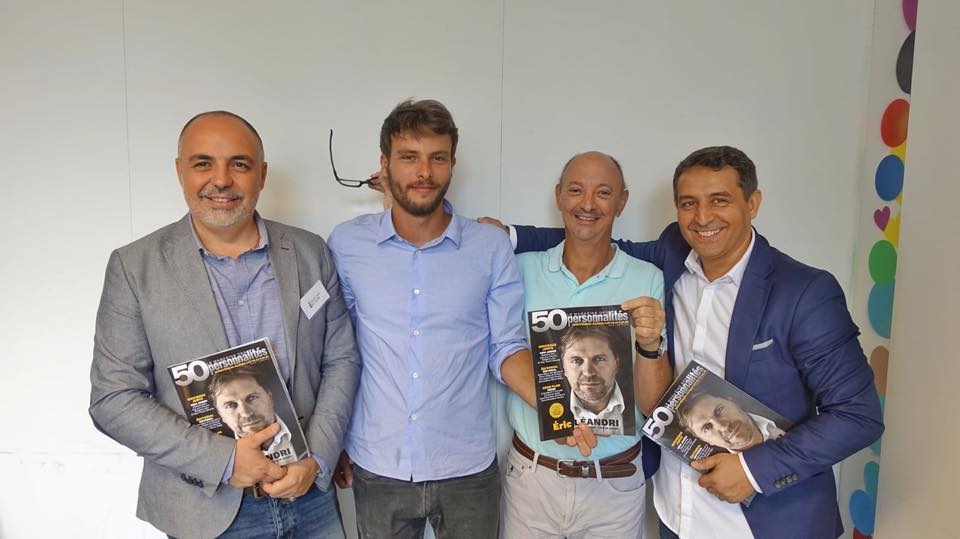
Away from the formal pitch, Buridant has publicly listed golf and travel among his interests. His suggestions for New York included Bryant Park, where outdoor films and pétanque could offer a French touch in Manhattan. It is a modest recommendation from someone selling international connections. A park, a game and a shared language can make a foreign city feel a little more usable. The skyline may advertise New York; ordinary encounters help people inhabit it.
When an introduction becomes a partnership
The network eventually attracted institutional partners. In December 2022, Tikehau Capital took a minority stake by purchasing an existing shareholder's holding. That transaction brought a new partner into the business. Mathieu Chabran, Tikehau's co-founder, said he had met Buridant on arriving in New York in 2018 and appreciated how he led the community. The relationship had its own history before it became a corporate announcement.
In January 2024, Frenchfounders raised €4.5 million in a round led by Bpifrance and Tikehau Capital. The accompanying plans included international business development for 40 startups and a CFO club connected to Bpifrance Le Hub. At the time, the broader network counted more than 25,000 leaders, including 4,000 members of the Club, across 19 cities. Those are different groups. The larger figure describes the wider network; the smaller one describes the selected membership at its center.
Investment also became part of the organization's activity. Buridant has described creating the Frenchfounders fund with Géraldine Le Meur and Deruelle. Recruitment and business development extended the original service into other decisions a founder has to make. His stated ambition in 2024 included supporting people through their careers, from leaving school to becoming business leaders. The idea of helping at the next difficult step had acquired a longer horizon.
Back to coffee, in 2026
In March 2026, Frenchfounders published an observatory of French-speaking leaders working internationally. It covered seven geographic zones. Among the respondents, 62% expressed confidence in their region's economic climate, while nine in ten considered sharing experience with peers important for validating strategic decisions. These are survey responses from that group, and they describe a persistent appetite for comparison, advice and perspective. More information is available than ever; people still want to know how another person made a decision.
Buridant attached a plain explanation to the release: sharing and mutual assistance were the reasons the club existed. It was a statement about what the organization should do with the knowledge it collected. The usefulness of a network grows when people bring experience back into it. That puts a demand on the organizer as well as on the members. Connections require upkeep. A list can sit still; a community needs reasons to return.
That same month, he was listed to introduce a Discovery Breakfast at Frenchfounders' New York offices. The schedule was wonderfully concrete: coffee, an introduction, breakfast and networking. Choc O Pain Bakery supplied the pastries. Twelve years after the launch, the invitation still depended on bringing people into a room and giving them a reason to speak. Buridant's business had accumulated platforms, partners and international reach. Somewhere in the middle of it, there was still a person asking another person what they were working on.