A T-shirt carrying a familiar character looks simple only after everyone has done their job. Before it reaches a rack, somebody has decided which story belongs with which customer, which retailer can give it a proper audience, what shape the product should take, and whether the calendar, factory and price can all be persuaded to agree. The finished garment may be casual. The chain of decisions behind it is dressed for work.
Angelina Yagudayev has spent more than a decade learning that chain from the inside. Mad Engine first brought her in to expand its sales presence in Canada. Her assignment did not remain a sales assignment for long. She came to lead the entire Canadian division, taking responsibility for sales, creative, production and operations - four functions that often speak in different dialects even when they are discussing the same shirt.
In September 2024, Mad Engine promoted her to chief merchandising officer. The new remit put the company's sales division across the United States, Canada and additional markets under her direction. A career that began with one country's growth brief had widened into the job of connecting brands, retail partners, teams and markets at global scale.
A market as an apprenticeship
Canada was more than a territory on Yagudayev's route upward. It was an operating education. Expanding a sales presence asks an executive to win accounts. Leading the division asks her to understand what happens after the promise is made. Creative teams need a useful brief. Production needs a feasible one. Operations must move the result through a system that does not care how charming the original idea sounded.
That sequence helps explain the particular value of her experience. She did not merely add departments to a title. She worked across functions that depend on one another. A retail commitment changes a production plan. A licensing condition shapes a design. A delivery window may improve or ruin the commercial opportunity. In fashion, taste receives the applause; timing quietly sends the invoice.
Mad Engine said Yagudayev helped turn its Canadian operation into one of the country's major distributors of licensed goods. The claim describes business growth, but the route matters as much as the destination. Distribution in this context is not simply the last mile. It is the outcome of repeatedly getting the match right: a property with a product, a product with a retailer, a retailer with an audience.
The useful art of the match
Licensed apparel begins with borrowed affection. A film, game or character arrives with an audience already attached. Recognition may open the door, but recognition alone cannot decide which product deserves to exist. The property must be translated for a category, channel and customer without flattening the thing people liked in the first place.
Mad Engine works across licensed, private-label, branded and creator-led products, serving channels that range from direct-to-consumer and e-commerce to mass retail, department stores and specialty shops. Each channel asks a different question of the same idea. A design suited to a specialist store may be wrong for a broad family retailer. A quick online moment may demand a tempo that a seasonal floor set does not. The merchandiser stands in the middle, holding enthusiasm in one hand and constraints in the other.
“She operates thoughtfully with intention and empathy.”Danish Gajiani, then CEO of Mad Engine, on Yagudayev's leadership
Gajiani also described her strength as identifying promising brands and pairing them with the right retail partner. Put those observations together and a distinct executive portrait appears: commercial judgment without the sharp elbows of caricature. Empathy matters because merchandising is a negotiation among people with legitimate but competing needs. The licensor protects a world. The designer wants coherence. The retailer wants movement. The production team wants reality.
One product, four simultaneous tests
The bars above are an editorial model, not company metrics. Their lesson is that no single score can rescue the others. A beautiful product that arrives late has missed its appointment. An efficient product with no emotional spark is merely punctual. The chief merchandising officer's work is to keep all four questions alive long enough to produce one convincing answer.
When the remit becomes a map
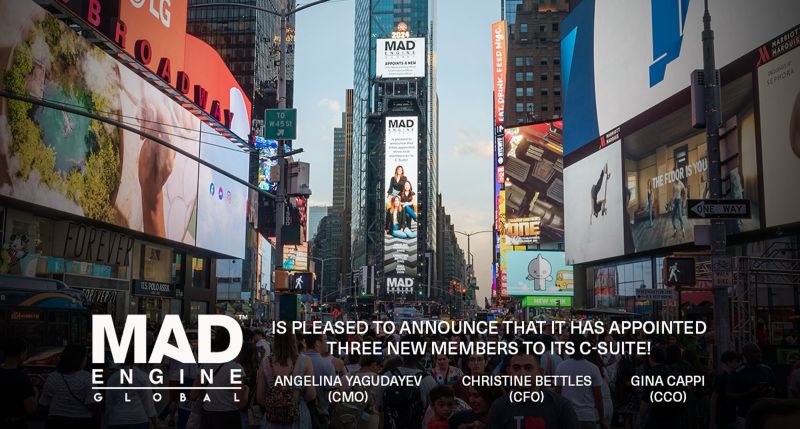
Yagudayev's promotion arrived with two other appointments: Christine Bettles as chief financial officer and Gina Cappi as chief creative officer. Mad Engine announced the trio on a Times Square billboard, a fittingly unsubtle location for a consumer-products company. Yet the useful detail was organizational. Merchandising, finance and creative leadership were being named together. Product requires imagination, but imagination needs a budget, a customer and a route to market.
As CMO, Yagudayev was charged with driving growth and sales strategy while overseeing the United States, Canada and international business. Scale complicates the match. A retail partner in one market may not serve the same audience in another. A property can be universal while its expression remains local. The executive's map therefore has two layers: the global logic of the brand and the local logic of the shelf.
Her public professional description calls her a passionate, dynamic executive with more than 15 years in retail. The visible career record supplies the less decorative version of those words. Passion meant staying close enough to the category to recognize opportunity. Dynamism meant widening from sales into the machinery that makes sales promises possible.
The education between departments
Long before the Times Square announcement, Yagudayev spent 1996 to 1998 at Seneca College of Applied Arts and Technology. The institution's name has a pleasing relevance to the career that followed: applied knowledge is exactly what merchandising demands. Theory can describe a market. An operator must still decide what to put in it on Tuesday morning, for a buyer with a budget and a customer with other plans.
Her later education happened inside an apparel company. Consider the difference between selling into a mass retailer and serving a specialty shop. The former can offer tremendous reach but demands clarity, consistency and operational muscle. The latter may address a narrower audience with a sharper point of view. Department stores, e-commerce and direct-to-consumer channels add their own clocks and conventions. Mad Engine works across all of them, which turns “sales” into a plural noun disguised as a singular one.
A chief merchandising officer spanning those channels cannot simply carry a winning item from one door to the next. The question changes with the room. Who is browsing here? What price feels native? How quickly does the assortment move? How much explaining can the product do for itself? The same licensed story may need a different silhouette, graphic treatment or product category before it can speak naturally to a new customer.
This is where Yagudayev's Canadian division experience becomes especially legible. Sales taught her to hear the retailer. Creative oversight brought her closer to how an idea becomes visible. Production replaced possibility with choices about what can be made. Operations supplied the final discipline: an item has to arrive, accurately and at scale. Each department corrected the blind spots of the others.
The pattern resembles a relay, but a relay race lets each runner release the baton. Apparel executives are less fortunate. The merchandising leader must remember the first promise even as the work reaches its fourth or fifth handoff. She has to preserve the reason for the product while allowing every practical expert to make it real. Too much purity and nothing ships. Too much compromise and nothing charms.
Yagudayev's title therefore sits at an interesting border. “Chief” suggests altitude. “Merchandising” insists on contact with the object, the account and the shopper. The role asks for a view broad enough to direct markets and specific enough to know why one partnership fits while another merely looks impressive in a presentation. It is strategy with a hangtag attached.
A million small proofs
One of Yagudayev's sparse public posts came during 2020, when she amplified Mad Engine's commitment to give one million fabric masks to charities and organizations supporting frontline and essential workers. “The world is in need,” she wrote, “and we all have to do our part.” The message is brief, but it rhymes with the empathy her colleague later used to describe her management.
Her online footprint otherwise reads like that of many operators: the company's milestones, the team's wins, the partnerships. She shared enthusiasm for a Lilly Singh collaboration at Canadian retailer Ardene. She celebrated a partnership with the creators We Wear Cute. In late 2025, she reposted Mad Engine's announcement that Warner Bros. Discovery Studios had named it Fashion Partner of the Year. The through-line is not personal display. It is the recurring act of connecting audience, creator, property and retailer.
That may be why the most transferable idea in Yagudayev's story is also the plainest. Careers become larger when responsibility becomes connected. She began with a market, then learned the handoffs around it. Sales led toward creative, production and operations; division leadership led toward a multi-market remit. The ladder was real, but so was the web.
A famous character on a shirt will always attract more immediate attention than the operating system behind it. That is the bargain of good merchandising. The customer sees a story they recognize. The retailer sees an item that belongs. The teams behind it see a hundred decisions resolved. And somewhere between affection and inventory, an executive has made the complicated thing look casual.