Aneesh Sathe had a problem with the clock. During his PhD at the National University of Singapore, analysing research images could consume weeks. He wrote a program to help. The task became a ten-minute job. There are many reasons to learn to code; getting several weeks of your life back is a persuasive one.
The interesting part is what followed. A shortcut through his own research became a route into building a company. Years later, the same researcher would be writing about the pleasure of getting lost. His career offers a useful complication to the usual story of efficiency: someone can want a computer to finish the tedious work and still want the rest of life to remain full of unexpected turns.
He co-founded Qritive with Kaveh Taghipour in 2017. Today he is based in San Diego and works as vice president of AI and data science at Qureator. Between those two company names lies a less easily filed set of interests: elaborate games, poetry, institutional history, personal websites, photography, and an experiment in making the machinery of civilization visible.
You could arrange these things into a tidy professional biography. You would lose some of the fun. Sathe gives the impression, through what he chooses to make and write, of someone who would like the filing cabinet to have a secret passage.
Learning the room, then changing it
Long before the startup, there were repeated moves. His father’s job took the family to a new city every three or four years, first within India and later beyond it. Home was happy and full of books. The world outside required fresh orientation. In his July 2026 essay about identity, Sathe describes arriving quietly, learning a place, and becoming more outgoing before the next departure.
He calls the ways he adapted masks: borrowed mannerisms and temporary ways of carrying himself. He now describes confidence, sociability, and occasional defiance as closer to his own character. These are his reflections on his past, rather than a personality test administered from a distance.
The timing gives the professional biography a human dimension. After his doctorate, he felt able to shed some of that protective posturing. Entrepreneurship followed; later came a return toward science and technology. His preferred description of himself is a “tech-obsessed geek.” It is considerably more comfortable than a title that requires a conference badge.
The appeal of this account is its lack of a neat victory scene. Learning how to enter a room remains part of a life spent entering new fields. A founder’s photograph shows the person after he has found his footing. His essay remembers the orientation period.
Two researchers, one unfamiliar job
Sathe’s academic route began with a dual-degree programme at Savitribai Phule Pune University in 2003. A research-assistant role in Bangalore followed in 2008. In 2009 he began his doctorate in mechanobiology at NUS. He also co-founded SiCel Innovations in 2013, working on microfluidic applications before the business became a consultancy.
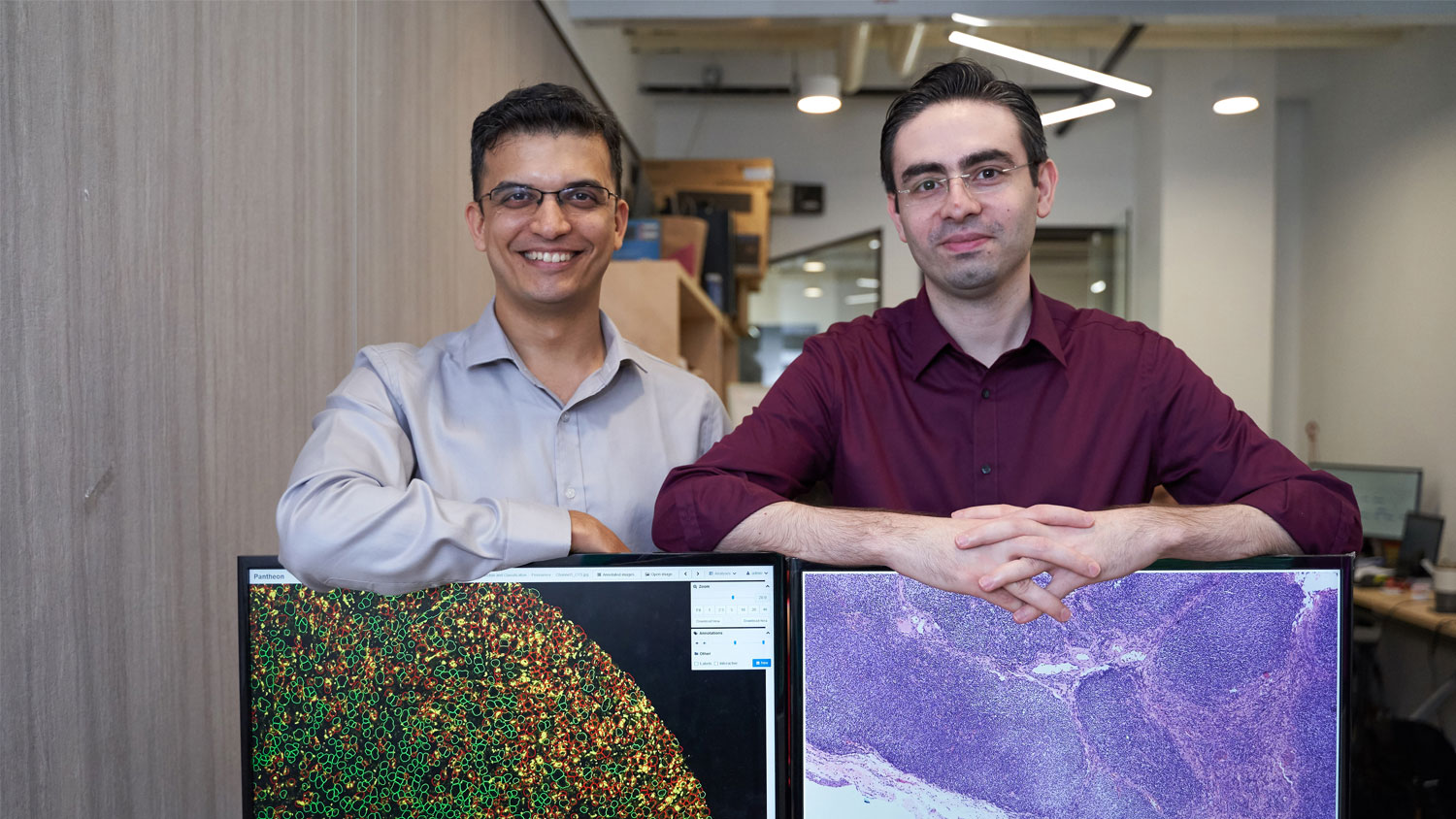
At NUS he met Taghipour, who was pursuing a computer-science doctorate. Their eventual partnership brought together different research backgrounds. The image-analysis work offered a practical opening, but company building introduced unfamiliar work of its own.
The pair recognised gaps in business development and commercialization. SGInnovate helped with guidance, hiring, and introductions. That detail matters because it gives the origin story colleagues and infrastructure. An algorithm can be written by a small team; getting a business to function requires people who understand jobs the researchers have barely begun to learn.
Sathe’s ten-minute result is satisfying because it has a finish line. The work of founding a company keeps moving that line. Hiring changes what a team can attempt. A conversation changes the problem it thinks it is solving. The researcher has to learn to ask questions beyond the ones that first made the software useful.
The conversation is part of the product
In a 2020 interview, Sathe was unusually direct about a familiar trap: scientists can build a solution and then look for someone who needs it. He advised innovators to understand the customer’s exact problem and to prioritise. Leaving the office and laboratory was part of how his team learned.
He also put communication near the centre of company life. Founders need to understand one another’s needs. Customers and collaborators help a business notice changing conditions. Investors need to understand the decisions. Team members need enough shared purpose to take initiative. In his account, conversation does practical work.
This is a useful counterweight to the romance of the solitary technical founder. A clever program has no automatic knowledge of the organization around it. Someone has to explain, listen, revise, and sometimes admit that the elegant answer was aimed at the wrong question.
By January 2023, Qritive had announced a $7.5 million funding round, with plans for geographical expansion and a broader product portfolio. Money gave the company room to proceed. The earlier lessons about finding the right problem remained relevant: a larger budget still has to be spent on something people will use.
A game with no tidy ending
There is another way into Sathe’s working imagination. In January 2025 he wrote an essay connecting Dwarf Fortress, Emacs, and AI. The three had held his attention for more than a decade. He was interested in systems whose possibilities keep opening as you learn them.
His distinction was between mastering a complicated apparatus and exploring a system that can produce surprising behaviour. He described the attraction in terms of creativity, patience, and experimentation. A small success changes what a person thinks might be possible next.
That is a revealing preference for someone whose early programming story turns on saving time. Some tools remove friction; others reward staying with the difficulty. Sathe’s interests make room for both. The attraction is the moment when understanding lets you attempt something you had not imagined attempting.
The joke practically supplies itself: an AI executive relaxes with software that asks him to learn still more software. Yet the appeal is understandable. A pastime can offer the freedom to experiment without having to turn every discovery into a quarterly objective. Sometimes an absorbing problem is allowed to remain absorbing.
“tech-obsessed geek”Aneesh Sathe, on himself
The bookshelf refuses a department
His public library keeps philosophy, fiction, poetry, history, and games close together. Its reading entries include Montaigne, Neal Stephenson, Fernand Braudel, Mary Oliver, and Billy Collins. Dwarf Fortress is marked as an all-time favourite. The page also makes room for Terry Pratchett’s Discworld series.
A list of books cannot tell us everything about the reader. It can show what he is willing to keep in view. Here, the range resists the narrow reading list one might expect beside a technical biography. A history of institutions can sit near an invented world; poetry can share the shelf with a question about causality.
His June 2024 essay on composable knowledge considered how ideas become easier to transmit and recombine. He traced that interest through successive forms of communication and storage, toward digital systems. The recurring concern was how one piece of understanding becomes usable somewhere else.
The relationship between the library and the technical work is suggestive. A reader crossing between subjects encounters unfamiliar vocabulary. A builder connecting datasets faces another version of that difficulty. Both activities reward keeping track of context. The analogy need not become a grand theory to explain why this particular bookshelf belongs beside this particular career.
Civilization, with a time slider
Sathe writes with the Protocol Institute on World Machines. His associated project, Prime Radiant, turns questions about institutional change into an interface. Its chart runs from 1200 to 2400 and lets a visitor move through time while exploring different classes of institutions.
The project treats such things as companies, states, and cloud platforms as machinery that can be described and related. Historical material and extrapolated futures occupy the same navigable space, with the speculative portions identified. The site describes the chart as revisable, rather than presenting it as a prediction to be accepted on faith.
There is a certain charm in giving a large intellectual question a slider. The visitor can move it, inspect it, and ask what the arrangement implies. An abstraction becomes something to handle. That does not settle the argument; it makes the argument easier to enter.
Another project, Invisible Cities, approaches the web through literature. Personal sites, blogs, channels, and webcomics are described as imagined cities in the manner of Italo Calvino. A directory acquires atmosphere. The question becomes where a visitor might want to spend time, as well as which link a visitor might want to click.
Leaving the feed, keeping the neighbours
In August 2026, Sathe wrote about moving away from platforms and toward his own blog. He valued control over the shape of a website, the ability to keep his content, and the freedom to write without organizing everything around engagement. At that point, the blog cross-posted to Bluesky and Mastodon.
He was participating in Blaugust, a month of blogging, and wanted to try shorter, easier posts alongside the essays. The idea was presence and practice. A personal site permits changes of scale: a long argument one day, a passing observation the next.
Those observations can be entertainingly ordinary. In an August 2025 note he praised Godzilla Minus One. In September 2026, a scene from Matrix Reloaded prompted him to say he missed his motorcycle. The person building models of institutions also has time for a good film sequence.
There is something hospitable about this arrangement. A visitor encounters a technical studio, a library, photographs, notes, and essays without each item having to justify its place in a single professional narrative. The site resembles a home with several occupied rooms. You can arrive for one subject and notice another on the way through.
A useful boundary, an open door
His August 2026 writing on scientific AI proposes a careful division of responsibility. Software can coordinate tasks, retrieve evidence, and run tools. Claims need checks and a traceable record. People remain responsible for framing questions and making consequential decisions. His compact rule is: “Agents can own workflows. They should not own truth.”
The technical project puts boundaries around what a system may do. His essay Nakatomi Drift asks how a person might discover routes beyond familiar intellectual boundaries. Drawing on geography, philosophy, and the architecture of Die Hard, he explores the value of approaching ideas through unexpected connections.
The pairing makes his interests more legible. Reliable work needs a record someone else can inspect. Exploration needs permission to follow an unforeseen connection. One activity gives a result its footing; the other allows the question to change.
Sathe’s story began here with weeks recovered from an analytical task. It ends with a person who has found plenty to do with time: build a team, change roles, write an essay, make a chart, keep a library, follow a strange link. The shortcut was useful. So are the passages that take a little longer to walk through.
Keep wandering
Open his personal site, library, photography portfolio, or technical Studio.
Explore Prime Radiant and Invisible Cities. Read Nakatomi Drift and his 2020 founder interview.