Andy Rubenstein’s business can be measured in tens of thousands of gaming terminals. It can also be understood by looking at a few square feet inside a neighborhood establishment. That smaller unit explains much of his career: find room for a machine, arrange the partnership, keep the equipment working, and give the owner a reason to keep doing business with you. Repeat the process across a state. Then learn how to repeat it somewhere else.
Rubenstein founded Accel Entertainment in 2009. By the end of June 2026, the company reported 29,281 terminals at 4,676 locations. Along the way, the former liquor retailer became the chief executive of a publicly traded gaming company. In August 2026, he passed the CEO job to Mark Phelan and continued as chairman. The change of title invites a look at how he got there, one local address at a time.
The shopkeeper before the stock ticker
His early résumé gives the story a useful starting point. Rubenstein earned an honors bachelor’s degree in economics and a master’s in international finance and economics at Brandeis University. He began his career in consulting at Arthur Andersen. Before Accel, he was an owner and operator of Super Liquors in central Illinois, as well as a co-owner and executive of Seven, LLC.
Liquor retail belongs in this account because it puts an actual counter in front of the economics degrees. A retailer has premises, customers and a limited amount of space. Accel would later offer its partners a way to earn gaming revenue within establishments they already operated. Rubenstein’s career moved between finance and that everyday retail setting. The combination is more revealing than the executive title alone.
His brother Gordon was a co-founder of Accel and remains its vice chairman. The brothers’ roles should be kept distinct: Andy led the operating company as CEO; Gordon served on the board. The enterprise had a family connection from its beginning, then acquired the management and governance of a public company. A familiar surname would eventually sit beside an unfamiliar ticker: ACEL.
Founded in 2009. Switched on in 2012.
The founding date and the operating launch were separated by several years. Accel received its Illinois terminal operator’s license in March 2012. Video gaming at licensed establishments across the state went live that October. A business formed in 2009 finally had an operating market in which its equipment could begin earning money.
Those dates put regulation inside the origin story. In this industry, finding a willing customer is only part of the job. Permission matters, and so does the sequence in which it arrives. The opportunity the Rubensteins pursued required an operator capable of working within the rules while developing relationships with establishments that would host the terminals.
By June 2019, Accel described a network of more than 8,000 machines in over 1,700 locations. Its partners included bars, restaurants, convenience stores and truck stops. The company entered long-term agreements with location owners. The proposition was concrete: bring equipment and operating support into a business where customers already spent time. There was no need to persuade every customer to make a special journey.
A bell, and something to buy with
In November 2019, Rubenstein and his colleagues gathered at the New York Stock Exchange. The photograph is delightfully less restrained than an earnings presentation: raised fists, applause, suits enjoying their day out. Accel’s combination with TPG Pace had closed on November 20. Trading under ACEL began the following day.
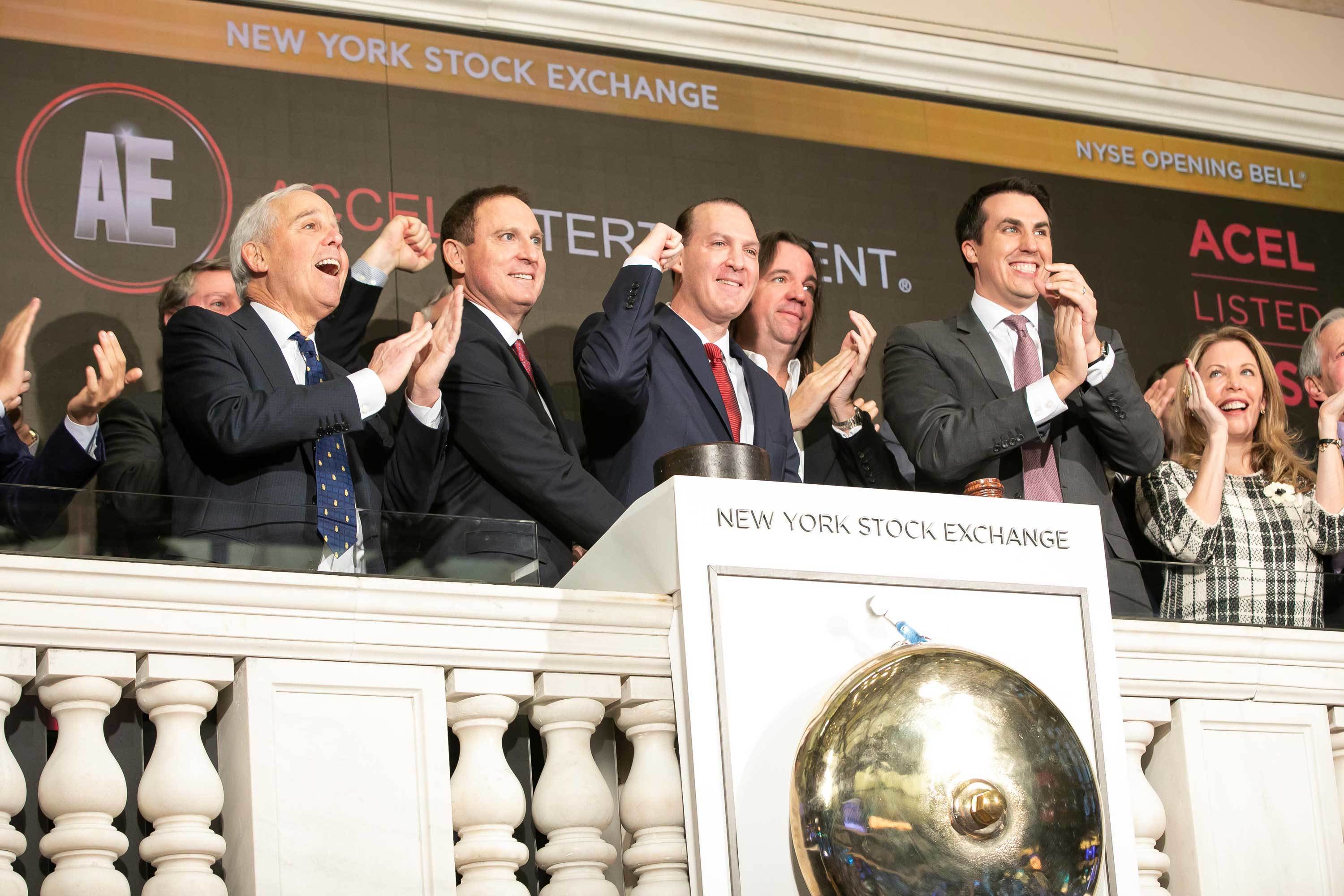
Months earlier, Rubenstein had explained what he wanted the transaction to accomplish. Public status would help the company expand, and its shares could be used in acquisitions. There was a regulatory argument, too. He said: “Regulators like the transparency of public companies and a listed stock currency will certainly help us consolidate faster.”
“Regulators like the transparency of public companies and a listed stock currency will certainly help us consolidate faster.”
Andy Rubenstein · June 2019
That sentence is a compact description of the business he was building. Capital, regulatory acceptance and the ability to acquire other operators had to work together. The exchange offered a way to connect them. The June announcement put the anticipated initial enterprise value of the combined company at approximately $884 million. For the neighborhood gaming operation, the financing had become rather less neighborhood-sized.
The service call behind the screen
The machine is the part a player sees. Accel’s operating work includes installing, maintaining and servicing terminals and related equipment, handling redemption devices and providing cash logistics. Data analysis and reporting sit alongside the physical work. These are recurring responsibilities attached to physical addresses, with location owners expecting the equipment to function.
The company also supplies amusement equipment, including jukeboxes, dartboards and pool tables. In describing that business, Accel has explained that these services provide continuing contact with customers. It is an instructive detail. A pool table may be a modest item beside a public company’s revenue figure, but it gives the operator another reason to be useful to the establishment.
There are operating advantages to a network. Machines can be moved to locations where they are needed, and access to parts helps keep equipment in use. Procurement, maintenance and customer contact become connected jobs. A gaming business can sound rather abstract when described through financial multiples. Introduce a broken machine and a business owner waiting for help, and the practical requirements become clear enough.
A longer route west, then south
Expansion took Rubenstein beyond the Illinois model. Accel closed its Century acquisition on June 1, 2022, bringing operations in Nevada and Montana into the business. Century’s existing management continued to operate it. The transaction gave Accel a presence in established gaming markets, with local teams already doing the work.
Other markets needed time. Discussing Nebraska in 2022, Rubenstein described customer play as below the company’s more established markets and pointed to the operating approach developed in Illinois. The distinction mattered. Entering another state did not mean inheriting the same customers, the same maturity or the same immediate results. Geographic expansion came with separate learning curves.
Louisiana followed in 2024. Accel bought 85% of Toucan Gaming and LSM Gaming for approximately $40 million. The combined business kept the Toucan name. Stan Guidroz retained 15% and remained in charge. That arrangement is a particularly clear example of the company’s method: acquire a controlling interest while keeping an experienced local operator involved.
The Louisiana transaction included truck stop locations and smaller establishments with three machines each. Those details make the national map tangible. Expansion could involve a cluster of terminals in a modest premises as readily as a conspicuous new property. Under Rubenstein, Accel’s reach widened through a collection of businesses whose individual footprints often remained quite small.
Then came the horses
The 2024 agreement to acquire Fairmount Holdings introduced a different setting: a racetrack in Collinsville, Illinois, serving the greater St. Louis area. The announced consideration was roughly 3.45 million Accel shares, worth approximately $35 million at the stated reference price. The property also brought a casino development opportunity and a sports wagering relationship with FanDuel.
For a company associated with routes of machines, Fairmount was a conspicuous address. The plan included casino construction, improvements to the racing experience and food and beverage amenities. Accel engaged casino development and operating expertise, including Tony Rodio and Holly Gagnon. A larger venue brought a different set of people and responsibilities around the table.
Rubenstein ended the acquisition call with a straightforward invitation: “We welcome you to come visit the track.” After the capital allocation discussion, it was a pleasingly practical instruction. There was somewhere to go and something to see. Fairmount Park’s casino opened in April 2025, adding another chapter to the company’s local gaming ambitions.
Financing continued to support the broader operation. In September 2025, Accel completed a $900 million credit facility consisting of a revolving facility and a term loan. Rubenstein described it as a way to support investment in distributed gaming, Fairmount and targeted growth opportunities. The ambitions had widened considerably from the first Illinois installations.
The founder changes seats
Accel finished 2025 with approximately $1.331 billion in revenue and $51.3 million in net income. Those figures describe the company, rather than Rubenstein’s personal finances. They also show how much operating weight had accumulated around a business that began with a state-specific opening seventeen years earlier.
In February 2026, the company named Rubenstein chairman and announced the succession to Phelan. Rubenstein pointed to the depth of the management team after seventeen years. His continuing contribution would include the local and industry relationships and regulatory experience developed during that period. Phelan took over as CEO and president on August 7.
The June 2026 terminal and location totals give the handoff a physical scale. Thousands of establishments still needed service, equipment and attention. Rubenstein remained connected to that work through the board and an advisory role. The founder had changed seats in a business whose daily obligations continued to arrive at thousands of separate doors.
His career leaves a concrete picture: economics degrees, liquor stores, an Illinois gaming license, an exchange balcony, a racetrack invitation. The connecting thread is the place where a customer actually turns up. Rubenstein’s company grew into a national operation by organizing the work around those places. However large the financial statements became, someone still had to answer the next service call.