THE CUSTOMER GETS A CHAIR
Andriy Logvyn has an unusual way of seating a meeting. At Kasta, he says, one chair is left empty for the customer. Everyone else can arrive with a budget, a forecast or a persuasive explanation of why a project deserves another month. The absent guest has a simpler concern: will any of this make buying something easier? It is a useful person to invite. They never need a slide deck.
That small piece of meeting furniture offers a way into a career spent changing the shape of a company. Logvyn co-founded the Ukrainian shopping business known first as ModnaKasta. It has since sold discounted fashion, broadened its assortment, developed delivery and payment services, and introduced a shopping app with banking features. The name has become shorter. The job description has expanded considerably.
In April 2026, he described Kasta's e-commerce operation as still short of profitability, though close to breaking even. He also said the company's immediate focus was Ukraine. These are useful coordinates for understanding him: an entrepreneur with an international ambition, working on a very specific domestic business, whose next transformation still has to earn its keep.
Before the clothes, the cables
Logvyn was born in Donetsk on 24 August 1980. His education took in law, business administration and an MBA at Kyiv-Mohyla Business School. Before shoppers knew his name, he worked in telecommunications, serving as general director of CDMA Ukraine from 2007 to 2011. His first industry involved getting people connected. The next would involve persuading them to do something with that connection.
He remembers opening an internet-provider business at 17. His early encounter with the internet came in a café in England, before Google, when the possibility of reaching across the world from a single seat struck him as extraordinary. Watching traffic grow in telecom gave him a reason to look beyond the pipes. There would be businesses inside this network worth building.
His account of the move into retail includes a friend, a flight to Istanbul in 2010, and an investor willing to put up $500,000. Afterwards, the friend wondered how the investor could be sure they would not buy two BMWs. Logvyn's answer was that they had promised not to. An investment committee might prefer a longer explanation. The anecdote has the advantage of being memorable.
A dress is a surprisingly technical problem
The first proposition was straightforward: branded clothes at attractive prices. Kasta dates its founding to 2010. The flash-sale format gave shoppers a reason to return for changing offers. It also placed Logvyn in a category where a picture cannot settle every question. A dress has a size, a fit, a texture and a buyer who may reasonably want to try it on before making peace with it.
That problem kept pulling the business beyond the screen. In 2019, Kasta introduced KastaID, a service using facial recognition to identify customers and let them try an order before paying for the items they kept. Whatever one makes of the mechanism, the question behind it was practical: how could an online order acquire some of the reassurance of a fitting room?
In 2020, Logvyn described the infrastructure behind another deceptively small promise: returning a customer's money in four minutes. Kasta had built fitting rooms into its pickup network and created KastaPay, a separate financial company. Fast refunds required work across payments and physical delivery. A customer could experience the result as a brief, pleasant absence of inconvenience.
He also separated online retail into four working parts: technology and product, content, marketing, and service. Under service sat the awkward business of moving both money and goods. It is a useful corrective to the idea that opening a shop online mostly involves opening a website. The website gets the photograph. Everything else has to get the parcel home.
The refund time Logvyn described. Behind it: fitting rooms, delivery operations and KastaPay.
The shop stops closing its shelves
By 2018, the company was changing its name and its trading model. ModnaKasta became Kasta. Daily promotional offers gave way to a continuously available range, stretching beyond clothing and shoes. The retail association's account of that change makes the distinction clear: the business wanted to become an entry point for other retailers and a place customers could use for more of everyday life.
There is an unglamorous difficulty hidden in that move. A flash sale can concentrate attention on what happens to be available today. A broader marketplace invites a different expectation: the thing a shopper needs ought to be there when they need it. More choice is a promise with operational consequences. It creates a longer list of opportunities to disappoint someone.
Logvyn was already looking at the economics of this larger machine in his 2021 writing. He described rising customer-acquisition costs and a future in which shopping, financial services and logistics would gather inside broader apps. He pointed to Amazon's mix of businesses and to Kazakhstan's Kaspi. The later banking ambitions had a public prehistory; they did not suddenly arrive with an orange logo.
- 2010Flash salesDiscounted branded fashion
- 2018A wider shopA permanent, broader assortment
- 2025Shopping + bankingThe SuperApp direction
Milestones in the customer offer, not three overnight switches.
When rebuilding becomes compulsory
Then came Russia's full-scale invasion of Ukraine. The chronology of Kasta's 2022 crisis is brutal: an investor agreement on 23 February, followed by a business that came close to bankruptcy by August. Logvyn's subsequent account centred on changing the model again. In wartime, the freedom to choose a convenient moment for reorganisation was scarcely part of the offer.
By 2023, Kasta recorded revenue of 1 billion hryvnias and ranked thirteenth in a list of Ukraine's thirty largest online sellers. Those figures describe a business still trading after a severe rupture. They do not tell us that every problem had been solved. Survival and a satisfactory operating model are separate achievements, and the second can take considerably longer.
The habit of rebuilding also changes what it means to be a founder. A familiar process acquires defenders because people have learned it, invested in it and made it work. Replacing it asks them to surrender some of that competence. Logvyn's career makes that tension unusually visible: the company has kept its connection to shopping while repeatedly revising how the work gets done.
Orange, with a bank attached
On 1 August 2025, Logvyn presented another version of Kasta. He appeared in denim shorts, a white T-shirt and running shoes as the company replaced its traditional black identity with bright orange. The wardrobe was modest for an announcement involving a marketplace, a payment card and a super app. At least the shoes were suitable for another long stretch.
The launch followed DCH's purchase of a majority stake. Planned investment was $120 million over three years, a forward commitment rather than a sum to confuse with money already spent. The new direction combined commerce with financial services, including a Kasta Visa card developed with Bank Credit Dnipro and Visa. For a founder accustomed to changing the machinery, this was a substantial addition.
The practical idea is that shopping and paying can reinforce each other inside one app. Kasta's current offering includes cashback, a Black subscription with delivery and return benefits, and instalment options. Its own company page lists five million products and nineteen thousand brands. The consumer proposition has travelled a considerable distance from waiting for the next batch of discounted clothes.
A super app is also a demanding promise to put on a phone. Each additional function has to justify its presence. A customer who came to find shoes is unlikely to admire organisational complexity for its own sake. Logvyn's wager depends on the extra machinery producing a service that feels simpler at the point of use.
Learning to leave the room
There is a revealing earlier episode in his management education. In 2018, he attended the Stanford Executive Program. He initially tried to keep steering Kasta from abroad, then became absorbed in the course. On returning, he found the company had continued to function. His own account acknowledged that he had feared it might fall apart without him.
For a founder, that is a particularly useful discovery to bring home from an expensive course. An organisation that requires its creator's constant intervention places a ceiling on what the creator can do next. Logvyn's example gives the usual praise of delegation a concrete test: leave long enough for other people to run the business, then look at what actually happened.
His more recent hiring criteria are concise: intelligence, energy and honesty. He has also described wanting an interview to leave him with a fresh view of a problem. That makes recruitment an opportunity to learn as well as to judge. It asks something of the person on each side of the table.
Forcing yourself to think deeply is already a competitive advantage.
Andriy Logvyn · April 2026
Translated from Ukrainian
A longer game, a smaller unit of progress
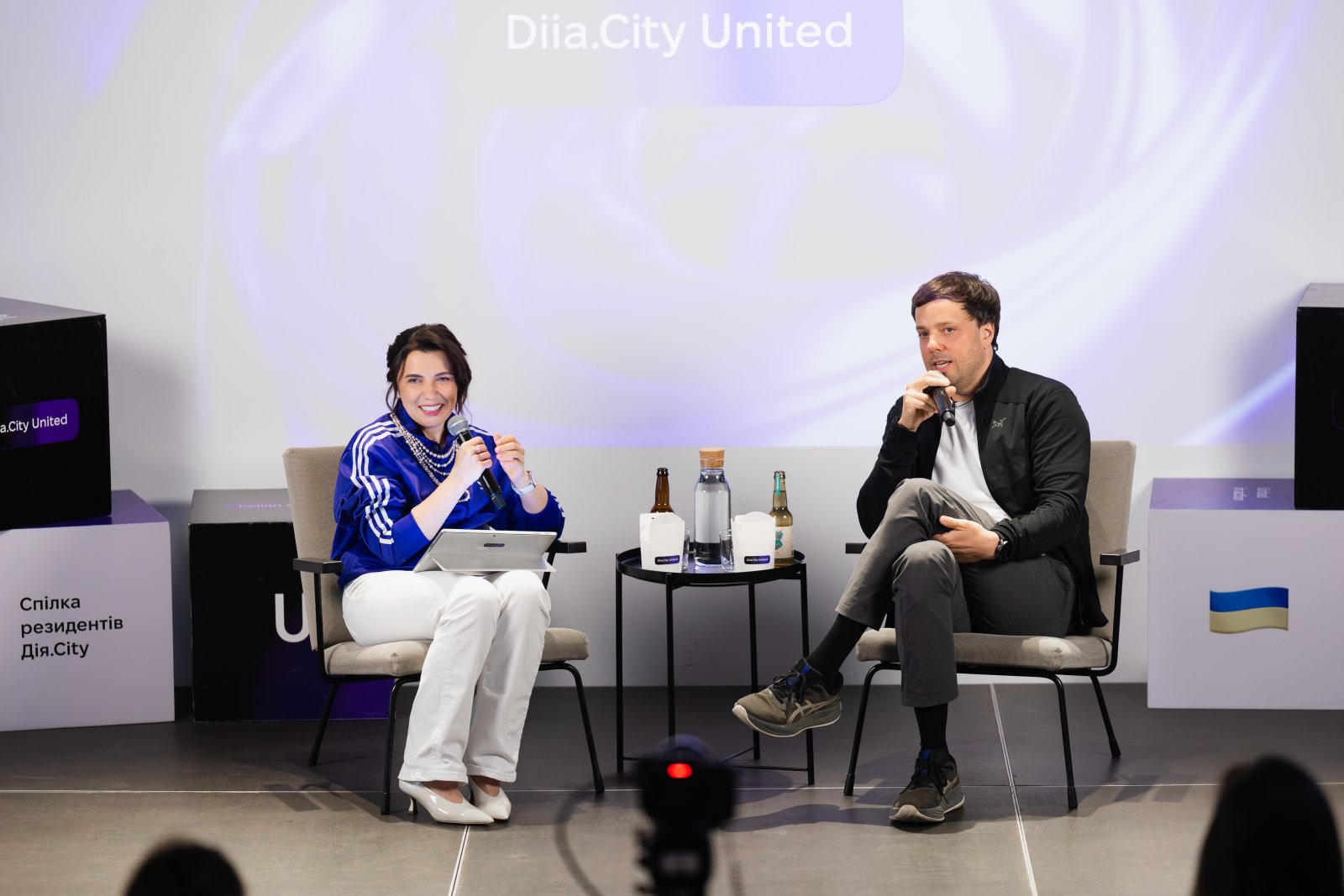
By April 2026, Logvyn was discussing these decisions with Diia.City United, whose strategic board he had joined. The conversation moved from company survival to responsibility and Ukraine's economic future. He argued that enterprise matters to the country's strength, and that learning remains a personal obligation even when circumstances are difficult.
“Forcing yourself to think deeply is already a competitive advantage,” he said. It is an interesting sentence from someone whose working life rewards speed. Thought takes time; retail keeps asking for an answer. His task is to preserve enough attention to choose a direction while keeping a business in motion.
His stated aspiration is to help demonstrate that people in Ukraine can build internationally significant products. The ambition is larger than a clothing category, but it has to pass through mundane tests: an order that arrives, a refund that clears, a customer who returns. That is where the public dream meets the operating business.
And the empty chair remains a good place to end. The person it represents owes no loyalty to an old business model, a new colour or a founder's favourite analogy. They can simply shop elsewhere. Keeping that person in the room gives Logvyn a reason to keep changing his mind, and a fairly strict way to decide whether the latest change was worth making.
Continue the conversation
INTERVIEWS, IDEAS & THE WORK ITSELF