Andrew Sachs had spent years working in technology, where getting people to solve a problem together was part of the job. Then his daughter, a strong student, made an awkward observation about school. She disliked group projects. Here was a young person doing well at the very institution meant to prepare her for the world, learning to resent one of the ways that world worked.
For a parent, this might have been an invitation to complain about homework. Sachs treated it as a design problem. His children were encountering incentives that rewarded individual performance while making cooperation feel like an inconvenience. A clever student could get ahead by becoming very good at carrying the work. Helping another person learn was harder to fit into the marking scheme.
He returned to that concern publicly in August 2024, describing how his children had become reluctant to ask questions, help others or enjoy teamwork. The sting was that they were attending what he considered a good school. Success within the system could coexist with habits he thought would serve them poorly beyond it. The report card and the working world seemed to be marking different assignments.
Sachs is the founder and CEO of Nobel Learning PBC, which operates as Nobel Navigators. The organization connects young people internationally through collaborative learning and leadership practice. Its premise carries the unmistakable imprint of a father who has heard enough about a miserable group assignment: give learners something worth doing together, then let them take responsibility for helping the next person.
What happens when helping someone else learn becomes part of your own education?
A math geek learns to listen
There is a useful wrinkle in his argument for cooperation. Sachs describes himself as a math geek whose early recognition came from individual achievement. His own introduction to the value of people skills arrived through a supportive workgroup. He has characterized that experience as a kind of informal boot camp. The technical person advocating empathy had needed lessons himself.
His career gave those lessons somewhere to land. Before Nobel, Sachs worked in broadcast technology at Volicon, where he became vice president of product management. By 2014, he was explaining tools that helped broadcasters capture and reuse television content. A collaboration with Adobe brought recorded broadcasts into Premiere Pro CC, giving production teams a quicker route from something aired to something edited and ready to use again.
This was a practical world of workflows, viewers and deadlines. In 2015, he was listed among the presenters at PBS TechCon for a session on closed-captioning quality. The job involved bringing engineering into contact with the needs of people making and distributing programs. A system had to work for its users as well as for the people who could explain its circuitry.
By 2016, his scheduled NAB presentations ranged across editing for social platforms and broadcast monitoring. These are unglamorous details in a founder biography, which is precisely why they help. Sachs came to education after dealing with technology as something people must actually use together. His later emphasis on communication makes sense against that background. An elegant tool still leaves a human being with a task to finish.
He also has a pleasingly economical account of his educational credentials as a reformer. In conversation, he has joked about having gone to school and married a teacher. His wife, a teacher, figures in his account of changing careers: when he floated becoming a teacher himself, she chuckled. He went on to start an education company. There are many ways for a household discussion to get out of hand.
“Soft skills like teamwork aren’t natural for everyone, but they can be learned and then the sky’s the limit.”Andrew Sachs
Six people is a beginning
Nobel Navigators began with six youth leaders in 2019. By March 2024, its reach was described as thousands of participants across 142 countries. An August 2025 event listing put the community at more than 10,000 across 174 countries. Those are dated snapshots of a network, rather than a promise about how any one learner will fare. They do show how far the experiment travelled from its beginnings in Potomac, Maryland.
The scale is striking because the basic unit remains small: people trying to learn something together. Coding, web design, cybersecurity and entrepreneurship supplied concrete work in the earlier Nobel programs. The organization’s 2020 description already joined technical subjects to a progression from learner to leader. The social part was built into the assignment, rather than saved for a lecture after the interesting work was over.
Consider what that asks of a founder. A program organized around peer leadership depends on people passing along what they know. Every additional learner brings a possible future facilitator, but also another person who needs attention now. The attractive arithmetic of a growing network meets the less obliging arithmetic of someone’s available time. A community cannot be multiplied like a mailing list.
For Sachs, the international element also has a purpose beyond the pleasure of adding countries to a map. People bring different assumptions into the same project. A question that sounds obvious in one place may need explaining in another. Collaborators have to listen closely enough to discover what they have been taking for granted. Geography becomes part of the lesson, without requiring anyone to pack a suitcase.
Your next assignment: help someone else
The progression Sachs describes moves from learner to leader, mentor and coach. Someone learns a subject and then helps facilitate it for somebody else. The arrangement makes teaching part of learning. It also puts a useful obstacle in the path of bluffing: explaining an idea to another person has a way of locating the bits one has merely nodded through.
His view of agency is unusually direct. He wants young people to practise decisions, including decisions that fail. There is a practical difficulty here for adults who would like a lesson to proceed neatly. Genuine responsibility includes the possibility of choosing something the adult would have avoided. A perfectly managed exercise can leave very little room for the person supposedly learning to manage.
Participant accounts give the mechanism some texture. Solomon Ifechukwu described taking courses in presentation, leadership, internet basics and web design, then facilitating an introductory course and helping with the group interview process for incoming interns. He also described working in breakout rooms and staying in touch through Discord. These are recognizable pieces of an ordinary workday, repurposed as opportunities to learn.
That matters to the story of Sachs because his idea depends on what other people do with it. A founder can announce that everyone is a leader; a participant who must explain a task, answer a question or help a new arrival has something more concrete to report. The responsibility has to appear in somebody’s calendar.
In November 2025, Atlantic International University recognized Anjola Ademola-Osinuga’s participation in a Nobel internship. Its account credited Sachs with recommending the African Village initiative as part of the experience. The example adds a community-centered dimension to the technical work: learners can bring their own places and interests into the program. The international network need not erase the local reasons someone wanted to learn in the first place.
- 01LearnerLearn a subject.
- 02LeaderHelp facilitate it.
- 03MentorSupport others.
- 04CoachHelp leaders grow.
“If you want kids to lead, let them learn to make decisions. Let them make decisions. And let them make mistakes.”Andrew Sachs · Giving Youth Voice in Their Education
Leave room for the other voice
One of the more revealing appearances in Sachs’s public record puts him beside a young participant. In March 2024, he joined Emine Naz Can for a conversation about learning across borders. Can had worked on sales, negotiation and networking programs through Nobel. She described how meeting teammates from different countries introduced different perspectives on the same problem.
The pairing suits the argument. If young people are going to lead, they ought to be heard explaining the work. Sachs can supply the origin story, but another voice can describe what happens after joining. There is an editorial virtue in that arrangement too. The founder has to share the microphone with someone who has experienced the system from the other side.
His public responses to participants repeatedly return to people. In April 2025, he emphasized that Nobel’s value came from the young people who wanted to learn, lead and help make the world better. In another post, he celebrated a youth-led forum and a participant named Asma. The attention falls on somebody taking a turn in public, which is consistent with the behavior he wants the organization to encourage.
There is a quiet reversal here for someone whose early achievements were individual. A founder’s name can become the easiest thing to remember about an organization. Sachs’s model asks people to remember the person who helped them, and then become that person for somebody else. Its most interesting measure may be how often the founder can leave the conversation and the conversation continues.
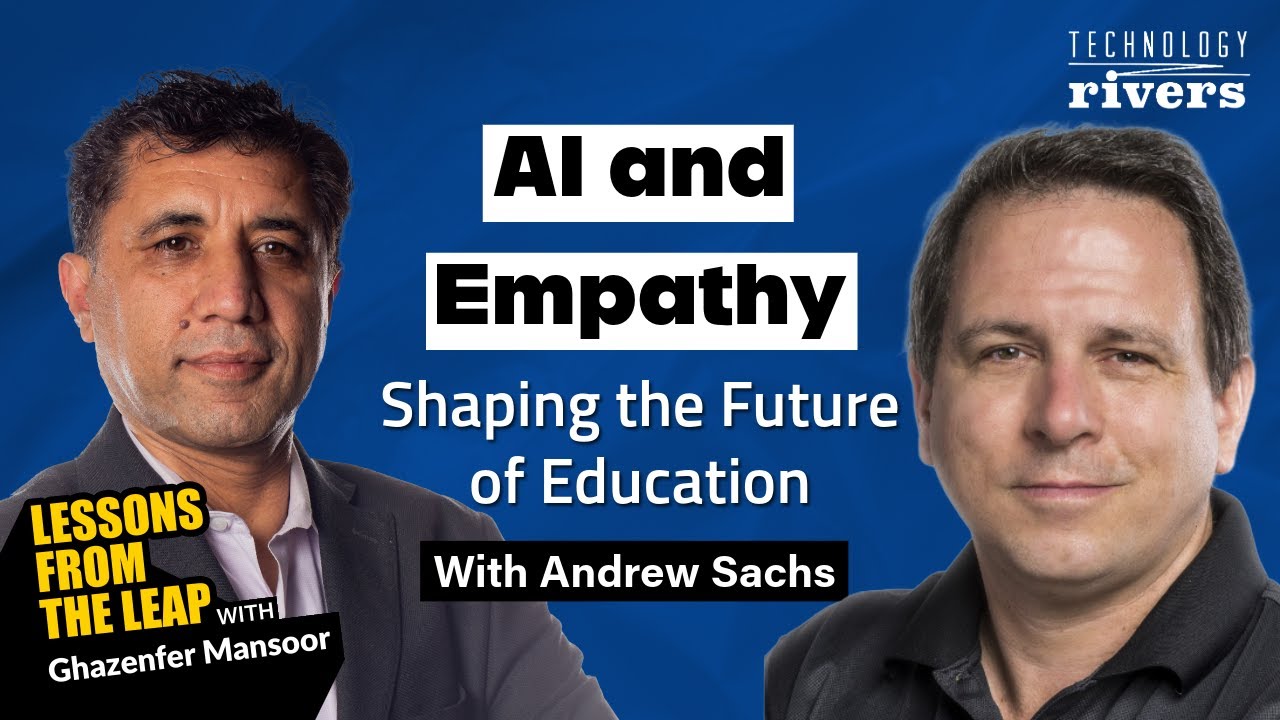 Watch the conversation ↗
What counts as the right answer?
Sachs now brings that interest in human collaboration to conversations about artificial intelligence. He discusses AI alongside empathy, curiosity and the ability to work with others. The connection follows from his earlier career: tools change the work available to people, and people still have to decide what is useful, for whom, and why. Technical fluency alone leaves those questions open.
His ambition is to make opportunities for learning and leadership available across income and birthplace. Nobel presents its program as free, flexible and built around projects. Those choices address different barriers: cost, time and the distance between a subject studied and a task attempted. None makes the work effortless. They make it possible for more people to begin.
Back at the beginning of the story, the daughter’s complaint was about a group project. The response has become an organization devoted to giving collaboration a better set of circumstances. Sachs’s wager is that young people can learn the difficult social parts of work by doing them, with support, while helping one another acquire useful technical skills.
A right answer can be satisfying. It can also end the discussion rather quickly. The more interesting moment in Sachs’s work comes when someone who has just learned something stays around to explain it. Now there is another question, another person, another chance to misunderstand and try again. The group project has acquired a reason to keep going.