He could have spent his life on fusion reactors. Instead he handed the whiteboard marker to a room full of kids and asked them to teach themselves.
Walk into a Prenda microschool and the first thing you notice is what is missing. No teacher pacing at the front. No thirty desks bolted into a grid. Instead: five to ten kids of mixed ages, an informal room, and an adult who is called a "guide," not a teacher. The kids set the goals. The kids run the show. Kelly Smith built a company on that quiet inversion, and today it powers more than a thousand of these rooms.
Smith is the founder and CEO of Prenda, an education company headquartered in Mesa, Arizona. Prenda does not run schools so much as it hands ordinary adults - parents, retired teachers, a dance instructor down the street - the tools, curriculum, and support to run world-class microschools of their own. The model is small on purpose: groups of 5 to 10 students, mastery-focused, project-based, and stubbornly student-led. Since 2018 it has helped over 1,000 adults launch microschools and nearly 10,000 K-8 students step up to lead their own learning.
What makes the whole thing strange is where Smith came from. He is not a lifelong educator. He is an engineer who earned a master's degree in nuclear fusion from MIT, worked in engineering and marketing roles at technology companies, and built and sold a small clean-energy software business before he ever thought about school. The path from plasma physics to first graders is not a straight line. It runs through a public library.
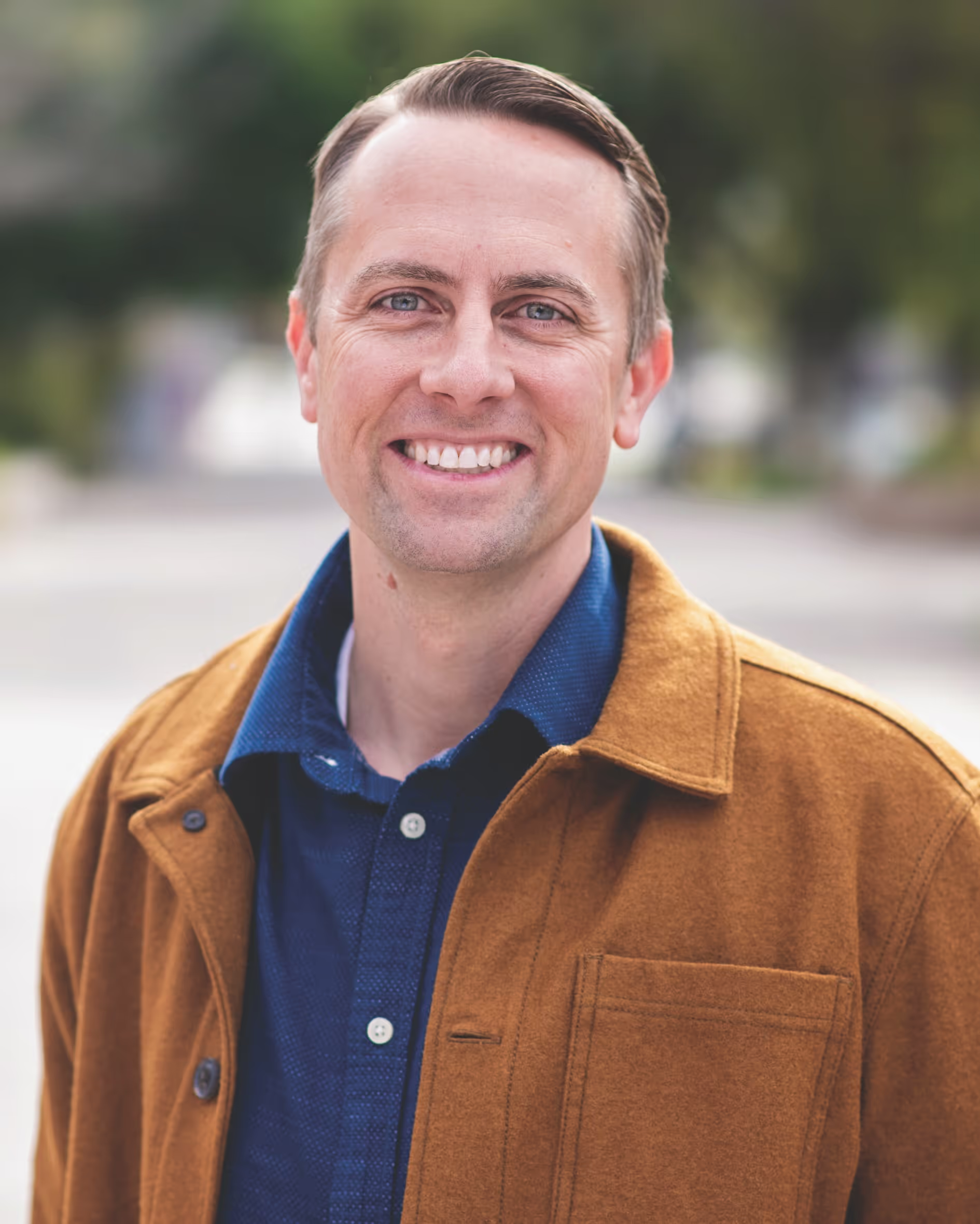
Back in 2013, Smith started volunteering at a public library, teaching kids computer programming after school. He called it Code Club. The thing spread - other libraries wanted it, and Prenda Code Club was born long before Prenda the company existed.
One week he tried to be the expert. "I grabbed a whiteboard marker and drew them this beautiful explanation of logic," he has recalled. And then the light went out of the room. "I had turned into the teacher from Charlie Brown." The kids heard the muffled trombone. So the next week he threw out the lecture and handed them a "challenge of the week" instead. The difference was electric. "I saw the difference between a child who makes the decision to learn and one who's just kind of along for the ride."
That was the seed. Around the same time, his own daughter, a first grader acing every objective measure, seemed quietly bored by learning itself. "She was doing really well by any objective standard," Smith said, "but we could see that she was disengaged from learning." Two observations, one conclusion. By 2017 the question had crystallized into four words he could not shake: What if all of school was like this?
He did not pilot it in a district. He did not write a grant. In January 2018 Smith started the first Prenda microschool around his own kitchen table with his son and six neighborhood kids. It was scrappy and small, which turned out to be the point. The magic he had seen at Code Club - kids owning their own learning - held up when the subject was not just code but everything.
From there it scaled in a way that looks less like a school district and more like a movement. Prenda built the curriculum, the software, the training, and the community, then invited motivated adults to run the classrooms. "Persistence and scrappiness," is how Smith describes the early years - proof that homeschool parents, retired educators, and dance instructors could create genuinely great learning while earning a living and serving their neighbors.
The guides are the quiet radicals here. Prenda does not call them teachers. They are mentors who facilitate rather than transmit, which flips the oldest assumption in education: that the adult in the room is the source of the knowledge. In a Prenda room, the adult is the source of the momentum.
You can hear the fusion training in how Smith talks. He is less interested in blaming teachers or curricula and more interested in the design of the system itself - what it rewards, what it starves. Traditional school, in his read, was never built to meet an individual kid where they are. So he redesigned the unit of delivery: shrink the group, hand over the controls, and let curiosity do the work heat and pressure used to do.
"All the important things are a team sport," he says - a founder's way of admitting that no reactor, and no school, runs on one person. He credits the Startup AZ collective and investor Gregg Scoresby among the mentors who kept the early company alive.
"I saw the difference between a child who makes the decision to learn and one who's just kind of along for the ride."
"All the important things are a team sport."
"She was doing really well by any objective standard, but we could see that she was disengaged from learning."
"I hope they know I see them as humans, that I care about them, and that I believe in them."
Smith grew up in the Phoenix area and, by his own admission, did not appreciate the desert at first. He came around. On Saturday mornings you might find him hiking the Superstition Mountains or paddleboarding the Salt River. His grandparents were teachers - a lineage he credits for shaping how he thinks about kids and belief. Around Mesa he favors Worth Takeaway and Myke's Pizza.
There is a tidy irony worth sitting with. A man trained to contain the energy that powers the sun decided the more interesting reaction was the one that happens when a bored kid suddenly decides, on their own, that they want to know something. Fusion needs extreme heat and pressure. Curiosity, it turns out, just needs a little room and someone who believes in you.