The company that decided school was too big - and built the software to make it small again.
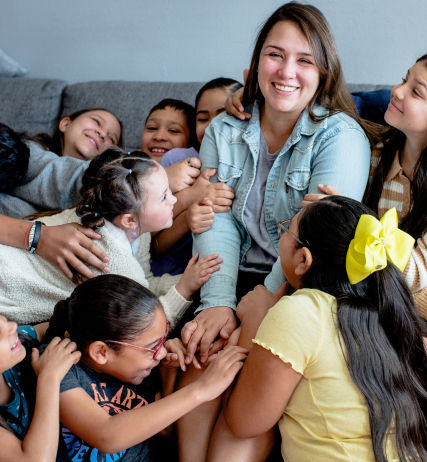
Prenda, photographed in the wild.
One kid, one workbook, zero rows of 30 desks. This is the whole pitch in a single frame.
Somewhere in Arizona, eight kids are mid-lesson. There is no bell.
Eight children sit around a table that, until 8 a.m., was somebody's dining room. One is deep in a Khan Academy math set. Two are arguing about a science project. An adult - not a "teacher," officially, but a guide - leans over a shoulder and asks a question instead of giving an answer. This is a Prenda microschool, and there are more than a thousand of them.
Prenda is the Mesa-based company that makes these rooms possible. It doesn't own the buildings, doesn't employ the adults, and doesn't, technically, run a single school. What it sells is everything that turns a willing grown-up and a handful of neighborhood kids into a functioning K-8 education: enrollment software, a curriculum, training, coaching, and a map through the maze of state school-choice funding. Nearly 10,000 students have learned this way.
"Prenda's mission is to empower learners."
- Prenda, on the about page, with admirable refusal to use more words than necessaryThe conventional classroom is a triumph of logistics and a compromise on everything else. Thirty students, one teacher, one speed. The kid who gets it in five minutes waits. The kid who needs fifteen falls behind and stays there. We have known this for a century and built the schedule around the buses anyway.
For families who wanted something smaller, the options used to be expensive private school or full-time homeschooling - one demanding money, the other demanding a parent's entire day. There was no middle. The problem Prenda set out to solve wasn't "make a better classroom." It was make a smaller one, and make it affordable. That second half is the hard part, and it's the part most reformers quietly skip.
A school small enough to know your kid's name on day one. The catch was always who pays for it.
- The tension Prenda exists to resolveKelly Smith studied physics at Brigham Young University and nuclear science at MIT, which is an unusual resume for someone who would end up reinventing elementary school. He got pulled in sideways: volunteering at a library code club in Mesa, he watched kids teach themselves to program and got, by his own account, a little obsessed with self-directed learning.
So in January 2018 he started a microschool around his own kitchen table - seven neighborhood children, no curriculum company behind him. The bet, shared with co-founders Andrew Jennings, Cahlan Sharp, and Luke Miller, was counterintuitive: the bottleneck in education isn't talented teachers, it's the structure that wastes them. Give an ordinary caring adult the right software and support, and a kitchen table can outperform a classroom of thirty.
You don't need a teaching credential to be a Prenda guide. You need training, tools, and the willingness to show up. Prenda supplies the first two.
Small scales. Every new guide doesn't strain the system - they create a new microschool. The model gets bigger by staying small.
// FROM ONE TABLE TO A NATIONWIDE NETWORK
What Prenda actually ships is a platform. A guide signs up and gets plug-and-play software to manage enrollment, track progress, process payments, and even build a marketing site for their school. A setup specialist and a coach come included. None of it requires the guide to have written a lesson plan in their life.
The school day runs on four modes - connect, conquer, collaborate, create. Adaptive diagnostics in math and reading set each child's level, then the day blends third-party tools (Khan Academy for math, Lexia for reading) with Prenda's own writing software, all organized around mastery rather than the calendar. Year-round academic coaches stay on call for the messy human parts: motivation, behavior, the kid having a bad week.
Lectures not included. The guide asks the questions; the student does the learning.
- How a Prenda day actually worksThe money is where the model gets clever. Guides set their own tuition - most land around $6,800 a year per student - and Prenda charges the guide roughly $2,200 per learner for the platform and support. Crucially, most families cover tuition through state school-choice and ESA dollars, which is how a private-feeling microschool ends up costing the family close to nothing. Prenda's quietest, most valuable product may be helping founders navigate those funding programs at all.
A kitchen-table experiment is a nice story. Ten thousand students is a different kind of claim. Here is the growth that turned skeptics into investors.
A microschool network, scaling by staying small
Sources: Prenda; TechCrunch (2022, "3,000 students"); company statements (2025, "nearly 10,000"). Bars scaled to ~10,000.
The proof showed up in the cap table, too. Y Combinator backed Prenda in 2019. In June 2022, Reddit co-founder Alexis Ohanian's firm Seven Seven Six led a $20M Series B, joined by edtech specialist Learn Capital. And the policy world cooperated: when Arizona broadened its ESA program in 2023, microschools - many running on Prenda - multiplied. Partnerships with state-credentialed institutions are what keep the whole tuition-free arrangement legal and real.
Microschools went from fringe to funded. Prenda built the rails the boom runs on.
- The pattern across the headlines"Empower learners" reads like the kind of phrase that ends up on a tote bag. Prenda uses it as a job description. The model puts the student in charge of the goal-setting and the pace, and demotes the adult from lecturer to guide. That's not a branding choice; it's the entire mechanism. Take away the autonomy and you've just built a very small classroom.
It also reframes who gets to teach. By insisting no credential is required - only training and support - Prenda turned "empowerment" into a second audience: the parents, former teachers, and community members who always wanted to run a school and never had a way in. The company likes to point out there's no cap on how many can join, because each new guide creates capacity rather than consuming it.
Students take an active role in their education. They set personal goals and, with their guide, move forward bit by bit each day.
- Prenda, describing what "empower" is supposed to meanPrenda's wager - that the future of school is smaller, not bigger - used to be heresy. It's now a fundable thesis with a national rollout attached. The plan is availability in all 50 states by the end of 2025, which means the kitchen-table model is about to meet fifty different funding systems, fifty regulatory moods, and a lot of families who've never heard the word "microschool." Whether the quality of one well-run room survives multiplication by ten thousand is the open question, and Prenda knows it.
But go back to that Tuesday morning. The kid mid-math-set, the guide asking instead of telling, the dining room that becomes a school at 8 a.m. and a home again by 3. Seven years ago that room held seven children and existed nowhere else. Now there are more than a thousand of them, and a company in Mesa spends its days making the next one easier to open. School got smaller. It turns out a lot of people were waiting for that.
They don't run the schools. They hand over the keys - and the map to who pays for it.
- Prenda, in one line