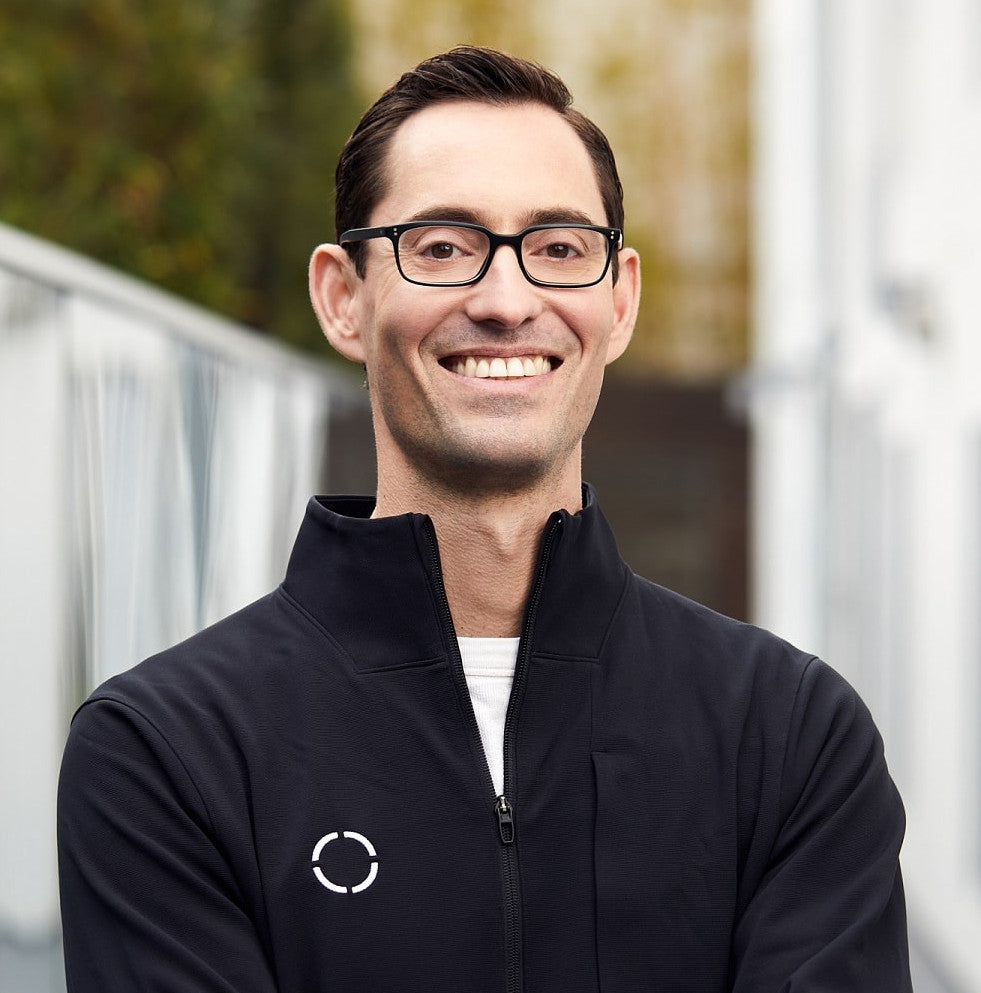
A budget analyst walked into the Pentagon and walked out obsessed with how humans arrive.
Most people think jet lag is a fight against the clock. Andrew Herr thinks that is the wrong enemy. His answer to feeling wrecked at 30,000 feet is not more melatonin. It is a theory about air pressure, inflammation, and the exact hour you should be staring at the sun.
Andrew Herr runs Flykitt, the flagship product of his company Fount, and his pitch is disarmingly blunt: jet lag is not inevitable, it is a solvable engineering problem. His core claim is that large changes in cabin air pressure trigger an inflammatory response in the body. That inflammation, he argues, is what scrambles your thinking and makes it nearly impossible to shift your internal clock quickly. Fix the inflammation, time the light and the supplements, and the fog lifts.
Flykitt bundles that theory into something you can pack: custom supplements, blue-light-filtering glasses, circadian drink mixes, and an app that tells you exactly when to take what based on your itinerary. Kits start around $199. The company says roughly 95% of users report traveling with minimal jet lag, and it has become the jet lag system quietly trusted by traveling pro sports teams.
Large changes in air pressure when flying cause an inflammatory response that impairs how you think, feel and perform, and makes it nearly impossible to shift your circadian rhythm rapidly.
— Andrew Herr, on why flying wrecks you
Before the product, the Pentagon
Herr did not arrive at travel science through the wellness aisle. He arrived through national defense. He grew up in a household where the themes practically wrote the resume in advance: a gastroenterologist father, a mother from a decorated military family, and a constant undercurrent of science, health, and travel. He went to Georgetown's School of Foreign Service to study science, technology, and international affairs, then stacked three concurrent master's degrees on top of it - Microbiology & Immunology, Health Physics, and Security Studies - funded by a roughly $200,000 government scholarship.
Then he spent the better part of a decade inside the Pentagon's Office of Net Assessment, the Defense Department's internal think tank. He was hired, by his account, after a single interview, and handed a rare brief: figure out how biology could make people perform better. For about eight years he helped defense leadership decide where multi-billion-dollar research budgets should go, focused on human performance, synthetic biology, and artificial intelligence. Wired magazine once described the flavor of that work as giving soldiers something close to mutant powers.
The strategy job came with a tactical education. Herr worked directly with special operations personnel and fighter pilots - the people who actually had to think clearly after crossing ten time zones to do something dangerous. The U.S. Army named him a Mad Scientist. Twice. He picked up a Johns Hopkins Emerging Leaders in Biosecurity fellowship and started teaching in Georgetown's Security Studies graduate program on the side.
I'm good at this. I'm one of the best in the world, but this is going to be way better than me. That's so fucking cool.
— On building predictive models of the human body
The leap
In 2019 Herr founded Fount to do for civilians what he had been doing for operators: build a comprehensive, deeply personalized program to help people look, feel, and perform the way they want. The premise is that most health advice is uselessly generic. Ask the internet whether you should eat breakfast and you get a shrug. Fount's answer is to gather more than 100 data points on a single person - blood and urine markers spanning metabolism, immune and inflammatory activity, nutrient levels, organ function, cardiovascular signals - and then tell that specific person what actually works for their specific body.
The original Fount program was concierge-tier and priced like it, running into the thousands of dollars a month. That was deliberate. Herr treats the premium program partly as a data-gathering engine - a way to observe thousands of real bodies closely enough to eventually build predictive models, then push a far cheaper software version out to the masses. The money followed the ambition: Fount raised a Series A as part of roughly $12 million in total funding, with backers including Founders Fund, Not Boring Capital, Allen & Co., and the LA Dodgers' Elysian Park fund.
Flykitt was the breakout. Jet lag turned out to be the perfect wedge - a universal, miserable, oddly under-solved problem that Herr had already cracked for people whose jobs depended on it. Launched in late 2022, it took the protocols built for Navy SEALs and fighter pilots and shrank them into a kit anyone could buy. It is the rare consumer product that can honestly say its R&D lab was a special operations deployment.
The founder underneath
The polish hides a grind. Herr has said he heard more than 100 investor no's before a yes, and he is candid that starting companies can be brutal without a sense of humor about it. He is relentlessly, almost strategically optimistic, and he lists positivity alongside curiosity, iconoclasm, risk tolerance, and endurance as the traits that actually got him here. His own optimization routine is refreshingly unglamorous: diet first, unroasted almond butter bought in bulk, and organic rotisserie chickens as a clean protein default.
He is also genuinely well-traveled in the hard way. He has crossed more than 10,000 miles of Russia and Mongolia by train and lived among Kazakh eagle-hunting nomads in Central Asia - the kind of trips that make a person take the toll of movement on the body seriously. His performance clients have reportedly included the Miami Heat and USA Soccer, alongside executives and billionaires who can hire anyone and chose him.
If you can't see the bright side, founding companies can be brutal. It's crucial to have some fun.
— Andrew Herr
Where it's going
Herr's stated endgame is bigger than a travel kit. He wants to know, and then to tell anyone who asks, exactly what they should eat, take, and do to feel and perform how they want. He talks about building predictive models of the body and brain as the match that lights an entire industry - supplements, coaching, meal delivery, and eventually territory as ambitious as pharmaceuticals and insurance. The concierge program funds the data. The data funds the models. The models, he hopes, outgrow him entirely - which is exactly the outcome he seems most excited about.
For now the wedge is jet lag, and the promise is simple enough to fit on a boarding pass: get off the plane and feel like yourself. It is a strangely humble goal for someone who spent a decade thinking about how to build better humans. Then again, arriving as yourself may be the most radical performance upgrade of all.
Why the military background matters
There is a reason a defense-strategy career translates so cleanly into a consumer product. Special operators and fighter pilots are, in a sense, the most demanding wellness customers on earth. They cannot afford a bad night's sleep, a foggy morning, or a slow reaction time, and they operate in exactly the conditions - long-haul flights, brutal schedules, hostile environments - that break ordinary bodies. Solving performance for them means solving the extreme edge cases first, then working backward toward everyone else. Herr's whole approach is built on that inversion: figure out what works when the stakes are life and death, and the version for a business traveler crossing the Atlantic becomes almost easy by comparison.
It also explains his patience with detail. Herr has spoken about his appreciation for what he calls exquisite data, and about attacking problems by reconceptualizing them rather than patching them. Jet lag is a perfect example. The conventional wisdom fixates on melatonin and time zones. Herr reframed the whole thing around inflammation and cabin pressure, and once the frame changed, the solution stopped looking like a supplement and started looking like a system. That habit - refuse the obvious framing, chase the mechanism underneath - is the throughline connecting the Pentagon analyst and the founder.
His clients tell the same story from the outside. When the Miami Heat, USA Soccer, and a roster of executives and billionaires all reach for the same advisor, it is usually because that advisor is doing something the rest of the market has not caught up to yet. Being called one of the best in the world at human performance is the kind of claim that sounds like marketing until you look at who is quietly paying for it.
How Flykitt actually works
Calm the inflammation
Custom supplements target the inflammatory response set off by cabin pressure changes.
Steer the clock
Blue-light glasses and timed circadian cues shift your internal rhythm to the destination.
Follow the app
An AI-driven plan tells you exactly what to take and when, based on your specific itinerary.
The making of a mad scientist
Figures drawn from public interviews, company materials, and press coverage.Seven things that make him him
Twice honored as a U.S. Army “Mad Scientist” - a real distinction, not a nickname.
Earned three separate Georgetown master's degrees concurrently.
Crossed over 10,000 miles of Russia and Mongolia by train.
Lived alongside Kazakh eagle-hunting nomads in Central Asia.
Buys unroasted almond butter in bulk; rotisserie chicken is his clean-protein default.
Heard 100+ investor no's before Fount got funded.
Wired described his military work as giving soldiers “mutant powers.”