★Breaking: Jet lag is now a choice
★Built on research with Navy SEALs & fighter pilots
★Fount raises $12M Series A (2023)
★93%+ of users report minimal-to-no jet lag
★Glasses block ~99% of blue light
★Trusted by pro teams, execs & Olympians
★Breaking: Jet lag is now a choice
★Built on research with Navy SEALs & fighter pilots
★Fount raises $12M Series A (2023)
★93%+ of users report minimal-to-no jet lag
★Glasses block ~99% of blue light
★Trusted by pro teams, execs & Olympians
Cabin lights / 35,000 feet
It's hour nine of a red-eye, and one passenger isn't suffering
Somewhere over the Atlantic, the cabin has gone dark and most of the plane has surrendered. People are folded into seats at angles the human spine was not designed for. One traveler, though, is calm. Amber glasses on. A small packet of supplements already half-spent. A phone buzzing with a notification that reads, more or less, "sleep now." When the plane lands at 6 a.m. local time, that person will walk into a meeting and act like they slept in their own bed. That is the entire pitch of Flykitt, and it is a strangely literal one.
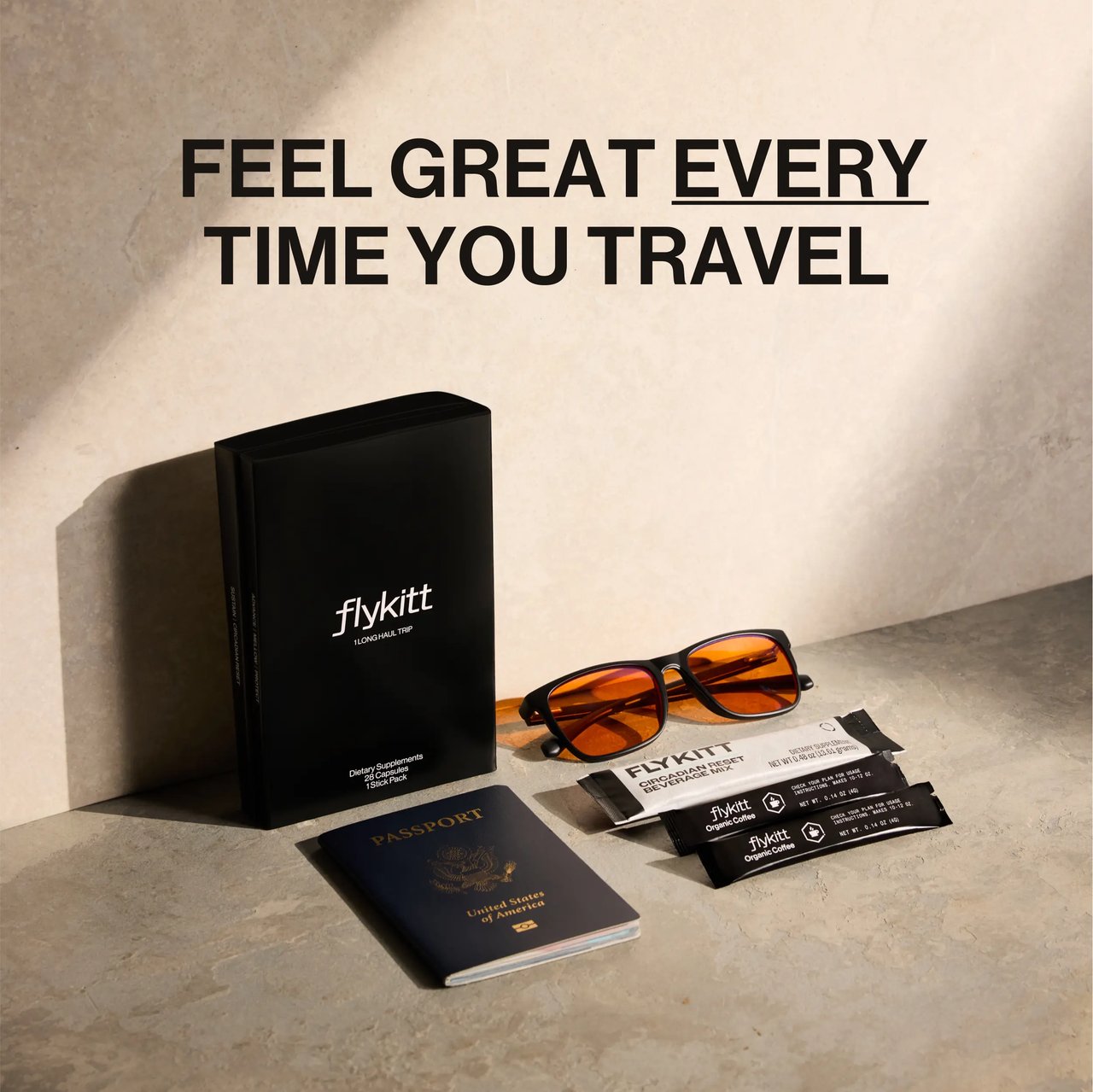
Flykitt is the consumer product from Fount, a Los Angeles human-performance company. The kit bundles three unglamorous things - timed supplements, blue-light-blocking glasses, and an app - into one coordinated protocol that aims to delete jet lag rather than merely complain about it. The company sells it directly to travelers and, increasingly, to the kind of organizations that measure performance for a living.
"Jet lag is a choice. Feel great on every trip."
- Flykitt's tagline, stated as a dare
The problem they saw
Everyone accepted that flying wrecks you. Flykitt refused.
For decades the standard advice on jet lag has been a shrug dressed up as wisdom: hydrate, avoid coffee, get sunlight, suffer for a few days. The travel industry treated arriving exhausted as a tax you simply paid for crossing time zones. It was, conveniently, a problem nobody was responsible for solving.
Flykitt's founding insight is that jet lag is not one problem but two, stacked. The first is the obvious one - your internal clock is stuck in the time zone you left. The second is quieter: long flights are a physiological assault. Pressurized cabins, dry air, immobility, and poor fueling produce real inflammation in the body. Treat only the clock and you still land feeling like you have a low-grade flu. Treat both, the company argues, and the misery mostly disappears.
"Being stuck in a different time zone and the inflammation of long flights add up to what we call jet lag. Most fixes only address half of it."
- The thesis, paraphrased from Flykitt's own explainers
It is a tidy reframing, and like most tidy reframings it is slightly annoying once you hear it, because it makes the old advice sound like it was treating a symptom and ignoring the patient.
The founders' bet
A Pentagon scientist who optimized SEALs, then aimed lower - at your carry-on
Andrew Herr did not arrive at jet lag through the wellness aisle. He spent years leading human-performance efforts for the U.S. military, work that earned him the U.S. Army's "Mad Scientist" honor - twice, which suggests either consistency or stubbornness. His academic background reads like a deliberately unusual stack: Georgetown graduate degrees spanning health physics, microbiology and immunology, and national-security policy.
The bet behind Fount was that the same playbook used to keep special operators and fighter pilots functional under brutal conditions could be packaged for civilians. Travel was the obvious wedge. Long-haul flights are a universal, repeatable, measurable stressor - which is to say, a perfect place to prove that human performance can be engineered rather than endured. Herr founded Fount around 2020 and launched Flykitt in November 2022.
"He was honored as a 'Mad Scientist' by the U.S. Army. Twice. Flykitt is what happens when that person gets bored on a plane."
- A fair summary of the origin story
The product
Three boring things, one bossy app
Flykitt's cleverness is not in any single component. It is in the choreography. You enter your flight details and some honest answers about your sleep, and the app builds a minute-by-minute plan: when to take each supplement, when to put the glasses on, when to eat, and when to sleep. The traveler's only job is to obey the notifications.
The App
An AI-driven planner that turns your itinerary into a step-by-step schedule of pills, light, food, and sleep - with nudges so you don't have to think.
The Supplements
A staged protocol - Advance, Sustain, Protect, Mellow, Circadian Reset - targeting inflammation, circulation, immunity, and the body clock.
The Glasses
Travel-engineered "Unwind" lenses that block roughly 99% of disruptive blue light to defend your circadian rhythm mid-flight.
Food & Fit
Newer features that make it easy to eat well and work out on the road, extending the system beyond the flight itself.
The packaging even got a redesign with a lighter color palette - specifically so you can tell the caps apart on a dark overnight flight. It is the kind of small, unromantic detail that tends to mark a product built by people who actually use it.
"The app will literally tell you when to eat the ribeye. This is performance science with a dinner reservation."
- On Flykitt's charming specificity
The proof
The numbers do a lot of the talking
A jet lag claim is easy to make and hard to live up to, because every traveler is a skeptic by 4 a.m. Flykitt leans on its own reported figures: the large majority of users say they experience minimal to no jet lag, with the company citing numbers in the 93-95% range across its materials. The glasses block roughly 99% of disruptive blue light. The supplement schedule is tuned to your exact flight, not a generic time zone count.
By the numbers
What Flykitt claims its system delivers
Users reporting minimal/no jet lag93%
Blue light blocked by Unwind glasses99%
Figures as stated by Flykitt/Fount in company materials and press. Treat as company-reported, not independently audited.
Beyond self-reported stats, the credibility comes from who reaches for it. The product traces back to research with Navy SEALs and fighter pilots, and the customer list now reportedly includes pro sports teams, Olympians, and the sort of executives whose calendars do not forgive a lost day. In 2023, investors agreed the thesis had legs: a $12M Series A, led by Amity Ventures with Not Boring Capital and others alongside.
3-in-1
App + pills + glasses
"Investors don't usually fund vibes. A $12M Series A is the market agreeing that landing fresh is worth paying for."
- On Fount's 2023 raise
The mission
Make elite human performance feel ordinary
Flykitt is the wedge, not the whole plan. Fount's larger ambition is to take the kind of personalized, evidence-driven performance work once reserved for operators and athletes and make it available to people whose only qualification is a boarding pass. Travel is simply the most universal proving ground - everyone flies, everyone arrives wrecked, and almost everyone had quietly assumed nothing could be done about it.
The company's stance is refreshingly unsentimental about wellness. There is no talk of vibes or balance. There is a flight, a body, a set of measurable stressors, and a protocol designed to counter each one on schedule. It treats your physiology as something you can plan around rather than apologize to.
"They're not selling sleep on the plane. They're selling the feeling of being human when you step off it."
- The mission, in one line
Why it matters tomorrow
Back to that dark cabin, nine hours in
Return to the red-eye. The plane is still folded into uncomfortable shapes, the same as it has been on every overnight flight in the history of commercial aviation. What's changed is that the misery is no longer mandatory. The traveler in the amber glasses isn't lucky or genetically gifted. They just ran a protocol.
That is the quietly radical thing about Flykitt. It takes one of travel's most universal complaints - the kind everyone grumbles about and nobody questions - and reclassifies it from "the cost of flying" to "a solvable problem with a checklist." If the company is right, the future of long-haul travel is less about endurance and more about preparation. The plane lands at 6 a.m. The traveler walks off and gets to work. The jet lag, for once, stayed home.
"Jet lag is a choice. Flykitt's whole job is to let you choose 'no.'"
- Where the story lands