Andrew Dayton was working at his desk when the room next door began producing a peculiar soundtrack: screams, then laughter. A visiting art team was taking turns inside an early version of Five Nights at Freddy’s: Help Wanted. The door was closed. The verdict was audible. For somebody who had spent years helping animated films reach an audience, this was a rather intimate form of audience feedback. The viewers were now participants, and they were making quite a racket.
He has returned to that memory when explaining the game’s appeal. The fright mattered, of course. So did the laughter afterward, and the pleasure of watching a colleague receive the same unpleasant surprise. There was a social event happening around a solitary headset. Dayton could hear the thing his team had been trying to make: people enjoying themselves inside somebody else’s carefully arranged trouble.
The second shift
Steel Wool began with a less theatrical sound: the conversation among colleagues who wanted to make something together. In March 2013, its five founders were still working at Pixar. Dayton described the venture as something that had taken shape gradually. They talked to people in games, developed ideas and brought in skills they lacked. Pixar’s legal team had approved the side project, provided the work happened outside working hours. Even an adventure needs a reasonably clear calendar.
Those boundaries gave the early company its peculiar rhythm. Film work occupied the day. Game development had to find room around it. There was no grand announcement in Dayton’s account of deciding to become an entrepreneur. The company emerged from an existing creative relationship and a shared appetite for games. The title arrived after the activity. First came people trying to make a thing.

In a 2014 description of his routine, Dayton placed the beginning of his Steel Wool day at around nine in the evening, after his children were asleep. The team worked remotely, coordinating through Box and Skype. He joked about the coffee involved. The useful detail is the less glamorous one: artists needed decisions from leads who could rarely gather in a room. Their experience organizing complicated animation productions helped keep the work moving.
A janitor gets the leading role
The first game, Flyhunter Origins, followed Zak, a spaceship janitor promoted by mishap into an adventure. Dayton called him “our Charlie Chaplin.” Zak’s performance depended on pantomime rather than dialogue. An awkward, brave little character had to make players care through movement. Here was a place where the founders’ animation experience could earn its keep without requiring them to reinvent the platform game at the same time.
The original idea came from co-founder Jonathan Hoffman. Dayton explained that they selected it from several developed concepts because its game structure was relatively straightforward. There is a useful modesty in that choice. A group experienced in one craft can make its first attempt at another needlessly complicated by insisting on being original everywhere. Steel Wool gave itself a recognizable form within which to learn.
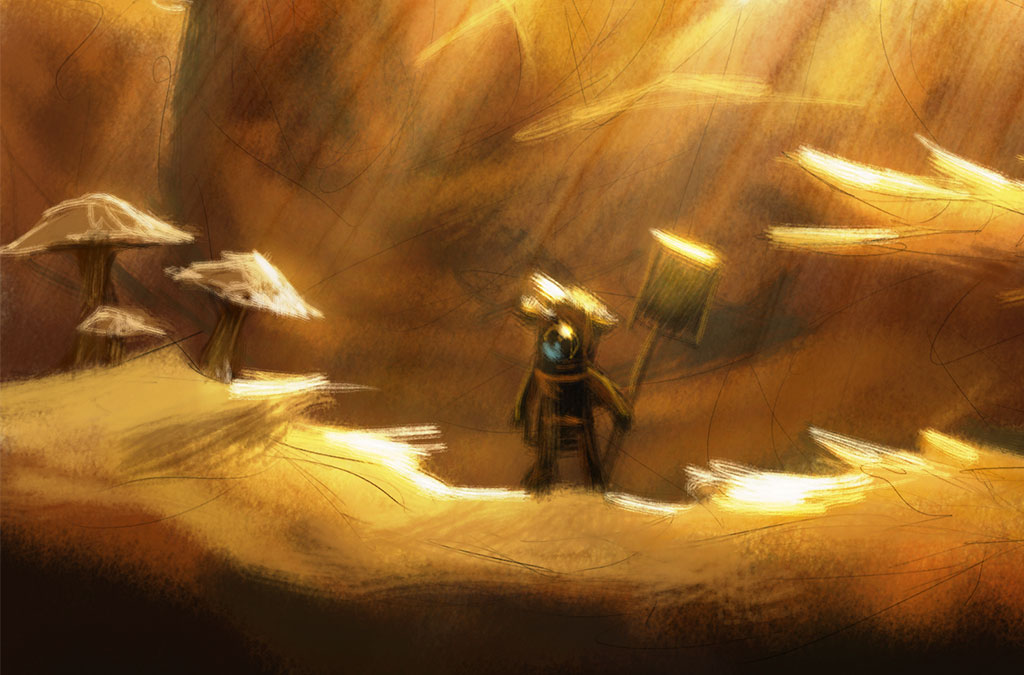
The setting made the same kind of economical joke. Zak’s sweeping landscapes occupied a small patch at the edge of a trailer park in the American Southeast. A swamp, discarded objects and vegetation could become an expedition when seen at his scale. Dayton put the action within roughly fifty feet of human space. A garden does not need to be especially exotic if your hero is sufficiently small.
His own gaming references included Sierra’s Space Quest and King’s Quest. Among platformers, he named Ghosts ’n Goblins, Super Metroid and Castlevania. These were specific enthusiasms behind a business that can otherwise be summarized too neatly as film people entering games. There were players in the founding group, with remembered worlds and particular tastes. Experience supplied the tools; affection supplied a reason to start.
What sixty years of experience could not buy
Writing about Flyhunter before its E3 appearance in 2014, Dayton counted sixty combined years of film animation experience among the five founders. He also made a disarmingly practical admission: enjoying games did not qualify them to design one. The comparison he reached for was a moviegoer assuming that watching films prepared them to direct. It is an observation worth keeping near any impressive résumé.
They studied the genre and listened to publisher Ripstone. Co-founder Joshua Qualtieri’s tabletop work provided useful grounding in rules. Their stated priority was an enjoyable game, with story and animation supporting it. The sequence matters. A beautifully performed character still needs something satisfying to do when the player presses a button. An animation background could improve that experience; it could not excuse an unsatisfying one.
“It’s been a serendipitous process.”
Andrew Dayton, on Steel Wool’s beginnings · 2013
The camera acquires opinions
Virtual reality made the question of player choice harder to avoid. At a 2016 developer roundtable, Dayton focused on the freedom a headset gives its wearer. Players can look somewhere unexpected. They can investigate an object while the designer would prefer them to follow the action. A team can anticipate behavior, but anticipation will never supply a perfectly obedient audience. Anybody who has hosted a dinner party may recognize the difficulty.
For a film artist, the change is fundamental. A framed shot offers a strong agreement about where attention should go. A person inside a virtual environment brings a head, hands and curiosity. Dayton framed the design problem as a decision about how much freedom to allow and how firmly to steer. The disagreement is built into the medium: a story wants to proceed, while a player may want to inspect the furniture.
An editorial illustration of the design problem Dayton described in 2016.
That year, HTC backed Steel Wool with a $5 million Series A investment. The studio had already brought Quar: Battle for Gate 18 to the Vive. Its next announced experience, Mars Odyssey, used NASA material to recreate explorers on the surface of Mars. The projects suggest why VR interested this group: a battlefield and a planetary visit both give scale a job to do. Looking becomes part of understanding the place.
A familiar bear, an unfamiliar distance
Freddy’s offered a different application for that sense of scale. Scott Cawthon had created the franchise; Steel Wool joined an established world with an audience already invested in it. Dayton and creative director Jason Topolski had met at Pixar, where working within recognizable fictional worlds was familiar territory. Lionsgate Games and Striker Entertainment introduced the studio to Cawthon. Dayton described a collaboration in which ideas and reviews could pass directly between them.
In VR, a threatening character gains a physical relationship to the player. Distance becomes harder to dismiss when it feels like your distance. Dayton emphasized spatial tension, including the feeling that something might be behind you. The game’s engineering also had to survive the move onto different hardware. For the Quest version, he singled out optimization and credited The Forge’s contribution. The audience could enjoy the fright because other people had spent time on less photogenic problems.
Moving Help Wanted to Nintendo Switch raised another collection of decisions: attached or separate Joy-Cons, handheld play, television play and different controllers. Dayton also compared VR’s resource constraints to painting with a smaller palette. The remark fits a technical artist: limitations become choices about what the picture needs. The same world has to communicate through different equipment, under different conditions, without losing the response that made it worth visiting.
The person behind the systems
Dayton’s Pixar work included The Incredibles, Ratatouille, Toy Story 3 and Brave. Over twelve years there, his technical work extended to asset management and a shared patent for a 3D modeling technique. These are the mechanisms behind the visible result: the means of organizing and shaping the material from which a fictional world is made. His move into leadership carries that practical background with it.
Teaching is another recurring part of his career. He has taught or lectured at institutions including NYU, the School of Visual Arts, Pratt and the Animation Workshop in Denmark, as well as at LEGO and the Game Developers Conference. Explaining a craft requires taking apart operations that experience can make automatic. It is a useful companion to leading people whose specialties differ from your own.
On Steel Wool’s tenth anniversary, he described a leadership approach learned from Ed Catmull: recruit people with greater expertise, then give them room. The sentiment connects the first company’s recognition of missing skills to the responsibilities of a CEO. A studio can only make use of its collective intelligence if the person in charge permits other people to exercise theirs.
The joke continues
There is also a less solemn Dayton in the interviews. Asked in May 2020 what Steel Wool would do next, he replied, “I could disclose that, but it would be a security breach.” The game bearing that title followed in 2021. His delivery allowed an answer to be both evasive and rather specific. It takes a certain pleasure in an audience to plant a joke whose explanation will arrive later.
The work has continued through Help Wanted 2 and Secret of the Mimic. In May 2026, Steel Wool released the latter’s Steam PC VR version alongside a PS5 patch. More worlds, more equipment, more opportunities for a player to do something inconvenient. Dayton’s path has carried him from shaping material behind a movie frame to running a studio that must accommodate the person inside the scene. Somewhere in that accommodation lies the possibility of another room full of laughter.