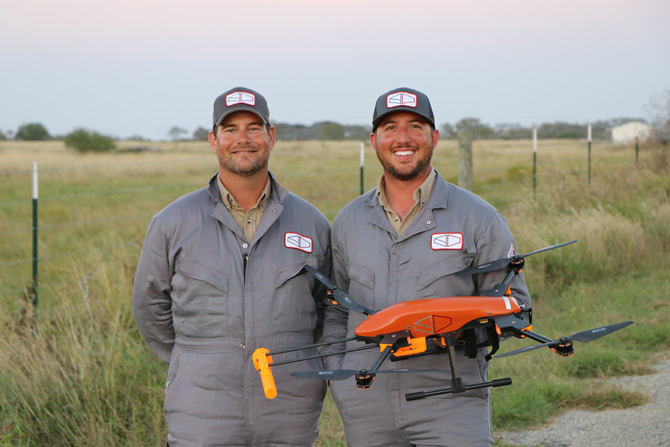
The drone in the photograph is orange, and the two founders are smiling. They wear matching work clothes and caps, with grass and a fence behind them. Andrew Aubrey’s new business looks thoroughly terrestrial. Somewhere in this assembly of rotors, electronics and practical clothing is a connection to Mars. It is a good joke played by engineering: an instrument with planetary ancestry, dressed for a day at work.
Aubrey co-founded SeekOps with Brendan Smith in 2017 after leaving NASA’s Jet Propulsion Laboratory. The company took licensed gas-sensing technology into commercial methane inspection. A customer could hire a team to fly over a facility, find escaping gas and produce measurements. The journey from laboratory to business had an unusually long geographical backstory. Its commercial destination was close to the ground.
That destination gives Aubrey’s career its shape. He has moved through research, startup leadership, partnerships, airborne surveying and, more recently, cargo aviation. Across those settings, the interesting moment arrives when a technical result must become useful to someone else. The laboratory has established a capability. Now there is a customer, a site, a flight plan and a working day to consider.
The customers came before the company
Aubrey completed his doctorate at the Scripps Institution of Oceanography in 2008. His subsequent work at JPL involved advanced sensors and sensor systems. That gives the founding story a substantial apprenticeship: years spent around instruments before the instruments acquired a company name. The commercial step came after technical work and contact with the people who might use it.
By February 2013, he was already addressing the pipeline industry as a JPL technologist. At a research exchange in Dallas, he and Enbridge executive Chuck Szmurlo gave keynote presentations encouraging participants to look beyond their own industry for useful technology. Nearly 300 people attended. The premise of that gathering anticipated his later business: a solution might have developed somewhere with very different requirements.
At JPL, Aubrey helped secure energy-industry funding and led field demonstrations of methane sensing. By 2016, industry contacts were asking about a commercial version. These are consequential details. A field demonstration asks a device to perform outside the conditions that made its development possible. An interested customer asks what happens after the demonstration ends. Aubrey encountered both questions before leaving the laboratory.
The sequence makes the founding decision easier to understand. SeekOps emerged from a capability and a request for access to it. There was work to do beyond presenting an instrument: manufacture it, integrate it, arrange operations and deliver a result. An interested audience became the beginning of a market. The founders then had to build the organization that could serve it.
- 2008Scripps doctorate
- 2013Industry exchange
- 2017SeekOps launch
- 2023Airborne surveys
- 2025Cargo aviation
Mars technology, Earth arithmetic
The company’s early licensing agreement was with the California Institute of Technology for miniature gas-sensor technology developed at JPL. Aubrey was CEO; Smith was COO and led drone integration. They had worked on industry applications of the Open Path Laser Spectrometer while at the laboratory. Familiarity with the design mattered because the new company was making sensors and preparing them for handheld or aerial use.
Miniaturization made the aerial application possible. Aubrey described reducing the technology to 150 grams. That number belongs to the early equipment, rather than every sensor the company would ever make. It captures a useful engineering constraint: a flying instrument has to justify the weight it brings aboard. Sensitivity is valuable, but the aircraft still has to carry the thing.
“We take that tech and shrink it to 150 grams”
Andrew Aubrey, describing the early SeekOps sensor, 2017
The operating model also had arithmetic of its own. Early SeekOps combined in-house sensor manufacturing with drones obtained from another company. It offered survey flights as a paid service and made handheld equipment. That put the founders in several businesses at once: instruments, integration and field operations. A customer buying an inspection needed the combined result, regardless of how many engineering disciplines sat behind it.
Methane escaping from equipment is a measurement problem with a commercial consequence. Lost gas represents lost product, and operators need information about where emissions occur. A detection provides an opening. Localization gives someone a place to investigate. Quantification helps describe the scale of the release. SeekOps organized its service around those separate jobs, making an invisible process more legible to the people responsible for the equipment.
Detect
Find methane in the sampled air.
Locate
Identify where the release originates.
Quantify
Estimate the rate of emissions.
A readable screen earns its place
One revealing detail in Aubrey’s early company work concerns a tablet. A SeekOps field team used a Panasonic Toughpad G1 to view information streaming from the drone. The described operation involved a pilot, a safety observer and a ground-control operator. The instrument was airborne. The decisions about what its readings meant still needed a useful interface on the ground.
Aubrey’s explanation for choosing the hardware included sunlight readability, battery life and portability. These are modest words in a story with a Mars connection. They also explain how a sophisticated system survives contact with an ordinary workplace. A screen that loses the argument with daylight makes every impressive upstream component less convenient. The sun is an indifferent product reviewer.
“With a screen readable in even the harshest sunlight”
Andrew Aubrey, on field hardware in a 2017 case study
His comments describe a founder attending to the full operation. The data must reach the person who uses it, at the place where that person works. Such details give the company’s early story texture without requiring a mythology about its founder. The test of usefulness sits in batteries, screens, setup and the interpretation of readings. A successful flight is one part of a service.
A sensor needs a flight partner
By September 2020, Aubrey was identified as SeekOps’ senior vice president for strategic partnerships. That month, the company announced a collaboration with Flylogix for offshore methane measurement on the UK Continental Shelf. SeekOps supplied its sensing technology and analytics; Flylogix brought unmanned aviation capabilities. The sensor was integrated into the partner’s FX2 fixed-wing aircraft.
Offshore operations made the partnership’s purpose concrete. Taking a measurement required reaching an installation and operating beyond the pilot’s visual line of sight. The flight capability and the sensing capability had to meet in the same mission. In this setting, a partnership was part of how the system worked. Two complementary organizations could address a task neither component described adequately on its own.
Aubrey’s role continued to appear in public discussions of emissions measurement. In 2021, he participated in a methane forum alongside specialists in aircraft, satellites and other sensing approaches. The range of technologies is instructive. An operator’s question might concern a specific source, a whole facility or a broader area. The useful platform depends on the question being asked and the conditions surrounding it.
From a flight path to a bigger picture
At the 2022 Global Waste Management Symposium, Aubrey discussed SeekOps’ drone-based approach to landfill emissions. The workflow used a digital elevation model to help generate flight profiles, then mapped methane concentrations along the aircraft’s path and calculated emissions. The terrain mattered. Repeatable coverage mattered. An inspection had to be planned around the place being inspected, rather than an abstract patch of sky.
Repeatability adds another dimension to the business of measurement. One useful flight answers a question about one occasion. A program of inspections needs a method that can be carried out again. Flight planning and data processing become part of the result. The attractive photograph of a drone captures very little of that labor. Much of the value arrives afterward, in the map and the calculation.
Aubrey later worked with Carbon Mapper. A September 2023 report on airborne methane surveys in California names him as project manager, with Riley Duren as principal investigator. His responsibilities had moved into another organization and another surveying context. The continuity was methane measurement; the platform and the scale of the work had changed.
A 2025 conference biography also described his consultancy, Celatech LLC, working with companies in environmental technology and drones. Consulting fits between technical possibilities and organizational choices: what to build, where it can operate and what it needs around it. His public career contains repeated encounters with those boundaries. That pattern offers a useful reading of the work, without pretending every change was planned from the beginning.
The payload changes again
By the 2025 Energy Drone & Robotics Summit, Aubrey was representing Skyways. The subject had expanded into cargo aviation. During the panel, he described aircraft carrying 30 pounds over missions of up to eight hours or 500 miles. These were capabilities discussed at that event, rather than a promise about every flight. He also spoke about autonomous operations involving vessels and delivery missions.
In November 2025, he appeared as a Skyways senior advisor in a Houston discussion of energy drone operations beyond visual line of sight and preparations for FAA Part 108. His later public profile continues to place him at Skyways. Airspace access and operational permissions belong in this chapter because they determine where a flight can become a routine service. Technical capability alone does not write the flight schedule.
His forecast at the earlier summit put sensing, cargo and eventually people in sequence. Read across his career, that order has particular resonance. He began with instruments, helped build a company around measurements and moved toward aircraft carrying useful loads. Each application changes what the customer expects to receive. Each leaves familiar questions about deployment, integration and a task completed reliably.
Sensors → Cargo → People
Aubrey’s staged aviation forecast at the 2025 summit.The orange drone in the early photograph carried an instrument. The business carried a larger obligation: make the instrument’s findings usable. That obligation has followed Aubrey into different organizations and different aircraft. His story is most interesting at those handovers, where a discovery leaves the laboratory, a reading reaches an operator, or a payload reaches its destination. Something has to arrive. Someone has to know what to do next.