Before Anand Kashyap learned to program, he solved analytical problems by hand. His father was an engineer who put weight on mathematics and science; access to computers came later. It is an unshowy beginning for someone whose working life now concerns what happens inside a machine when its owners would rather nobody looked. The habit came first: take the problem seriously, work through it, find an answer that survives contact with reality.
That last requirement has followed him from university into research laboratories and, eventually, the chief executive’s job at Fortanix. A security idea can be elegant on paper and awkward on a customer’s servers. Kashyap has spent his career moving between those two settings. The distance between them is where a considerable amount of engineering lives.
His particular problem is trust. Computers routinely handle information their owners would prefer to keep private. Those computers may belong to somebody else. The people operating them may have considerable power over the software running inside. Kashyap’s company was built around making sensitive information useful under those uncomfortable conditions.
The apprenticeship before the startup
IIT Kanpur gave Kashyap his undergraduate education in computer science and his introduction to programming. A doctorate in computer science at Stony Brook followed. University taught him to pursue difficult questions; the jobs that came afterwards supplied different tests of an answer.
At Symantec Research Labs, he worked on security and networking. His research career included papers and more than 25 patent filings. At Arkin and VMware, the work included network visualization software: making complicated systems easier to understand. Each setting demanded a different kind of usefulness. A research result has to establish something. A product has to help someone do something.
In a 2020 interview, Kashyap recalled advice he had received: “first you learn, then you earn”. He described learning how to turn research into prototypes and then prototypes into products. It is a less cinematic preparation for entrepreneurship than the sudden flash of inspiration. It also provides considerably more practice.
A familiar face, an unfamiliar proposition
Kashyap and Ambuj Kumar knew each other from their undergraduate days. When they reconnected in the Bay Area, they brought complementary experience to their conversations: software and cloud security from Kashyap, hardware security and cryptography from Kumar. They co-founded Fortanix in 2016.
The startup began with a question that was easy to state and difficult to implement. Could sensitive information remain protected while a computer actually worked on it? Encryption already had familiar jobs protecting stored files and information moving across networks. Processing introduced a more troublesome interval.
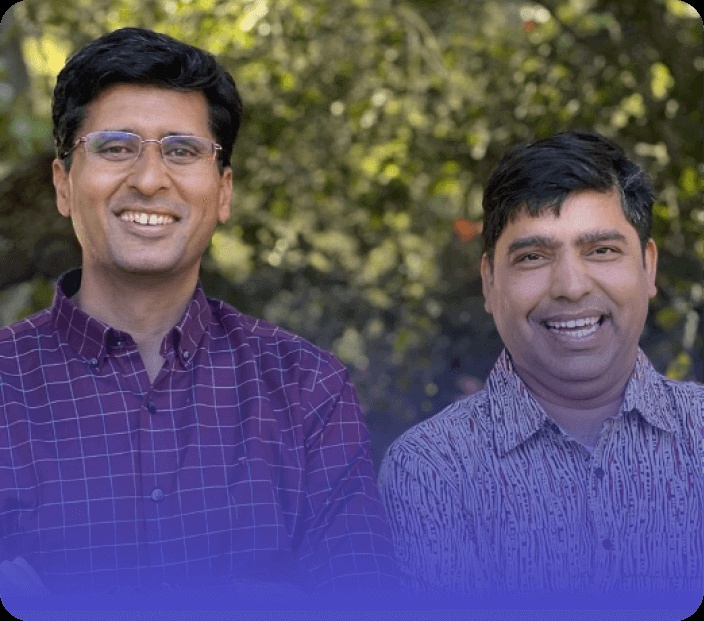
Foundation Capital led the initial financing and incubated the company in its former Menlo Park offices. That detail gives the origin story a useful scale. Before the enterprise deployments and the later funding announcements, there were people trying to make a new security approach work inside somebody else’s office.
A founder has to persuade several audiences in succession. An investor asks whether the idea could become a business. An engineer asks whether it can be built. A customer asks whether it will fit the systems already running. Winning one conversation does remarkably little to excuse you from the next.
Confidential computing addresses the third state, using a hardware-based protected execution environment.
The customer is an exacting editor
Kashyap initially served as CTO. The title put him close to engineering, but the work of a young company was wider. He and Kumar recruited, helped shape the product and looked for customers. Kashyap recalled more than 100 candidate interviews over three months before the first hire.
His account of an early banking opportunity is similarly brisk. A cold email reached a security executive conducting a vendor selection. Fortanix’s product needed additional features to compete; the team built them quickly and won the business. For a researcher, a customer’s requirements can be a rather direct form of peer review.
The episode explains something about the kind of builder Kashyap became. A technical position earns its keep through implementation. The sales process can expose precisely which parts of a promising idea are still missing. The response requires engineering judgment, time and an appetite for discovering that the product is less finished than its creators hoped.
In September 2022, Fortanix announced a $90 million Series C led by Goldman Sachs. Foundation Capital marked the occasion by recalling the company’s beginnings in its offices six years earlier. Financing put resources behind the next stage; it also put more expectations there.
By December, Kashyap had taken on the CEO role. The company’s newsletter placed the appointment alongside an eventful year of financing, executive hiring, product work and expansion. His responsibilities had widened from building the technology to running the organization around it.
The promotion changes the scale of the practical question. A CTO can spend a great deal of effort deciding how a system should work. A CEO also has to consider how the people building, selling and supporting it work together. Kashyap’s earlier experience offers a way to read that transition: each stage of his career added another audience for the same technical idea. The researcher acquired customers; the engineering leader acquired responsibility for the whole business.
- 2016Co-founds Fortanix
Begins as CTO - 2022Becomes CEO
After the Series C year - 2026Extends the argument
To enterprise AI
Who gets to hold the keys?
Some of Kashyap’s later writing concerns a component few people outside security have reason to contemplate: the hardware security module, or HSM. Its job includes protecting cryptographic keys. Those keys help decide who can unlock information. An impressive lock invites a fairly immediate follow-up question about its keyring.
In a November 2025 essay, he argued that cryptographic services should become easier to automate and consume through application programming interfaces. His concern was how security fits distributed infrastructure, where workloads can appear quickly and run across different environments. Managing a physical device is a different proposition from providing a service wherever software needs it.
The interest is consistent with his earlier product work. Protection has to be available in a form a developer can use and an organization can operate. Otherwise, the gap between security policy and daily practice can become expensive. A beautifully specified control still needs a workable route into the application.
This is the operational side of his story. People often describe security through the attack that might happen. Kashyap also writes about the ordinary machinery that must keep functioning: keys, policies, verification and deployment. These subjects have limited red-carpet potential. They do, however, have customers.
AI gives the old question three owners
By 2026, Kashyap was applying his argument to AI infrastructure. In February, he wrote about purpose-built AI factories: environments organized around sustained AI workloads. His point was that infrastructure choices belong inside an organization’s AI strategy, with decisions about control and isolation made alongside decisions about computing capacity.
He also separated protection for the underlying environment from controls addressing an AI application’s behavior. Keeping a workload private and managing what a model says are different engineering tasks. That distinction matters when a buyer is looking at a stack of products whose descriptions all promise security.
His August essay on private and sovereign AI approached the question through ownership. A model provider has invested in the model’s weights. An enterprise wants to use its own sensitive information. A separate organization may operate the infrastructure. Each participant wants something reasonable; their preferences do not automatically fit together.
Put plainly, the customer wants the model nearby without handing over its data. The model builder wants distribution without handing over its intellectual property. The operator needs to run the system. A contract can describe those intentions. Technical verification has to establish what the system actually permits.
The engineering question: can they work together while limiting access to one another’s sensitive assets?
Kashyap’s proposed answer uses trusted execution environments and attestation: hardware-backed isolation, paired with checks on the environment before sensitive material is released. He also acknowledges that implementation matters. Verification has to be performed securely. A reassuring word on a product sheet cannot perform the work of a correctly built system.
A container still needs a boundary
On October 18, 2026, Fortanix announced support for CNCF Confidential Containers in its Confidential AI platform. Containers package applications for deployment; Kubernetes helps run and manage them. The announcement carried the company’s long-standing security question into that way of shipping software.
“Moving AI into containers doesn’t change the threat.”
Anand Kashyap · October 2026
The proposed integration connects environment verification with control of encryption keys. Checks come before key release, including verification covering CPU and GPU hardware. The announcement described open-source plugins under development. The ambition is to make protection travel with a deployment method AI teams already use.
In a contemporaneous interview, Kashyap discussed the practical complications: different hardware configurations, evolving container support and the additional services required around the protected workload. The attention to these details brings the story back to his apprenticeship. Technical possibility is the beginning of the job. Making the pieces cooperate is a further occupation.
There is room for a person outside that occupation. In 2020, Kashyap described family trips and listening to podcasts on subjects ranging from science to history and politics. Curiosity had a life beyond the product roadmap.
That breadth makes a useful counterpoint to the concentration his work demands. His story began with mathematics done by hand, then programming, then research, then products. The steps do not supply a tidy formula for becoming a founder. They show how much preparation can sit behind a company that later gets introduced in a sentence. By the time Kashyap had a startup to run, he had already spent years learning to ask whether an answer could be built and used.
His professional curiosity keeps returning to the same awkward bargain: information must become useful without becoming available to everyone who operates the machinery. Ten years after Fortanix began, AI has supplied new participants and more valuable material to protect. Kashyap is still working through the conditions of the bargain, one deployable system at a time.