Amy Stanton began college preparing to become an engineer. She was good at mathematics and science; engineering seemed a reasonable destination. Then came advanced calculus at the University of Pennsylvania, and a rather less reasonable feeling that she had chosen the wrong room. She transferred to the College of Arts and Sciences, studied communications and added a marketing concentration at Wharton. The future founder of Stanton & Company had made an early discovery about careers: being capable of something is a poor reason to spend your life doing it.
Her subsequent résumé looks purposeful from a distance. New York advertising. An Olympic bid. Martha Stewart. A company of her own. A book about femininity. Up close, the connections are more interesting: a recommendation from a former boss, a campaign that lost, a short stay in a prestigious job, and a persistent question about what women have to suppress to be taken seriously.
The city was the client
Advertising gave Stanton her professional training. She worked in account management at agencies including BBDO, JWT, Ellenson Group and BBH, learning the business from both large organizations and smaller shops. The work was useful preparation for a job she would hardly have known to put on a wish list: marketing New York’s bid for the 2012 Olympic Games.
Jane Gundell, a former boss who became a friend, recommended her for the director of marketing and communications role at NYC2012. Stanton has described Gundell’s kindness and integrity as lasting examples. That introduction changed the scale of her work. An account manager accustomed to representing products was now helping a city explain its future to itself and to the world.
The campaign brought her into contact with Olympic athletes, city leaders and advertising creatives who were accustomed to competing with one another. She helped develop local and international campaigns. There was a shared objective large enough to make people cooperate across their usual boundaries. New York ultimately lost the Games to London. Stanton later attended the London Olympics and admired what the winning city had done.
What survived the defeat was a different appetite for work. She wanted a purpose she could feel. Dan Doctoroff and Jay Kriegel, her bosses on the bid, also gave her a model of leadership that combined directness with consideration. She would carry both the ambition and the manner into her own business.
Martha Stewart, without the fan club
The next opening came through another relationship. Rick Boyko, who had rallied a creative council for the Olympic bid and served on Martha Stewart’s board, recommended Stanton for the chief marketing officer position at Martha Stewart Living Omnimedia. She went into the conversation without the usual credentials of an enthusiast. She had neither followed the magazine nor watched the show nor bought the products.
That makes her recollection of Stewart particularly engaging. She admired an entrepreneur whose attention remained alert to ordinary things. A flea market or a Costco could become an occasion for close observation. The business lessons included the difficulty of coordinating marketing when authority and resources were scattered. The personal lesson was curiosity: even an established brand builder could keep looking at the world as if it still had something to teach her.
Stanton was the company’s first chief marketing officer. She stayed less than a year. It was a substantial title, but her next move would put her name on the door and the responsibility directly behind it.
A business where the women were the point
In 2006, Stanton started the business that became Stanton & Company. The Olympic bid had introduced her to accomplished female athletes whose public visibility seemed out of proportion to their ability. She wanted to help build their platforms and commercial opportunities. With her early business partner, Sheryl Shade, she began assembling a roster of women across different sports.
“There’s no money in women’s sports” was the discouraging refrain she recalled hearing. It made the idea more attractive to her. There is something useful about a consensus that announces itself quite so confidently: at least an entrepreneur knows which assumption she is testing.
The venture broadened as Stanton returned to Los Angeles and the original partnership ended. Representation sat alongside public relations, consulting and events. The agency could work with a person’s public identity, then help connect that identity to partners, audiences and projects. Its emphasis on women remained, even as the client mix expanded beyond athletes.
By 2019, she was describing work alongside clients including gymnast Jordyn Wieber and chef Cat Cora. Her phrase for the people and businesses she wanted to represent was “philosophy-driven”: they needed a point of view. The attraction was a reason for being that could sustain a story over time. For someone selling attention, she was unusually interested in what deserved it.

The other F-word
Stanton’s public argument gradually became more personal. In her TEDxVeniceBeach talk, published in December 2013 under the title Femininity vs. ambition, she put the tension in plain view. A woman could be determined, successful and professionally forceful while still wondering what that performance required her to set aside.
The question became The Feminine Revolution, co-written with Catherine Connors and published by Seal Press on November 6, 2018. Gabby Reece contributed the foreword. Connors brought her own experience in publishing and digital media, including leadership at Babble and Disney’s women and family content business. Stanton brought years spent building brands around women.
The book examines 21 qualities associated with femininity and asks readers to reconsider the judgments attached to them. Sensitivity, intuition and emotional expression receive a hearing. So do glamour, conversation and the pleasure of making a home. The argument is deliberately roomy: traits that have been treated as professional liabilities can also support connection, perception and confidence.
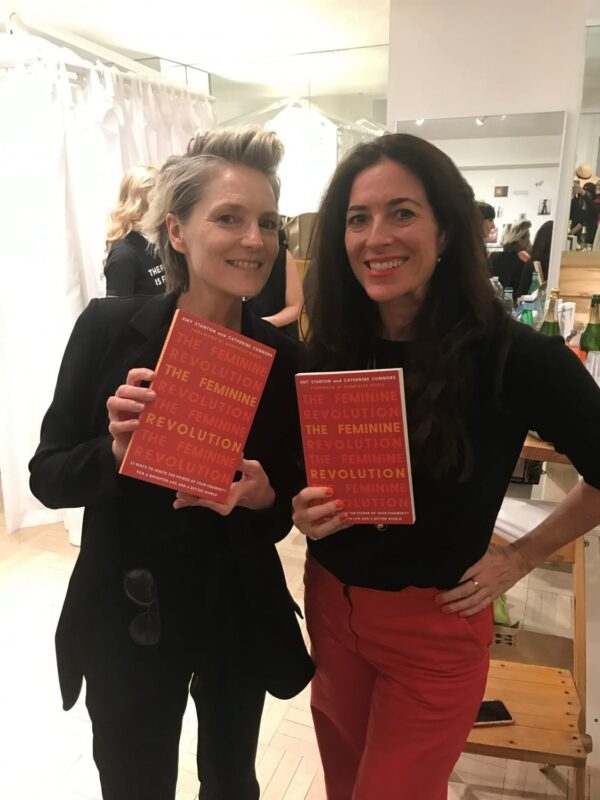
Getting those ideas into print took about five years. Stanton later acknowledged that fear probably had something to do with the delay. A founder used to representing other people was preparing to expose her own thinking to readers who might disagree. Having Connors beside her made the leap easier. The collaboration gave the argument somewhere to go when personal conviction alone had not yet produced a finished book.
In a later conversation with the Insight Out podcast, Stanton returned to the balance between assertiveness and the qualities she had learned to undervalue. Her position allowed for both. A person could develop confidence without treating sensitivity as excess baggage. For a woman whose career involved helping others become visible, this was a surprisingly intimate version of the same assignment.
More room to be yourself.
The book revisits the labels attached to femininity, asking how those qualities might serve life and work.
The grandfather at the desk
Her own model of authority has a family resemblance. Stanton has kept a photograph of her grandfather beside her desk and described asking herself how he would handle a problem. He was her first business mentor. She admired his integrity, deliberate reasoning and belief that a difficult situation could be worked through.
That is a helpful companion for an owner whose surname is also the company name. Responsibility has a certain permanence in that arrangement. Clients may be pleased or displeased; employees may flourish or make mistakes; the person on the door remains accountable. Her grandfather’s example gives that accountability a human reference point, someone to think with when a decision becomes uncomfortable.
She has extended the opportunity to learn through proximity to others. In 2012, Stanton mentored Dina Louis of Cairo through the inaugural U.S. State Department and espnW Global Sports Mentoring Program. Louis was one of 17 women chosen from different countries. Her account of arriving at the agency begins with the team heading into the Santa Monica Mountains on her first day. An introduction to an office had become an introduction to a landscape.
Louis wanted to build a swimming academy in Cairo. Time with Stanton and her team connected an international ambition to the daily business of representing female athletes. For Stanton, whose own career had turned on people making introductions and recommendations, the arrangement offered a practical way to pass that advantage along.
A founder who still takes lessons
The pleasure of following Stanton beyond the job titles is that the hobbies refuse to sound like a strategic plan. She took up dance classes, enjoyed the community around them and started singing lessons. In 2019, her karaoke repertoire included Elton John’s Rocket Man. Her favorite film was When Harry Met Sally. Asked what she would buy after a lottery win, she chose a yacht. Some ambitions deserve a deck.
“I’d rather stop and talk to a dog than a person any day!”
Amy Stanton, 2014
There was also Bernard, her dog, rescued with his mother and siblings after Hurricane Katrina. In a 2014 conversation, Stanton spoke about supporting dog rescue organizations, including the ASPCA and Wags and Walks. Her affection for dogs had a practical outlet in rescue work as well as companionship.
Her writing about travel is similarly concrete. A trip to Greece still involved preparation for client presentations. She described working during vacations and finding small pockets of enjoyment rather than expecting an uninterrupted escape. On arriving at her hotel, she went straight to the pool. The inbox could claim part of the trip; it did not need every minute.
By May 2025, her conversation on Group Y Live had returned to female athletes, representation and the challenge of running a company where people could speak openly. The subjects connect the early agency to the author she became. She is still occupied with who gets heard, how they appear in public and what it costs them to appear that way.
The engineering student changed courses. The marketer changed clients. The founder became a beginner again when she wrote a book and took singing lessons. Across those decisions is a willingness to revise the assignment, including her own. Stanton’s career has room for determination, doubt, a dance class and the occasional dog who has something more interesting to say.