The cockroach arrived during lunch with a national newspaper’s legal correspondent. It landed on Melissa Davis’s head. Her companion’s instruction to stay still was followed by the sound of the insect being dispatched. As relationship-building exercises go, this had the advantage of being difficult to forget.
Davis later recounted the encounter with considerable good humour. Years afterwards, she was still in touch with the journalist, whose beat had moved to the Middle East, where her consultancy also had a growing client base. The lunch had acquired a useful afterlife. The uninvited guest had, presumably, enjoyed rather less of one.
There is a whole professional philosophy inside that small, undignified episode. Davis, founder and chief executive of MD Communications, works in an industry that spends much of its time discussing reputation in abstract terms. Her own explanations tend to involve actual people: someone who made an introduction, someone who answered a call, someone whose company made a long journey enjoyable.
She advises lawyers on being understood and remembered. She has also spent years giving them reasons to remember her. The interesting question is how those apparently ordinary encounters become the foundations of a business.
Three clients, and a nervous departure
In 2010, Davis left the Law Society of England and Wales, where she had led media and PR, to start her own consultancy. She had experience of the legal profession’s public arguments and institutional habits. Leaving a respected organisation still invited questions, including from her father. She had questions of her own.
Her opening target was pleasingly concrete: three clients on launch day. Those clients were Peters & Peters, the Legal Ombudsman and barrister Gerard McDermott, then a QC. Each subsequently introduced her to others. The first contracts provided income; the introductions gave the enterprise somewhere to go.
She remembers different lessons from each relationship. Keith Oliver at Peters & Peters showed her the continuing work involved in a network. McDermott demonstrated composure and an appetite for trying new things. Adam Sampson, then chief executive of the Legal Ombudsman, encouraged her to take her own abilities seriously.
That is a more personal account of founding than the usual slide of logos and dates. Davis describes business knowledge arriving through particular people, each with a recognisable influence. It makes sense that the resulting firm would sell advice in which understanding the person matters as much as understanding the organisation.
The long-train-journey test
Sampson also supplied a practical test for a working relationship: could you sit together on a long train journey? Davis adopted it when thinking about whom to work with. It is a demanding little standard. A meeting has an agenda and an escape route. A train to Birmingham offers fewer distractions from someone’s personality.
The test fits a founder who credits her parents with teaching her perseverance. They left school at fourteen and bought their own shop while still young. Their example gave her a close view of people taking responsibility for an enterprise. Her own move into ownership came with the less glamorous discovery that the accounts now belonged to her too.
Her connection to Darlington remains part of how she describes herself. In a recent public post, she celebrated the town’s station redevelopment and noted that she and Lewis Silkin joint managing partner Jo Farmer had both grown up there. Both had been shortlisted at the Women and Diversity in Law Awards in 2026. The coincidence mattered to her as a connection between people, careers and a shared place.
Davis’s working world is international, but her way of talking about it repeatedly returns to these smaller points of recognition. A hometown, a railway carriage and an early client can explain more about trust than a polished paragraph promising it.
The colleague she nearly missed
Relationships also require a willingness to reconsider your first answer. Davis has described almost passing over Linsay Leslie because she was based in Scotland while the consultancy was based in London. Leslie joined in 2017 and became a partner in 2019. By the firm’s tenth anniversary, Davis was openly grateful that geography had not settled the decision.
It is an instructive admission from someone whose business depends on judgement. The founder could see, retrospectively, that a familiar assumption about location might have cost her a valued colleague. The company went on recruiting from a wider geographical pool. The story has a useful modesty: an important hiring decision included a concern she later thought better of.
In 2024, after the birth of her second daughter, she wrote about handing responsibility to colleagues, including Leslie and James Hayhurst, her partner at home and at work. Louise Hood joined the partnership team during that period. Davis found that giving people room to decide helped the business and gave her more time to think about its direction.
For a founder whose work involves being available, turning off phone notifications was a small but revealing choice. She described choosing when to enter the working day. Delegation had become something she could practise rather than merely recommend.
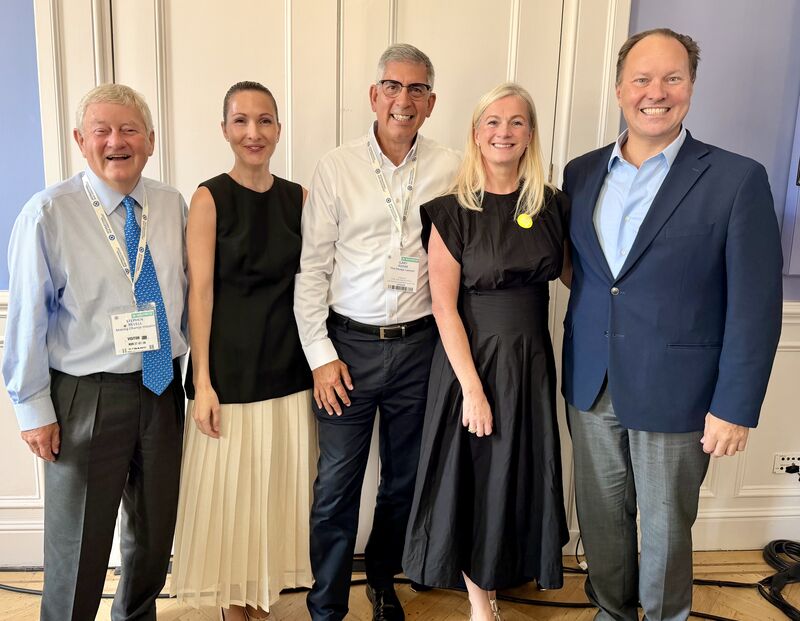
A hand in the air says quite a lot
In July 2026, Davis returned for her sixth year on the International Bar Association’s Law Firm Management Committee Academy for Leaders. At King’s College London, the programme brought together leaders from more than twenty jurisdictions. Her session covered business development, reputation and personal brand.
She brought a question from her experience as a Legal 500 referee: would you follow your principal lawyer if that lawyer changed firms? Almost every hand went up. It was an economical demonstration of a problem that law firms can spend substantial sums trying to understand.
The firm owns its name, offices and presentation. The person across the table may own much of the client’s loyalty. Davis used the response to raise the need for stronger relationships with the institution alongside the individual. The audience had supplied the evidence before she needed to labour the argument.
Her book, How to PR a Law Firm, published in 2023, gives that outlook a practical form. Its subjects include journalists, campaigns, social media, personal brand, legal directories, awards and crises. Reputation becomes a collection of daily responsibilities, distributed around a firm rather than confined to the person who writes its announcements.
When everyone wants a quick reply
There is a sterner side to being remembered. Davis’s work includes helping organisations communicate when attention is unwelcome. Her advice on misinformation puts preparation before the dramatic moment: decide who needs to act, establish the facts and make sure the lawyers, communicators and leaders are working together.
She has warned that an emphatic denial can give an allegation a larger audience. Silence has its own dangers. The difficult work lies in judging what is true, correcting errors and explaining the response without turning every criticism into a public wrestling match.
“Fake news travels faster than due diligence.”
Melissa Davis, discussing crisis communications
The line has the briskness of someone accustomed to impatient newsrooms. Her broader point is that an organisation needs habits it can rely on when the clock speeds up. Rehearsal matters because the first public statement is a poor moment to discover that nobody agreed who was responsible for it.
Her earlier writing about journalist lunches is similarly practical. Read the reporter’s work. Choose somewhere you can hear one another. Be useful beyond your immediate pitch. Answer when the journalist calls later. Even the colourful cockroach story ends in the ordinary discipline of maintaining contact.
AI enters the conversation
By October 2026, those questions of contact and confidence were appearing in MD Communications’ research on artificial intelligence. Launched at the IBA conference in Copenhagen, Human in the Loop examined the lawyer’s role as a trusted adviser. It combined a survey of fifty legal-services businesses across several regions with detailed interviews.
The survey identified confidence as a significant obstacle to developing the next generation’s relationship-building skills. It also found plans to invest in business development and, among a majority of respondents, to increase headcount. These are findings from that research sample, rather than a census of the profession. They give Davis specific questions to put to leaders considering how their firms will change.
The work between people
Her interest in technology sits beside a long-running interest in how people become known for useful work. In May 2026, she compared LinkedIn participation with attending a large legal conference. Trying to meet everyone leaves little time for a worthwhile conversation. Being associated with a particular subject gives others a reason to remember you and make an introduction.
The consultancy is also extending its international capabilities. Helen Scott, who worked with the team on a project in 2020, returned as international PR director in September 2026. Davis welcomed someone she already knew, with experience as both a solicitor and a communications adviser. Once again, a previous working relationship had become part of the next chapter.
The introduction has somewhere to go
Some of Davis’s work puts communications behind a cause rather than a client’s profile. She co-founded the Parents Promise with Hayhurst, and MD Communications powers it as a major pro bono initiative. Launched in 2021, it asks parents to commit to putting children first if their relationship later ends.
A 2025 initiative took that work into schools, with resources for teachers and parents and a launch in Parliament. The practical ambition was to help adults manage separation without allowing their disagreements to take over school life. It connects her professional skills with an explicit public objective.
In 2026 she was shortlisted for Business Leader of the Year at the Women and Diversity in Law Awards. Her contribution also appeared in Deborah Brightman Farone’s Breaking Ground, a book about women building legal practices. These are recognitions of a career spent close to the profession without practising law herself.
The next stage of that career is already taking shape through teaching, research, recruitment and campaigning. The recurring activity is easy to overlook because it sounds so ordinary: keeping a relationship alive long enough for something useful to happen. Davis has made a business of that work. Occasionally, lunch supplies an anecdote too.