There is a useful kind of person at every large conference. They know which managing partner has just arrived, which journalist is looking for a quote, which introduction would be helpful and which conversation should wait until after coffee. Melissa Davis built a company out of being that person - then hired more people who understood why the introduction mattered.
MD Communications began in London in 2010, after Davis left her job as Head of Media and PR at the Law Society of England and Wales. Some people questioned the wisdom of leaving a respected institution for a new consultancy. Her father did, too. The proposed product was not exotic: better brand awareness and stronger reputations for the UK legal sector. The interesting part was the machinery behind it. Davis knew the media, the professional bodies and the peculiar rhythms of law firms. She was not learning the market while billing the client.
Today the company is a specialist communications consultancy for law firms, barristers' chambers and other professional-services businesses. It works on public relations, reputation, crises and litigation, brand and messaging, digital content, social channels, internal communications, client listening, legal directories, awards, bids, tenders, training and events. The list is long because the underlying problem is stubborn: professional firms possess plenty of knowledge but often struggle to turn it into a clear reason to be chosen.
The niche is the distribution system
A generalist agency can send a press release. MD Communications sells context: which legal publication will care, how a cautious partnership is likely to react, what a directory researcher needs, and whether the polished claim in a campaign can be defended by employees and clients. Its advisers have worked inside law firms, accountancy firms, consultancies, business publications and agencies. The company says each consultant brings at least 15 years of experience. Seniority is not decoration here. It reduces the translation tax between a lawyer describing a complicated issue and a journalist deciding whether anyone else should hear about it.
The reputation circuit
Leaders, lawyers, employees, culture, matter evidence and client relationships.
Journalists, directories, associations, recruits, referrers and prospective clients.
That loop explains why the menu reaches beyond PR. Client listening discovers what buyers actually value. Directory work forces a firm to collect evidence and referees. Bids convert evidence into possible revenue. Employer-brand work checks whether the internal experience matches the external promise. Crisis counsel tests the entire structure under pressure. Different deliverables, same raw material.
A crisis is a very expensive first date
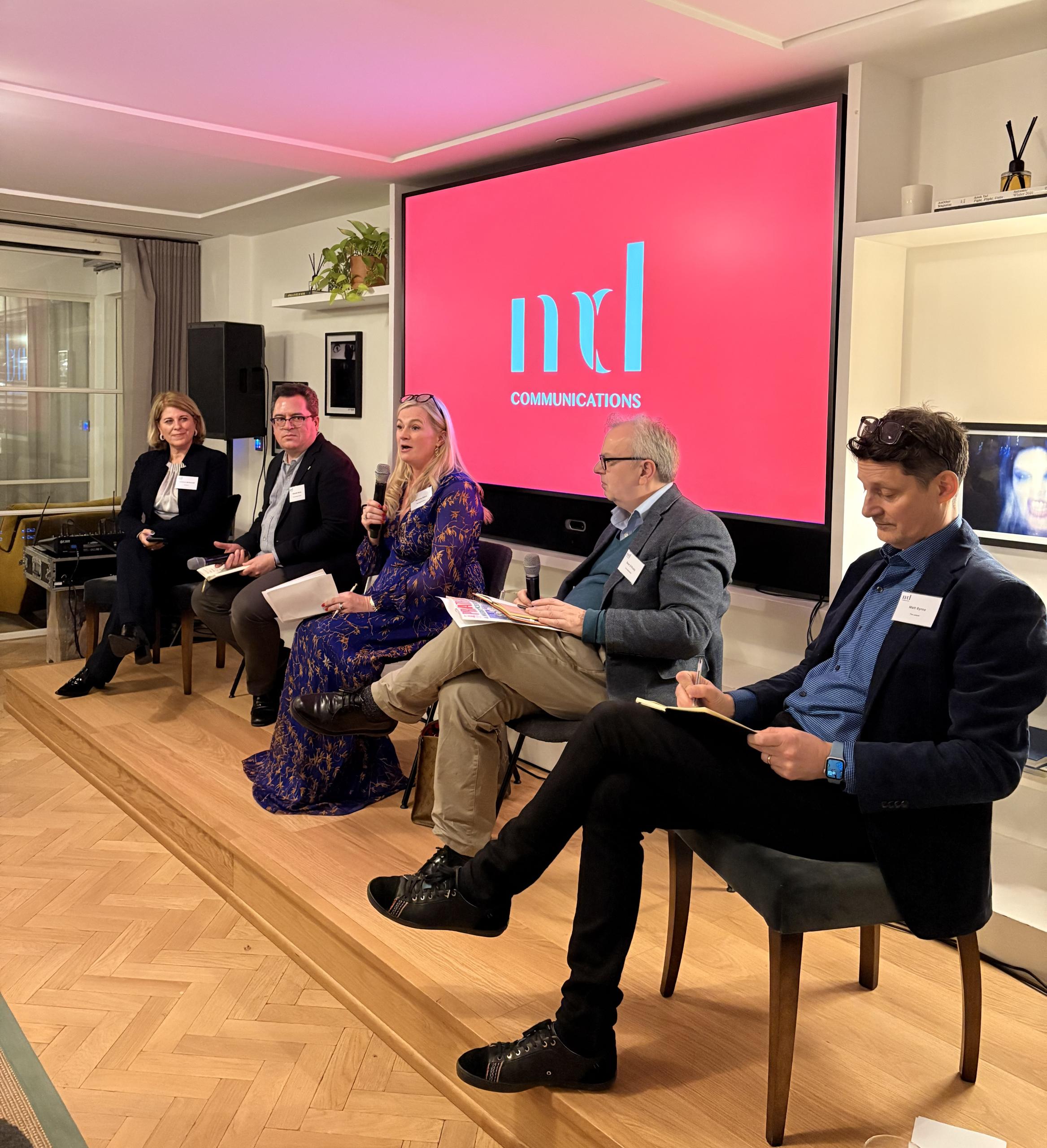
At a 2025 Meet the Media event, Davis chaired a panel with journalists from the Law Society Gazette, The Lawyer, Channel 4 and The Independent. Their advice was bracingly practical. Appoint a spokesperson. Understand the difference between public interest and what merely interests the public. Avoid “no comment.” Above all, build press relationships before the bad day arrives. If an organisation appears only when it wants a damaging story softened, the relationship is already malformed.
“Journalists aren't your friends - don't try to control the narrative.”Published takeaway from Meet the Media, 2025
This is where the firm differs from a publicity shop. Reputation is treated less like paint and more like stored credit. Useful research adds some. Thoughtful access adds some. Responsive experts add some. A defensive memo that leaks, a vague statement or a burst of superficial values language spends it quickly.
The same logic appears in the company's 2024 workplace-culture study. Of 150 law firms, chambers and in-house legal departments surveyed, 95 percent called culture important or very important to business success. Yet only one third rated their current culture very good. The gap is a communications problem only in the broadest sense. No slogan closes it. The actual workplace has to change before the story becomes credible.
The almost-mistake that became the model
One detail from the company's tenth-anniversary account says more than the usual origin mythology. In 2017, Davis almost did not hire Linsay Leslie because Leslie lived in Scotland and the consultancy was London-based. Leslie joined, became a partner in 2019 and built an international practice. By 2020, hiring from a country-wide and worldwide talent pool was ordinary for MD Communications while many employers were discovering it under duress.
The change of mind was not a grand manifesto about distributed work. It was evidence: the person worked, the clients worked and geography mattered less than expected. That is a more useful lesson than pretending the company predicted the future. Small firms can test an exception, notice when it succeeds and promote the exception into the operating model.
Geographic reach now comes from people and partnerships rather than a procession of owned offices. MD Communications works internationally from London and has a strategic partnership with LLYC, whose presence across Latin America and Spain gives clients a bridge in both directions. The International Bar Association supplies another network. Davis has held committee and advisory roles there, and the firm provides pro bono communications support for IBA projects.
Products that also make a market
The cleverest outputs create reasons for the legal community to participate. Annual “What Lies Ahead” reports invite leaders to think aloud about AI, salaries, hybrid work and geopolitics. The 2025 edition found 86 percent of respondents viewed AI as a friend, while 63 percent felt more optimistic about the year than they had about 2024. “Navigating Global Growth,” launched around the 2025 IBA conference, turned the concerns of independent firms into a shared subject. These reports generate material for media, but they also provide a service: they tell a fragmented market what its peers are thinking.
Then there is the Legal 5K, a charity run in Regent's Park. The inaugural 2024 event drew 600 runners; the company reported more than 800 in 2026. It is a neat piece of institutional design. People who have sat through enough hotel networking can meet while doing something mildly ridiculous, physically useful and publicly generous.
The pro bono work is similarly woven into operations. MD Communications supports the InterLaw Diversity Forum and IBA projects, and powers The Parents Promise, co-founded by Davis and partner James Hayhurst to support children through parental separation. The company says a 2023 campaign helped persuade Tesco, Unilever and Vodafone to amend relevant HR policies, while a 2025 campaign produced more than 2,000 downloads of parent and teacher resources. Davis's 2023 book, How to PR a Law Firm, directs its proceeds to work in the autism space.
The copyable part
Do three things before deadline week: collect strong matter evidence all year, ask clients what they actually experience, and build journalist relationships when nothing is on fire. The method is dull in the way seatbelts are dull. That is why it travels.
What the buyer is really buying
Public pricing is absent, which fits a bespoke consultancy whose work can range from training or a directory project to ongoing reputation support. The economic proposition is senior judgment without building every specialty in-house. A law firm can buy a press office, a crisis adviser, a LinkedIn coach, a listening programme or help with a tender from one network of specialists. The alternative is an internal team, a generalist corporate agency or another specialist legal-marketing consultancy.
The model has conditions. It depends on access to leaders, timely answers and real evidence. A consultant cannot manufacture a healthy culture from a values page, make an unresponsive expert useful to a deadline reporter or rescue a weak directory submission without strong work and willing referees. Network effects also cut both ways: in a tight professional community, careless work travels quickly.
MD Communications' defensible position is therefore less glamorous than fame and more durable than novelty. It knows the room. It knows why the room has gathered. And after sixteen years, it has created several of the reasons to gather in the first place.