Amira Yahyaoui has a system for packing a suitcase. A trip somewhere cold gets one list; a trip to the beach gets another. Her family’s Tunisian recipes live in a shared digital cookbook, where her mother contributes and her aunt can add her own instructions. Even the apparently spontaneous business of leaving town has been given a little administrative help.
These are modest details in a life that has involved exile, revolution and the founding of two very different organizations. They are also a useful place to begin. Yahyaoui has spent much of her public life confronting systems that require ordinary people to know an unreasonable amount before they can participate. Sometimes the missing information concerns a parliamentary debate. Sometimes it concerns paying for college.
Her response has repeatedly been to make a route through. At Al Bawsala, the organization she founded after Tunisia’s revolution, that meant helping citizens follow their representatives. At Mos, it meant helping American students find financial aid. The route through entrepreneurship proved less orderly than a packing list. There was a banking expansion, a retreat and scrutiny of the numbers used to describe the company’s success.
A family with an inconvenient habit
Yahyaoui was born in Tunis in 1984. Her father, Mokhtar Yahyaoui, was a judge who challenged the lack of independence of Tunisia’s judiciary under President Zine El Abidine Ben Ali and lost his job. Political disagreement had consequences inside the family long before it became a subject for a conference stage.
As a teenager, she campaigned for freedom of expression. Exile took her to France. The country she had left remained central to her work: she continued speaking against the regime and participating in the networks of Tunisians organizing abroad. The internet offered a way to remain involved across a border.
Her account of those years places a particular value on education. Living without the documents that would have allowed a conventional student life, she pursued learning without obtaining a college degree. The later interest in access to higher education grew out of an exclusion she had experienced herself. A university can be nearby and still be out of reach.
The revolution needed a notebook
After Ben Ali’s departure in January 2011, Yahyaoui returned to Tunisia. She stood as an independent candidate in the election for the assembly that would write a new constitution. The work of opposing a government was giving way to the work of deciding how its replacement should behave.
Al Bawsala, whose name means “the compass,” took shape in that transition. Its early work included identifying assembly members and making their activities visible. For citizens trying to understand a new political order, even knowing who was speaking mattered.
The organization followed legislative proceedings and advocated for rights. Technology helped put the information within public reach. This was painstaking work with an immediate purpose: someone outside the room should be able to understand what happened inside it.
Yahyaoui also argued for treating civil society as paid, sustained work. A constitution does not arrange its debates around volunteers’ spare weekends. Her account of Al Bawsala stressed the need to attend, record and keep attending. The revolution had created a considerable amount of homework.
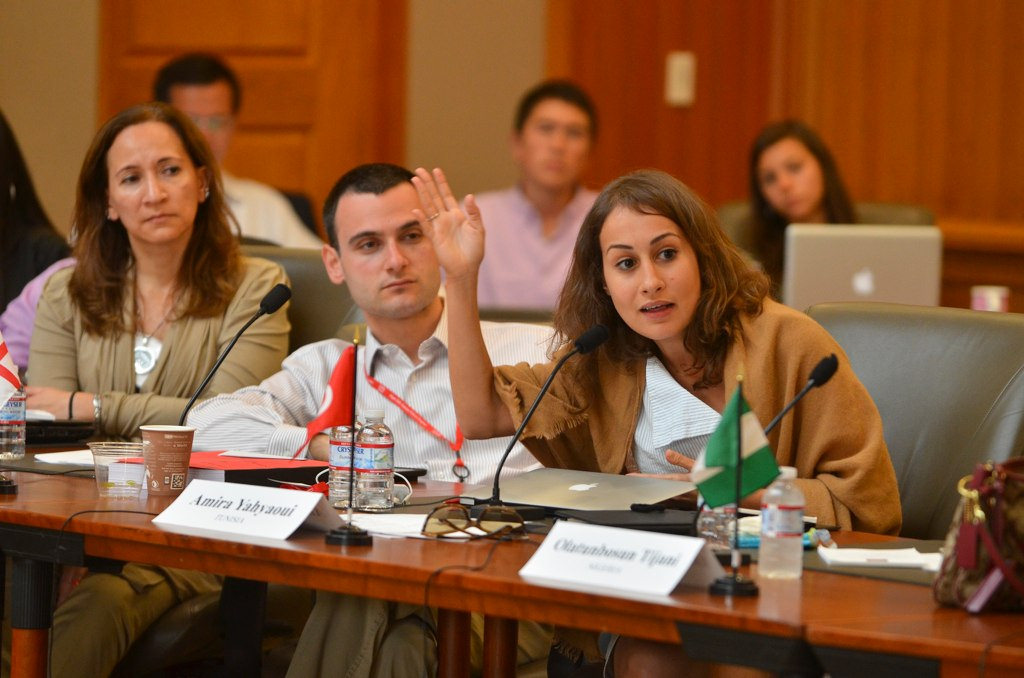
A seat at a rather different table
International recognition followed the civic work. Yahyaoui received a Vital Voices Global Trailblazer award in 2012, became a Yale World Fellow in 2014 and received the Fondation Chirac’s Conflict Prevention Prize that year. Stanford’s Draper Hills Summer Fellowship also brought her into a community of people working on democracy and development.
In 2016, she co-chaired the World Economic Forum’s annual meeting in Davos. The other co-chairs included Microsoft’s Satya Nadella and General Motors’ Mary Barra. Yahyaoui arrived with experience of watching public institutions from the citizen’s side of the desk.
The meeting’s theme was the Fourth Industrial Revolution. Her own work offered a concrete question to put beside the grand terminology: could technology help people understand the decisions being made in their name? A public database might lack the theatre of a futuristic demonstration, but it could give a citizen something useful to do tomorrow.
- 2011Returns to Tunisia after the revolution
- 2014Yale and Stanford fellowships
- 2016Co-chairs the Davos annual meeting
- 2017Mos founded
- 2023Mos closes its banking service
- 2025Mos recorded as acquired
Thirty chickens, then California
Between the watchdog and the startup came a farm. Yahyaoui has recalled spending six months there with 30 chickens after leaving Al Bawsala. It is a pleasingly specific interval in a biography otherwise crowded with institutions. The chickens, at least, were unlikely to request a panel discussion.
She has described the idea for Mos taking shape during that period, and a subsequent meeting with Khaled Helioui helping her see its potential. The move toward California was a change of setting and working method. She would build a company around an obstacle that families encountered in everyday life.
Mos was founded in 2017. Its name borrowed from Mos Espa in Star Wars, a connection to the films’ Tunisian locations. The business itself stayed firmly terrestrial: identify money available for education and help students navigate the process of asking for it. Space travel could wait until the tuition bill was settled.
The paperwork between a student and a future
The original Mos proposition combined software with people. Students supplied information about their circumstances; the service looked for aid they might qualify for, while advisors helped with the next steps. Eligibility was only the beginning. Applications, supporting documents and deadlines still stood between a possible award and a paid bill.
That distinction gives the company’s founding idea its force. A student can work hard, earn admission and remain baffled by the financial machinery attached to the offer. Families familiar with the process have an advantage. Other families must learn the vocabulary while the clock is running.
In her public interviews, Yahyaoui has returned to the people facing that problem. “For me, it's the people we're building for.” The sentence explains her stated motivation. It also sets a demanding standard for judging the service.
Mos produced educational material on social media, including TikTok, putting financial aid explanations where students were already looking. An advisor and a short video served different purposes, but both addressed the difficulty of finding an understandable answer at the right time.
When the numbers needed explaining
Mos expanded into student banking in September 2021. A $40 million financing followed in February 2022, at a reported company valuation of $400 million. The ambition stretched beyond college aid toward a longer financial relationship with young adults.
The banking service closed in 2023, and Mos cut staffing. A March 2024 investigation questioned its public metrics, reporting roughly 30,000 paying aid customers within a much larger registration total and raising concerns about how aid eligibility had been described as savings. Those were reported findings and allegations; the company’s spokeswoman declined to comment for that account.
The distinctions matter. Registering for an account, paying for help and receiving funding describe different events. A founder’s personal history cannot settle which outcome a product delivered.
The episode brings an uncomfortable symmetry to Yahyaoui’s career. Her civic work asked institutions to make their activities visible. A business promising greater access invites close examination of its own results.
A packing list and a family cookbook
Outside the company narrative, Yahyaoui’s interests provide a more intimate vocabulary. She has recommended political philosophy, including Étienne de La Boétie’s writing on voluntary servitude and Frantz Fanon’s The Wretched of the Earth. Questions about authority and participation have followed her from activism into business.
Her organizational habits occupy another register. Packing templates take one recurring decision off the table. A shared cookbook lets family knowledge travel between generations. The same software that holds a calendar can preserve a recipe someone remembers from childhood.
It would be a stretch to make a suitcase explain a career. Still, these details suggest the pleasure she takes in arranging information so it can be used. Her mother and aunt get to contribute, rather than merely receive the finished document.
“I would tell her to learn how to rest.”
Yahyaoui’s advice to her earlier self, 2020
That advice is refreshingly undramatic. A person can have ambitions for institutions and still need an afternoon off. Founder biographies would be more believable if they allowed both.
The door is still the question
By October 2026, Mos’s public website was again centered on scholarships, college financial plans and advisors. Its investor record listed an acquisition in 2025. The banking ambition belongs to an earlier chapter; the college money question remains visible in the product.
Across Yahyaoui’s career, a recurring subject is participation: being able to speak, follow a government’s work, enter an institution or obtain the help for which someone might qualify. Each involves an opening that can exist in principle while remaining difficult to use.
Her story contains achievements, errors of direction and questions about accountability. It resists the tidy ending in which a compelling origin guarantees a successful company. What continues to make it interesting is the practical problem she chose to pursue. Somewhere between a promise and a person sits a procedure. Someone has to make it understandable, and someone has to check that it works.
Read, watch, follow
- Mos: scholarships and financial aid · Company profile
- LinkedIn · X / @Mira404
- Watch: Youth Are Not the Future · Watch: women’s rights in Tunisia
- Al Bawsala and the work after the revolution
- The 2020 All Raise interview · The Pulse Spikes interview
- Inside her organizational habits
- March 2024 investigation, reproduced at New Edge Times
- Yale biography · Vital Voices · The 2016 Davos co-chairs · Mos’s investor record