Amir Reiter’s first useful business lesson arrived disguised as a water cooler. While in college, he imported and sold the machines, discovering that he could network, sell, and persuade. He also discovered that enthusiasm cannot compensate for aiming at the wrong buyer. Office managers and building custodians might appreciate the product, but their purchasing power put a low ceiling over the enterprise. Years later, Reiter could joke that steady door-to-door rentals might have made him rich by 33. The regret contained a principle he kept: small wins, repeated patiently, have a way of becoming large ones.
The path from those coolers to CloudTask did not run straight. Reiter sold office equipment, managed a water business, led sales and marketing at COSS Express, represented medical robotics, and worked with NetSuite. It reads less like a polished founder origin story than a long apprenticeship in how organizations buy. He learned the customer’s vocabulary, the difference between a user and a decision-maker, and the peculiar theater of enterprise promises. By 2015, when CloudTask began, he had spent a decade close enough to the sale to notice the machinery behind it.
The long apprenticeship
The company between two cities
CloudTask started as a managed workforce business for sales development, sales chat, and customer support. Its geography became part of the product. Reiter maintained ties to San Francisco while building in Medellín, a city he first visited with his mentor, software executive Eric Amon. The attraction was practical and personal: time-zone alignment with the United States, a growing technology community, and access to ambitious professionals whose careers could travel farther than they could.
Medellín also rearranged Reiter’s life. He met his future spouse while buying computers for his team at an electronics store. They remained friends for years, later started a family, and she joined CloudTask’s leadership as chief operating officer. He talks about the city with the convert’s inventory of small pleasures: reliable weather, early sleep, mountain hikes, food, a network of technology founders, and a Vizsla with an apparent instinct for posing. San Francisco supplies clients and concentrated ambition. Medellín supplies proximity to the people CloudTask places. Reiter moves between the two.
“Treat them like they might work with you for eight years. Get to know them and build real relationships in person.”Amir Reiter on distributed teams
That line is his remote-hiring doctrine compressed into two sentences. He advises American executives to fly down, meet the people doing the work, and share a meal. Contracts matter. Salary bands matter. Tools matter. Longevity is secured in the ordinary signals that say a colleague belongs. In one interview, he contrasted teams visited by their executives with arrangements treated as anonymous outsourcing. His conclusion was emphatic: the visited teams lasted.
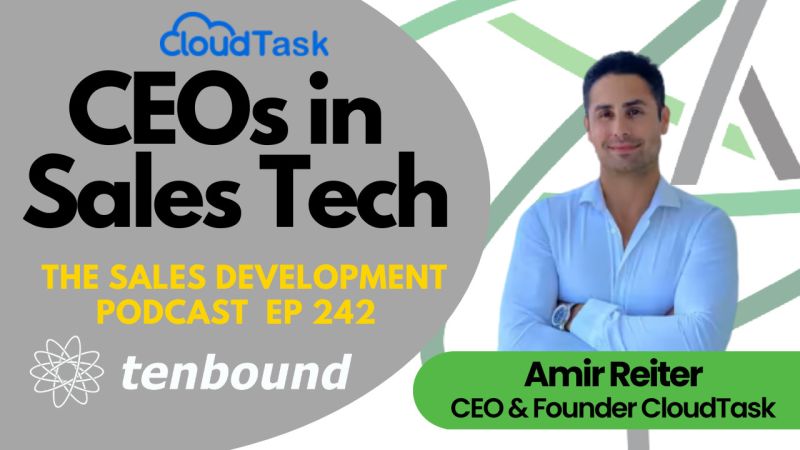
A profitable machine meets a dangerous idea
The service company grew. Reiter has described an operation of 265 contractors and roughly $6 million in revenue, made profitable by a cost base far below an equivalent American team. Success introduced a more interesting problem. Buyers often arrived asking for sales development representatives when their actual weaknesses lay elsewhere: an untested market, vague positioning, poor data, no coaching, or expectations that no honest team could meet.
A service provider has an awkward incentive in that conversation. It sells what it employs. If one agency refuses to promise fifteen-minute meetings before a product has market validation, another can nod pleasantly and take the contract. Reiter wanted a marketplace broad enough to show buyers agencies, software, and candidates, then diagnose the business challenge before prescribing the labor. He compared the idea to a store that carries every car brand and can recommend the right one.
So he took apart the profitable machine. CloudTask moved toward a technology marketplace. The ambition was enormous, and so was the bill for learning. A platform with more suppliers does not automatically produce more trust. Categories create choice, but they also create competing loyalties. Reiter later admitted that the expansion into software and service-provider relationships pulled him away from what had worked for him: helping people learn sales, customer success, and business development, then connecting them with careers.
The reset arrived in public. Reiter wrote that the previous three years had been tough and that the marketplace experiment had created friction. Some people who liked him in person read him differently online. Feedback from entrepreneur Khari Harper made the mismatch impossible to ignore. Reiter’s post did not hide behind a tasteful phrase like strategic realignment. “We have made a hard stop,” he wrote. CloudTask would close down the distracting relationships and focus on GTM, RevOps, and AI-trained talent.
The revised promise is deliberately concrete. CloudTask advertises vetted matches in 48 hours and a 24-month replacement guarantee, while positioning its team between an open job board and a conventional recruiting firm. Reiter’s contribution is the insistence that speed should follow diagnosis. A quick match built on a vague role only delivers the wrong answer sooner. The buyer has to reveal the compensation, expectations, workflow, and actual constraint. The candidate has to reveal how the work gets done. Transparency becomes part of the product.
“The more information you give, the better matches you’ll receive.”Amir Reiter on marketplace transparency
The operator replaces the script
The narrowed CloudTask still carries the useful piece of the marketplace idea: a buyer should understand what it is buying. Reiter’s latest argument is that many companies are buying a job description from 2019. The old sales development representative worked a sequence: make calls, send emails, book meetings, report activity. The emerging operator owns an outcome and can assemble a working system from tools such as Clay, Apollo, HubSpot, ChatGPT, and whatever arrives next Tuesday.
His preferred evidence changes accordingly. A résumé lists responsibilities. An operator can explain a workflow, demonstrate the tools, and show receipts. This gives Latin American candidates a route around pedigree. Software fluency can be learned and displayed. A candidate who once answered support tickets can become a revenue leader if someone supplies coaching, responsibility, and time. Reiter regularly points to long-tenured CloudTask colleagues who moved from junior roles into leadership as proof of that compounding.
There is tension in the thesis, and Reiter does not avoid it. AI should make companies faster, cheaper, and more efficient. It may also make them leaner. His hopeful answer is that lower barriers will create more specialized companies, spreading work across a larger number of smaller organizations. CloudTask’s job, in that version of the future, is not to preserve every old task. It is to get tools into people’s hands and teach them to ask better questions.
The rebel discovers patience
Reiter’s public personality is direct, loose, and occasionally combustible. He calls interview hosts “dude,” describes himself as a rebel, and is willing to say that a profitable pivot may end with either a pat on the back or proof that he was an idiot. The candor makes his later emphasis on patience more revealing. Young founders, he has argued, can be so ambitious that they overlook the dull ingredients of success: relationships, incremental improvement, and enough repetition for compounding to become visible.
His management ideas have long leaned toward trust. In 2018, he described sitting among employees, reducing layers of approval, rewarding experiments, and promoting internally. CloudTask once gave a bungee jump as an innovation prize after an account manager’s outreach idea improved results. The detail is wonderfully Reiter: freedom, competition, and a small amount of controlled peril.
The more durable version is quieter. A company visits its contractors. A manager teaches someone a new system. A marketplace tells a buyer that the requested solution will not work. A founder hears that his online presence has injured the mission and changes course. Reiter’s career keeps returning to the same exchange: confidence earns attention, but accountability earns another chance.
CloudTask now says it has made more than 10,365 full-time placements across 160 roles, with an average placement lasting two years. It lists four consecutive Inc. 500 appearances and a founding-team move to Medellín in 2026. Those figures describe scale. The more personal measure is Reiter’s stated pride in helping people land jobs, build families, and grow businesses. It is the part of the company he recovered after the marketplace became too broad.
A water cooler taught him to choose the buyer. An agency taught him to manage the work. A costly platform pivot taught him to choose the mission. The next wager is that AI can give talented people more leverage without turning them into interchangeable profiles. Reiter has spent twenty years learning that markets reward clarity. He is now trying to make clarity feel like opportunity on both sides of the match.