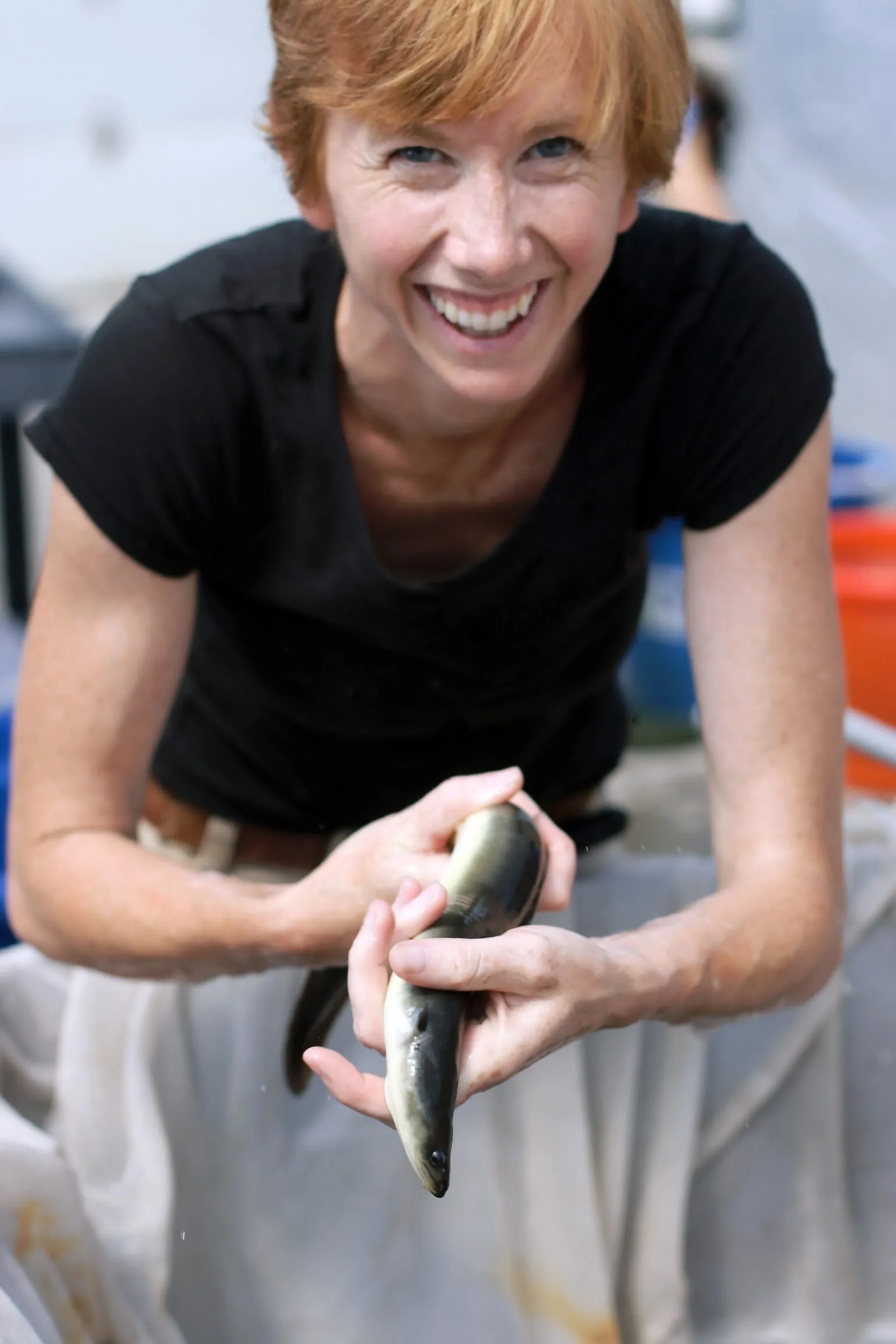
The American eel has a passport problem. A transparent juvenile, no longer than a toothpick, can be netted in a Maine river, flown to an Asian farm, grown for months, cooked, frozen and shipped back to an American sushi counter. Sara Rademaker saw that itinerary and, in 2014, placed a few glass eels in a tank in her basement. The premise of American Unagi was almost suspiciously sensible: keep the fish in Maine, keep its identity intact and sell a fresher eel to the country that caught it.
Rademaker was not a foodie playing farmer. She had studied fisheries and aquaculture at Auburn University, worked in a fish-disease lab, joined aquaculture projects in Uganda and Ghana, and helped Maine students build small coastal enterprises. She wanted a land-based farm using recirculating aquaculture systems, or RAS. What she lacked was the right species. Salmon demanded giant facilities and provoked giant fights. Eels were hardy, grew densely and already arrived every spring beside one of America’s most closely monitored fisheries.
There was one discomfort: eel farming is capture-based. Farms still depend on wild juveniles because no one has reliably closed the American eel’s breeding cycle at commercial scale. Rademaker hesitated. What changed her calculation was Maine’s response to an unruly, high-value fishery - quotas, licensed dealers, cashless transactions and a swipe-card system tracking landings. The wild input did not disappear, but chain of custody became a product feature rather than a shrug.
A supply chain drawn like a boomerang
American Unagi bought glass eels from licensed Maine harvesters, quarantined them, then managed heat, oxygen, pH, feed and water in indoor tanks. The fish grew from roughly 0.15 grams to anywhere from four ounces to more than a pound over eight months to two years. They did not grow evenly, so grading - the unglamorous ritual of sorting larger eels from smaller ones - became daily work.
The shortened route
The operating trick was enormous biological leverage. Rademaker said one pound of glass eels could become 1,000 pounds of grown fish. The commercial proposition was equally clear. Imported unagi generally arrived pre-cooked, sauced and frozen. American Unagi could offer live eel to chefs who wanted control, clean butterflied fillets to cooks who did not want a knife fight, and smoked or tinned eel to shoppers who wanted dinner without an apprenticeship.
Early customers included Cafe Sushi in Boston and Maine restaurants Solo Italiano, Hugo’s, Eventide Oyster Co. and Miyake. Later, the company sold through distributors and grocery channels, shipped direct from its Shopify store, and served the sort of restaurants investors describe with the useful phrase “Michelin-starred.” Public online prices ranged from $20 for smoked eel to $36 for premium fillets and $32 for a tin. In 2021, live eel was reported at $16 to $18 a pound.
The basement was a risk-control system
The cute version of the founding story is that Rademaker grew her first eels in a basement. The useful version is that she refused to confuse a plausible spreadsheet with a working farm. She moved from a handful of fish to a few thousand, then into University of Maine incubator space. By the time American Unagi committed to its commercial plant, the team had completed seven glass-eel seasons and several staff members had farmed beside her for four years.
“I started small, growing a handful of eels in my basement in the first year.”Sara Rademaker
That sequence answers what a reader can copy. Test the difficult unit before buying the beautiful factory. Borrow scientific infrastructure when it exists. Sell to demanding customers early. Add products that reduce adoption friction. And, before applying for town approval, talk to the people who work on the water. Rademaker spoke with Waldoboro’s clamming committee first. The project earned local permission partly because it extended a fishery rather than parachuting into town as an abstract “blue economy” asset.
The partnerships were practical. The University of Maine supplied incubation and research capacity. Maine Technology Institute and Coastal Enterprises helped commercialization. Dutch specialist ACE designed the recirculating system. Maine harvesters supplied the juveniles. The Passamaquoddy Tribe at Motahkomikuk invested, held an 11 percent stake, supplied eels through tribal fishers and won a federal grant for a processing facility that could have completed the domestic chain.
The stealable playbook
- Start with the supply-chain absurdity customers can understand in one sentence.
- Run multiple real production cycles before committing to commercial scale.
- Turn traceability into part of the product, not a footnote on the package.
- Build community permission before filing for formal permission.
- Match long-ramp physical assets with patient capital and working-cash reserves.
Then came the big tank
The company’s ambition hardened into concrete in Waldoboro: 27,000 square feet, multiple tank systems and processing capacity, designed to produce about 240 metric tons - more than 500,000 pounds - annually. Construction cost roughly $10 million. Covid delayed the 2020 start, but work began in 2021 and the plant entered operation in 2023.
This was more than a larger farm. It was an attempt to own the missing middle of an industry: grow-out, processing, product development, wholesale distribution and ecommerce. American Unagi’s butterflied, smoked and tinned products carried better margins and made eel usable beyond specialist kitchens. Its foodservice line won Best New Foodservice Product at Seafood Expo North America in March 2025. In June, Rademaker was still discussing expansion and a dedicated kabayaki facility.
Three months later, American Unagi filed for Chapter 11.
What failed first was not the species, the permitting argument or even demand. It was the financial structure around a slow-ramping physical operation. Court filings later showed approximately $10.8 million in assets against $12.7 million in liabilities. In November 2025 the company recorded a $152,000 monthly loss. Gross profit was barely positive, while interest and administrative costs dragged the result deep below zero. A farm can keep fish alive and still run out of oxygen on the balance sheet.
The bill arrived downstream
The Chapter 11 process sought a going-concern buyer. Interested parties looked, but no actionable offer appeared. Maine Community Bank, owed millions and secured by the assets, acquired them in December 2025 through a $1 million credit bid. The bankruptcy case was dismissed in January. By February 2026 the farm had shut, at least for the time being, while the bank looked for another buyer.
The damage was not confined to a cap table. Unsecured creditors were owed roughly $5.5 million. About a dozen glass-eel harvesters had not been fully paid for their 2025 catch, and the Passamaquoddy partnership’s planned processing facility went on hold. In her farewell message, Rademaker apologized to fishers and noted that the company had generated nearly $1 million in additional income for partner harvesters over its life. Both things can be true: the company created a valuable local market, and its ending left local people holding bills.
The clean founder fable would stop before that paragraph. The honest one does not. American Unagi’s achievement was real: it demonstrated that American eel could be raised commercially in Maine, sold fresh, processed into appealing products and traced to local harvesters. Its failure was also real: technical proof and product affection could not carry a capital structure built for a faster ramp.
When the model works - and when it won’t
A successor could make the model work under narrower conditions. The facility would need a purchase price far below original construction cost, patient financing, enough cash to bridge up to two years of fish growth, disciplined production targets and durable commitments from restaurant and distribution customers. It would also need dependable access to Maine’s regulated quota and trust with the harvesters who supply it. The asset may be more viable for its second owner precisely because the first owner paid to invent it.
It will not work where electricity, heat or debt is too expensive; where seedstock access is volatile; where mortality spikes; where the plant must hit nameplate capacity immediately; or where customers will not pay for freshness and traceability over cheap frozen imports. It also cannot honestly claim a closed biological loop. Wild juveniles remain the beginning of the system, so fishery management is not adjacent to the business. It is the business.
The broad lesson extends past eels. Climate and food founders love shortening supply chains, and often for good reason. But every removed flight, importer or processor can become a machine, payroll or inventory cycle the startup must now finance itself. Vertical integration gives control. It also sends every operational surprise to the same bank account.
American Unagi found an absurd route and drew a straighter one. It trained the fish, the chefs, the regulators and a town to imagine American eel differently. What it could not do was make the cost of the route disappear. For the next operator, that distinction is the whole map.
Keep exploring
Company, social and video