The first version of Sara Rademaker's eel empire required no ribbon cutting. It lived in her basement in Maine, where roughly 100 American eels circulated through a few tanks and a founder with years of aquaculture experience tried to answer an unreasonably practical question: could these fish be raised here, close to where they were caught?
Rademaker later joked that all good startups begin in basements. Hers had more water than most, and considerably less interest in software. Each animal was a test of feed, filtration, water quality, survival and patience. The eels were not a mascot attached to a pitch. They were the operation.
That experiment became American Unagi, founded in 2014. Over the next decade it moved through university incubators, a research center and finally a purpose-built 27,000-square-foot farm and processing plant in Waldoboro. The company sold live eel, fillets, smoked eel and kabayaki. It earned chefs, investors, awards and attention. It also accumulated the obligations of a serious physical business. In September 2025 it filed Chapter 11. By February 2026, after a buyer could not be secured, the farm had shut down.
The neat version of this story stops before the bills arrive. The useful version holds the whole arc: an intelligent insight, disciplined technical work, a product people wanted, a local coalition, a large plant and an ending that proved biology was only one of the difficult systems in the room.
01 / The openingThe useful question hiding in plain sight
Rademaker grew up in Indiana as a fish-tank kid. At Auburn University she studied fisheries and allied aquaculture, worked in a fish-disease laboratory and completed hands-on internships. After graduating in 2007, aquaculture took her to a USAID development project in Uganda. She then came to coastal Maine through AmeriCorps, teaching marine science and helping students, many from fishing families, build small aquaculture projects at Herring Gut.
A later job at Tropo Farms, a large tilapia producer in Ghana, showed her commercial fish farming at scale. When she returned to Maine in 2012, she wanted a land-based recirculating aquaculture system, but the species and the economics had to fit. Salmon attracted money and headlines. Eels offered a stranger opening.
Every spring, glass eels no longer than a finger enter Maine's rivers after drifting from the Sargasso Sea. Maine is one of two states with a legal glass-eel fishery. The catch is valuable, yet most of it historically left the country. Juvenile eels flew to farms in Asia, grew to market size, then some returned to the United States as the cooked unagi familiar in sushi restaurants.
The route Rademaker wanted to shorten
American Unagi's wager: keep the middle step near the fishery, with land-based tanks, local processing and a visible chain of custody.
The absurdity had entrepreneurial charm. Maine possessed the animal and the fishery. American diners supplied a market. Proven European technology could grow eels in recirculating tanks. The missing middle was domestic. “Why isn't anybody doing that?” Rademaker asked. She was sufficiently experienced to recognize the opportunity and sufficiently experienced to distrust a leap.
“I saw the chance to produce a better eel, one with more traceability and accountability through the supply chain.”Sara Rademaker
02 / The methodA founder who made the staircase first
The basement batch was proof at household scale. In 2015, Rademaker moved into an incubator at the University of Maine's Darling Marine Center. In 2016, the first American Unagi eels reached the U.S. market. The operation later shifted to the Center for Cooperative Aquaculture Research in Franklin, where a few thousand animals and a growing team made it possible to learn production without pretending the learning was finished.
By the time the commercial farm was built, Rademaker had worked through seven glass-eel seasons. Some team members had spent four years growing the fish beside her. She borrowed from European eel practice, adjusted feed and water parameters, and graded fish whose wild genetics made their growth uneven. It was patient work performed on slippery material.
The staircase also created evidence for people who did not speak fish. A feasibility grant helped test the concept. A USDA award supported work on value-added products. In 2017, Rademaker won a Fish 2.0 People's Choice Award and the Gorham Savings Bank LaunchPad Emerging Idea Award. Each milestone translated a little more biological confidence into institutional confidence. None was large enough to replace disciplined operation, but together they made the next room, tank and financing conversation possible.
The eels arrive nearly transparent and about the size of toothpicks. They must learn to take feed. In a controlled system they can reach a saleable size in roughly seven months to two years, while wild growth can take far longer. They do not observe a product manager's calendar. Each tank delivers thousands of small negotiations between biology and machinery.
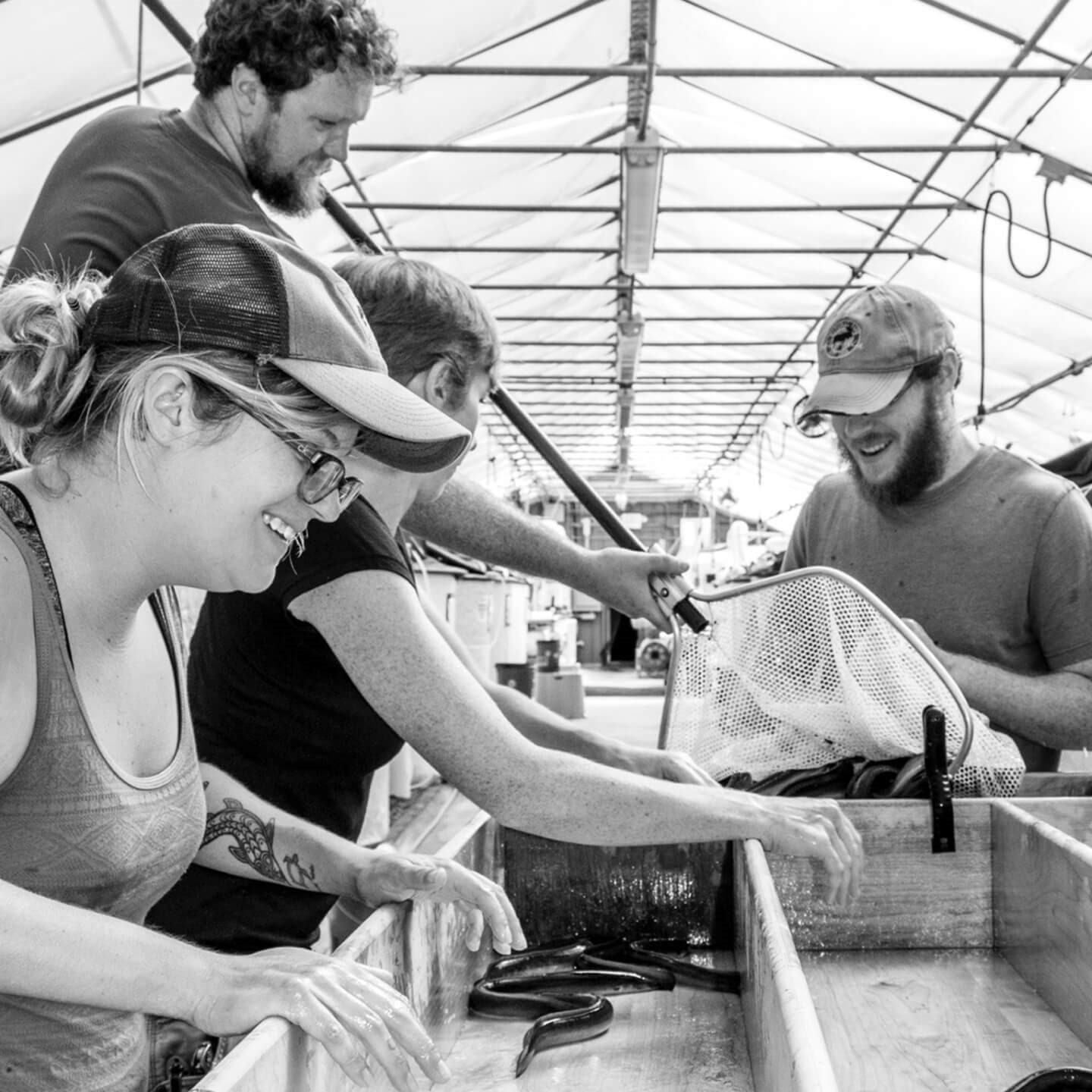
Rademaker liked the range. Aquaculture, she said, uses many parts of the brain at once: biology, mechanical work and business. On any day the chief executive might also be studying appetite, maintaining a site or solving a water problem. The title was dry. The sleeves were usually wet.
“Aquaculture is a humbling job - every time you think you know something the universe will tell you otherwise.”Sara Rademaker
03 / The plantConcrete, capital and local permission
A pilot can tolerate founder heroics. A commercial food plant needs concrete, pipes, processors, cold storage, permits, trained people and money that arrives before revenue does. American Unagi's Waldoboro facility cost about $10 million. The 27,000-square-foot building was designed to produce hundreds of tonnes of market fish each year, while processing them under the same roof.
Rademaker assembled grants, bank financing and equity, including support from Maine institutions and RuralWorks. She also worked on social permission. Before town approval, she spoke with Waldoboro's clamming committee. Local harvesters supplied glass eels. The Passamaquoddy Tribe became an investor and partner. Her broader work as a co-chair of SEA Maine connected the farm to a statewide conversation about fisheries, workforce and coastal resilience.
Maine's university facilities mattered just as much as money. The Darling Marine Center and the Center for Cooperative Aquaculture Research let the company use sophisticated infrastructure before it could sensibly own a commercial version. Rademaker had first toured the Franklin center while teaching aquaculture students and remembered her jaw dropping at what was available. The network became a kind of extended workshop: researchers, economic-development groups and technical advisers could help answer questions while the company was still small enough to change.
This was not community engagement as decorative listening. A land-based farm touches water, roads, jobs, fisheries and the working assumptions of a town. Rademaker understood that a permit grants legal permission; neighbors decide whether a project feels native to the place. The eel helped. It was already part of Maine's spring economy, even if most of its later value happened elsewhere.
04 / The creatureA mystery with excellent unit economics
Eels remain biologically impolite. American eels hatch somewhere in the Sargasso Sea, travel toward North American rivers, spend years in fresh water, then return to the ocean to spawn and die. Their captive breeding cycle has not been closed at commercial scale in the United States, so American Unagi still depended on a tightly regulated wild glass-eel harvest.
Rademaker once compared spawning eels in captivity to going to Mars: humanity may get there, but first it has to reach space. She left that frontier to researchers and focused on grow-out. Eels tolerate high densities, use relatively little land and water in recirculating systems, and suit a range of market sizes. They are also eaten across cultures. In Japan they become kabayaki; elsewhere they are smoked, jellied, grilled or folded into regional memory.
Chefs helped Rademaker understand the product. She said she had not known how good eel could be until she watched cooks handle it. American Unagi could offer traceable fish without added hormones or antibiotics, and could sell more than a live animal: butterflied fillets, smoked eel, tins and cooked kabayaki reduced the distance between curiosity and dinner.
Watch · EaterHow an eel farm grows and smokes fish for sushi restaurants05 / The reckoningThe product won before the company closed
In March 2025, American Unagi's gluten-free kabayaki fillet won Best New Foodservice Product at the Seafood Excellence Awards in Boston. In June, Food & Wine included the company among its Game Changers. These were real votes for the product, and they arrived during a year when the balance sheet was moving in the opposite direction.
The bankruptcy petition placed assets between $1 million and $10 million and liabilities between $10 million and $50 million. The company continued operating while seeking a new owner. In October 2025, Rademaker told an interstate fisheries board that a sale was proceeding and that she expected a buyer to continue the aquaculture quota applications.
No operating buyer emerged. Maine Community Bank acquired the secured assets through the process, and the bankruptcy case was dismissed in January 2026. The next month, Rademaker confirmed the company was shutting down. Harvesters holding unsecured debts were left unpaid, a painful break in precisely the local network the business had wanted to strengthen.
The sequence is a useful correction to the usual language of momentum. A factory can be winning customers while losing time. Recognition can improve a brand without refinancing machinery. An interested buyer is different from a completed transaction. The fish, meanwhile, continue to require feed, water and care every day. Physical operations do not pause while financial nouns negotiate with one another.
Rademaker's closing statement pointed to the aquaculture quota the company had helped secure and nearly $1 million in additional income it had generated for harvesters over the years. She also called the ending unfortunate. Both facts fit. An enterprise can create value across a decade and still fail people at the end. A fair account cannot use the first truth to dissolve the second.
06 / What remainsThe proof, the map and the warning label
American Unagi did not solve the financing of domestic seafood infrastructure. It did answer several earlier questions. American eels could be raised in Maine at commercial scale. Chefs and diners would buy a local, traceable alternative. A small team could learn the animal. Harvesters, researchers, public agencies, a rural town and investors could be assembled around an unfamiliar species.
Rademaker's experience preceded the pitch, and the basement preceded the plant.
A working pilot proves the process, not the durability of a capital structure.
Harvesters, neighbors and tribal partners were part of the model, not an audience for it.
Customer validation and financial resilience answer different questions on different clocks.
The next person who considers domestic eel farming inherits a better map. It includes tank practice, feed lessons, processing knowledge, customer education, permitting history and one expensive warning about the passage from technical competence to financial resilience. Maps do not guarantee arrival. They make the terrain harder to romanticize.
Rademaker once said that many of her fondest memories involved being constantly amazed by the fish. That may be the most revealing line in her record. It contains curiosity without conquest. The eel remained mysterious; the founder kept working. The company is closed, but the question she asked in 2014 is still swimming: how much of a local resource's journey, skill and value can remain local?