The wrist-sized version
- Amazfit sells smartwatches and recovery wearables from about $80 to expedition-watch prices, tied together by the Zepp App.
- Its practical edge is long battery life, lots of features for the money and no required subscription.
- Its limit is polish: cheaper models can trail Garmin on GPS and navigation, and the app can feel crowded.
- The proof of the strategy is financial - Amazfit products supplied all of Zepp Health's 2025 revenue.
A sleeping person is not a difficult athletic event. There is no finish line, no interval timer and, ordinarily, no hill. Yet sleep is where a smartwatch can fail in the most ridiculous way: it is on the nightstand, charging. The missing data point is not caused by a weak sensor. It is caused by absence. Amazfit has spent a decade turning that small nuisance into a business argument. A watch with ten, twenty or more days of battery is not merely convenient. It is present.
That explains the company better than the customary avalanche of features. Amazfit is the consumer wearables brand of Zepp Health, the company formerly known as Huami. It makes the inexpensive Bip, the everyday Active, the multisport Balance, the running-focused Cheetah and the rugged T-Rex, alongside Helio rings and screen-free straps. The devices count steps, map runs, watch heart rate and blood oxygen, estimate recovery and sleep, and pass the whole bundle into the Zepp App. They are sold online, through marketplaces and through retail distributors in more than 90 countries.
First, it learned to make somebody else's hit
The origin is less romantic than a garage and more instructive. Huami began in 2013 and became a major maker of Xiaomi's early fitness bands. Xiaomi and Shunwei Capital backed the company. Manufacturing for a huge partner taught Huami the unglamorous disciplines of wearables: cost, battery management, supply chains and how to put sensors on millions of ordinary wrists. In September 2015 it launched Amazfit, its own brand. The parent listed in New York in 2018, raising about $110 million gross, and renamed itself Zepp Health in 2021.
The part that changed was dependence. In 2023, more than a quarter of Zepp Health's revenue still came from a single customer controlled by a shareholder - the filing does not name it in that passage, though the historical Xiaomi relationship is well documented. That share fell to 6% in 2024 and zero in 2025. At the same time, Amazfit-branded products rose from 94% to 100% of company revenue. This was not simply a new logo. The supplier had finished becoming the shopkeeper.
The rebound matters because it prevents an easy fairy tale. Revenue reached $258.9 million in 2025, up 41.8%, and gross margin was 38.3%. But Zepp Health lost $40.1 million. Amazfit has traction, not immunity. Its challenge is to fund software, sensors, maps, athlete marketing and retail distribution while pricing many products below the specialist watches it wants to displace.
The bargain is a system, not a cheap watch
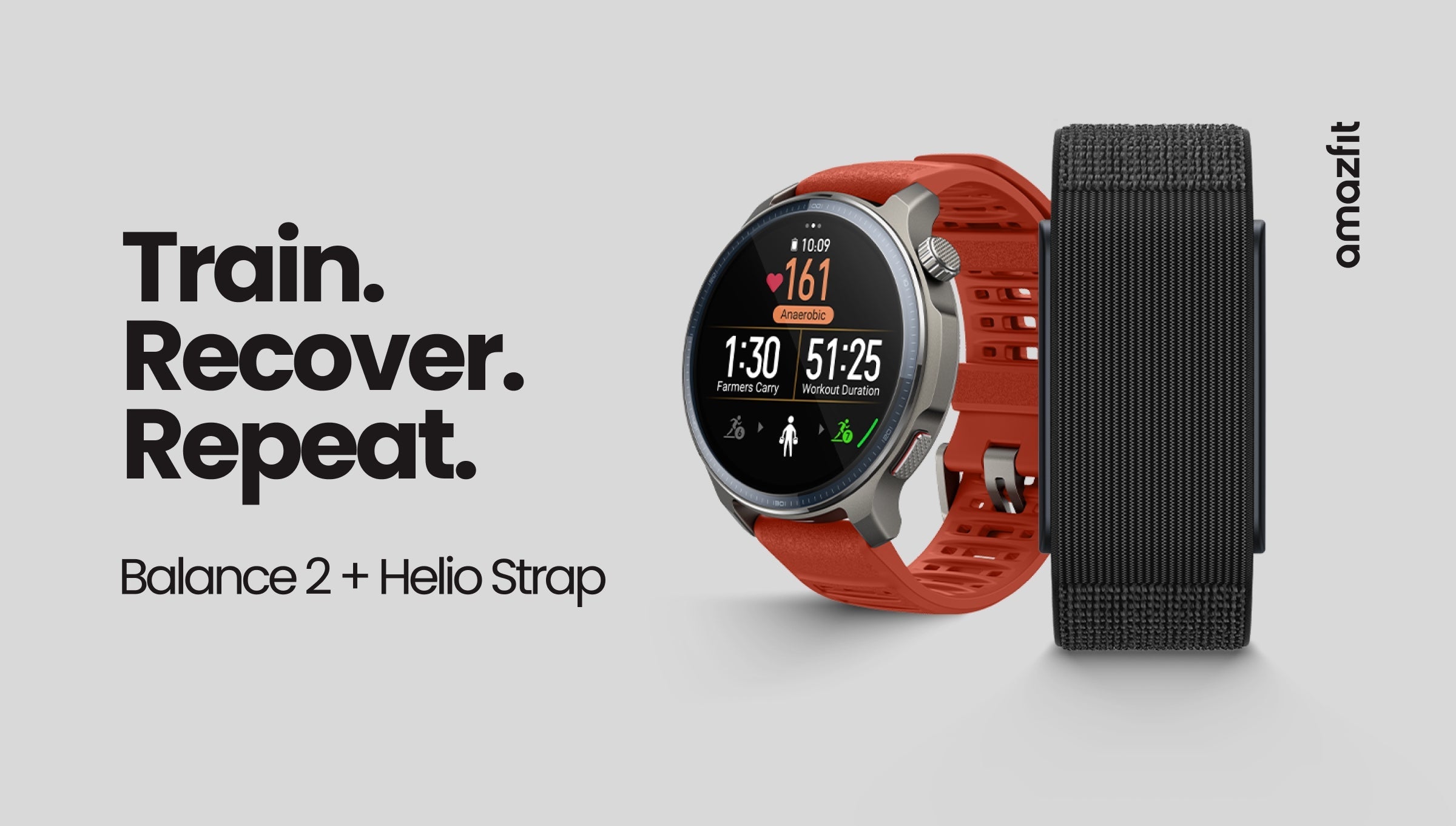
Consider the 2025 pair that made the strategy unusually legible. The Balance 2 launched in Britain at £299.90 with maps, more than 170 sports modes, golf-course data, diving support and a claimed 21 days of normal battery. The Helio Strap cost £99.90, had no screen, lasted up to ten days and carried no required subscription. Wear the watch to train. Wear the lighter strap to sleep or while the watch charges. The Zepp App merges the record.
A ladder, not a luxury gate
everyday entry
multisport middle
expedition top
This is what customers pay for: the hardware once, then the core app without a mandatory monthly toll. Optional Zepp services exist, but the everyday training and recovery proposition is not held behind a subscription. Against WHOOP and Oura, that changes the arithmetic. Against Apple, the difference is endurance. Against Garmin, it is often how much hardware arrives for the initial price.
The watch that stays on your wrist does not merely have better battery life. It has a better memory.The continuity advantage
Then HYROX supplied the missing verb
For years, Amazfit was easy to describe as “the cheaper Garmin.” That is a position, but not an identity. HYROX gave the brand an activity it could help shape. The fitness-racing series alternates eight one-kilometre runs with eight workout stations. It is legible, repeatable and spectacularly data-friendly. Amazfit's initial wearable and timekeeping deal became a three-year global partnership in April 2026. Its watches gained dedicated race, simulation and training modes. The company built plans, pacing tools and post-race analysis around a sport whose participants naturally care about transitions, fatigue and recovery.
That, in turn, changed the product language. The 2026 Balance 3 and Balance Ultra are pitched around a Hybrid Training System rather than isolated workouts. Helio Strap Pro can be worn at the wrist, arm or waist to combine heart rate with movement quality and muscle load. The idea is to follow a person across strength, endurance, sleep and recovery, rather than pretending that a run is the whole day. Sponsorship became useful when it started writing the feature list.
Where Amazfit wins
Battery endurance, bright hardware, broad sports features, low entry prices and core insights without a required subscription.
Where rivals pull away
Garmin brings deeper mapping and mature training software. Apple brings apps and iPhone integration. Specialist platforms can offer clearer recovery experiences.
What failed first was certainty
A bargain invites a comparison, and comparison finds the seam. In a month-long 2026 test, NBC's reviewer found the $100 Active 2 handsome, comfortable and excellent value beside a Garmin Fenix 8 that cost roughly eleven times as much. Then the cheaper watch wandered off paths on its GPS traces. The Zepp App presented too many charts and unexplained acronyms. Garmin's navigation was plainly better. The verdict was not that Amazfit failed; it was that price had purchased a real product and left real things out.
That distinction sets the conditions. Amazfit works well for someone who wants reliable everyday tracking, long wear time and many sports tools without turning a watch into a second phone bill. It works less well when route accuracy is safety-critical, when advanced outdoor navigation is the main job, when medical-grade certainty is expected, or when a polished third-party app ecosystem matters more than battery. No consumer wearable should be treated as a diagnosis.
The parts worth copying
The useful lessons are not about adding 170 sports modes. They are about choosing where complexity belongs.
- Make continuity a feature. Optimize for the product being present at the moment it creates value, not merely impressive in a demonstration.
- Let the entry product feel generous. A bright screen and credible materials make the inexpensive model an invitation, not a punishment.
- Build a ladder. Keep one app and a recognizable promise while charging specialists for maps, materials, diving and expedition endurance.
- Turn partnerships into product. HYROX mattered because race modes, plans and analysis followed the logo on the banner.
- Name the trade. “No required subscription” is clearer than vague talk of empowerment. So are 21 days of battery and a $100 starting point.
The newest object is almost too perfect a metaphor. The T-Rex Dual Solar, launched in September 2026, gathers sunlight through its AMOLED face and through a larger panel on its back. Amazfit says three hours a day at 50,000 lux can stretch typical battery from 25 to 34 days, and the rear panel can revive a depleted watch off-wrist. It costs £649.90 - proof that the former budget alternative now wants permission to sell at the top of the shelf.
But the old argument remains inside the expensive case. More sensors are useful. Better maps are useful. Artificial intelligence may be useful. First, the watch has to be there. Amazfit's most persuasive achievement is not teaching a wrist computer to say more. It is making the silence between charges long enough for the machine to listen.