After a Sunday spent gardening, Alyson Dutch lay back on a chaise lounge and looked up at the eaves. Two spiderwebs hung above her. One was full of flies. The other had apparently opened for business in the wrong neighborhood. Dutch considered the possibilities: wind, stickiness, scent. Then she noticed the light. The successful spider had built beside the outdoor lamp, precisely where its dinner liked to congregate.
“Huh! What a smart spider.” The observation became a marketing column. There is something revealing about a publicist who can finish a day in the garden and still find herself assessing an arachnid’s distribution strategy. Even the spiders, it seems, ought to know their customers.
Dutch has spent much of her working life arranging encounters between things and the people who might want them. The things have included cookies, watches, champagne, clothing and clean energy. The encounters have taken the form of publicity campaigns, product introductions and rooms where journalists can meet entrepreneurs face to face. Her own business has changed shape when circumstances demanded it. The lamp keeps moving. She keeps looking for it.
A Labrador gets a name on the door
Brown + Dutch Public Relations began in 1996 with an unusually agreeable naming arrangement. Dutch supplied one surname. Her chocolate Labrador, Rocky Brown, supplied the other. The agency describes its founding as accidental. Its name, at least, suggests that formalities were kept in perspective.
Before running her own firm, Dutch worked at Baker, Winokur, Ryder and Rogers & Cowan, and inside the publicity departments of Madison Square Garden and Landmark Theatre Corporation. Those jobs placed her in businesses where an audience’s attention has an obvious deadline. A performance happens tonight. A film opens on Friday. The publicist must make the invitation intelligible before the curtain goes up.
The career subsequently traveled across industries and borders. Her work has included publicity for Sun City in South Africa, a licensed Barbie fashion line for adult women, and Swatch’s digital ski timing technology. The products differ considerably; a watch does not have much in common with a dress. Each introduction nevertheless asks a similar favor of the public: understand this unfamiliar thing, then consider making room for it.
Running the firm also kept her close to the work. Dutch remains personally involved in projects while her team carries out strategies and tactics. The dog in the company name provides the joke. The founder still does the explaining.
The day the camera needed stopping
One early lesson arrived during her pageant publicity years. A reporter appeared with a live broadcast camera and began asking contestants controversial questions involving countries hostile to one another. Dutch stepped in front of the lens and stopped the interview. Her account gives the intervention five plain words: “Sorry, this is over.”
It is an instructive scene for anyone whose picture of publicity consists entirely of invitations, cocktails and knowing someone at a magazine. Sometimes the person hired to attract attention has to interrupt it. A live camera removes the luxury of a leisurely correction afterward.
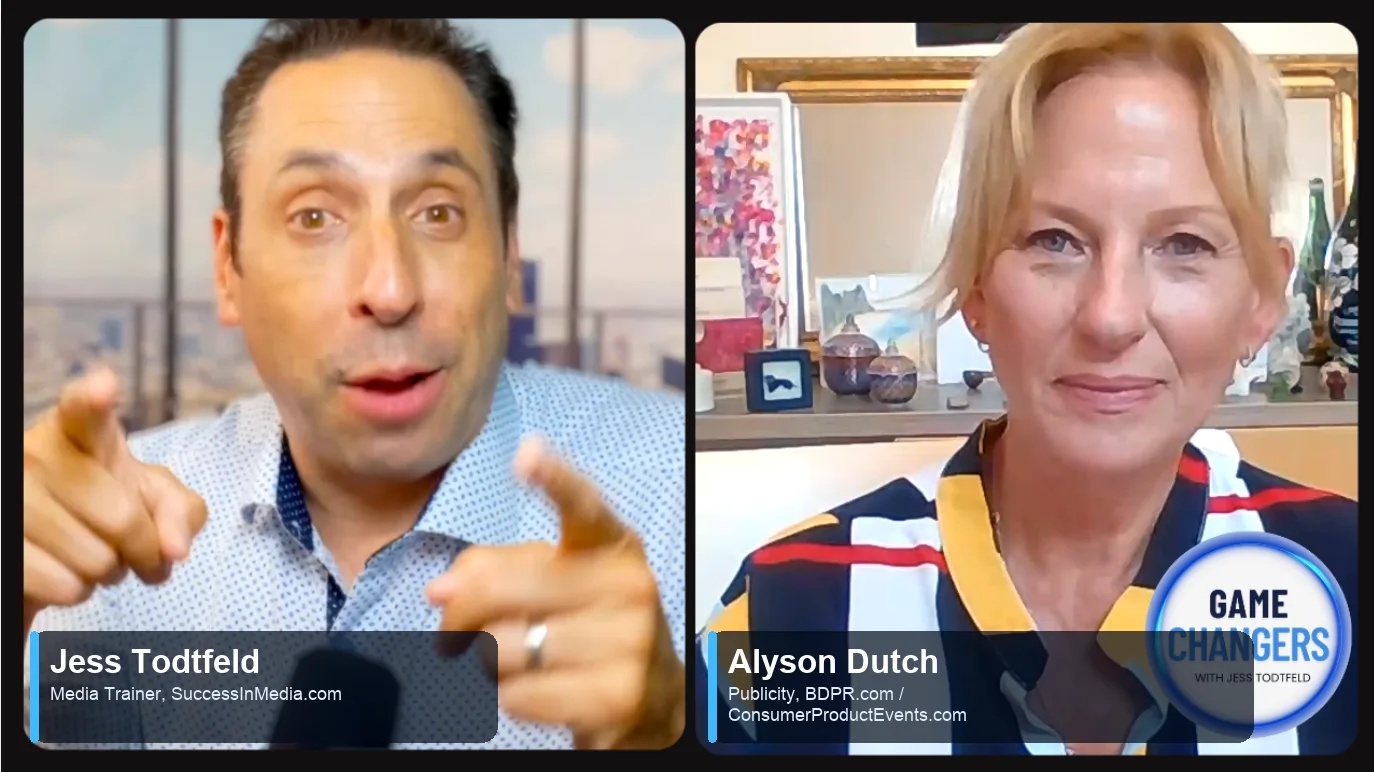
Decades later, media trainer Jess Todtfeld described her staying closely involved when clients practiced their interviews, encouraging them when their soundbites worked. Preparation mattered enough for her to remain in the room. The booking was only one part of the assignment; the person who had to speak still needed help doing it.
There is an ordinary service lesson underneath that attention. The client asking for publicity may want store traffic, recognition among peers, or something else entirely. Those ambitions require different work. Dutch describes getting clear about the expectation underneath the request before pursuing it. An impressive placement can still miss the reason somebody hired you.
When the retainer became the problem
During the recession, clients were cutting their public relations budgets. Dutch responded by changing what they could buy. Consumer Product Events, established in 2009, gathered product marketers and journalists in the same room. She called it “speed dating for products and the press.” Nobody needed to commit to a long courtship before discovering whether a product suited a story.
The format was simple enough to picture: tables, products, conversations. Journalists moved among exhibitors. The gatherings were timed around editorial occasions such as weddings, Valentine’s Day and holiday gift guides. A founder could explain an invention to someone who actually covered that category, rather than sending another hopeful message into an overcrowded inbox.
By May 2010, the new business had five full-time employees and planned 13 events that year. Within nine months of launching, it was making more money than her traditional agency. Exhibitors included KitchenAid, Hallmark and Tesla Motors. Dutch remembered the arrival of Oprah Magazine, “20/20” producers and USA Today as a career high.
The time it took Consumer Product Events to out-earn her traditional agency, as reported in May 2010.
The telling detail is the smaller unit of purchase. A client whose budget could no longer support an ongoing relationship could still pay for an introduction. Dutch had found a way to sell access in a form that suited the moment. The problem that threatened one business supplied the premise for another.
Three letters, several inconvenient questions
Dutch also writes books and practical advice for entrepreneurs. Her titles include The PR Handbook for Entrepreneurs and The P.O.M. Principle. The latter organizes a venture around product, operations and marketing. It is a compact framework with an unromantic implication: inventing something leaves quite a lot of work unfinished.
In her explanation, product includes the preparation needed to make something ready for sale. Operations covers how the business sells, funds and supports it. Marketing concerns reaching the customer who might buy. The categories force an inventor to look beyond the object on the table.
Her writing repeatedly brings the argument back to customer knowledge. There are practical consequences to that insistence. A product can be beautifully made and still have an unclear buyer. A launch can attract attention and still leave fulfillment unresolved. The framework gives these quieter tasks equal billing with the exciting invention.
Her RangeMe author biography also records speaking engagements and mentoring through SCORE. Teaching belongs naturally alongside the agency and the events: each gives entrepreneurs a different amount of help. Some need someone to run a campaign. Others need an introduction. Others need a usable explanation before they spend their next dollar.
The Oreo school of editorial judgment
Dutch’s business writing seldom sounds like a committee has polished it. Explaining editorial coverage, she compares it to the cream inside an Oreo. The comparison comes with a confession that, like her Labrador, she is food-driven. A reader may forget a definition. Remembering the middle of a cookie requires rather less effort.
Her point is about understanding what journalists are there to do. A list of features and benefits does not automatically become a news story. Reviews, roundups and gift guides have their own purposes and readers. The entrepreneur has to understand that setting rather than expect personal enthusiasm to carry the pitch.
The advice has a pleasingly practical sting. Founders know the hours that went into their product. A reader encounters the result without that history. Persuasion has to cross the distance between those two experiences. Dutch’s comic comparisons help make that distance visible without requiring a seminar in communications theory.
She has also written about the growing place of affiliate marketing in product publicity. In that arrangement, links allow a publisher to earn a commission on purchases. Her advice asks publicists to understand the commercial machinery surrounding coverage and develop relationships with the people who manage it. A good story now travels through a more complicated business arrangement.
This creates an interesting task for a publicist who values third-party credibility. She has to explain the product clearly while understanding how the publication pays its bills. Dutch treats the change as something to learn. Nostalgia would make a poor distribution plan.
Outside the office, the mountain
Dutch’s interests have long extended beyond a desk. In 2004, a portrait of her weekend life described her packing skis and a yellow Labrador into a Jaguar convertible and driving from Malibu to Mountain High. Her father had been a competitive ski racer. She had joined a mountain safety team in her twenties and became a National Ski Patrol member in 1998.
The contrast makes an appealing picture: a publicist with champagne clients setting aside weekends for the slopes. It also suggests how deliberately she made room for another kind of responsibility. Friday work had to finish because Saturday already had an assignment.
In an earlier account of her daily routine, she described setting aside part of the day for thinking about the business rather than only handling immediate tasks. Her name for it was “forest time.” Her entrepreneurial instruction was equally economical: “Execute. Execute. Execute.” The two ideas belong together. Step back far enough to see where you are going; then move.
“Execute. Execute. Execute.”
Alyson Dutch, on entrepreneurship
A story she had to tell for herself
In January 2025, the Palisades fire destroyed Dutch’s Malibu home. Later that year she published a personal essay, Witness., about the loss. The publicist who usually helped other people explain their lives was writing about her own. Her photograph showed pages from books caught in tree branches, a small remnant of the life the fire had scattered.
NAWBO California recognized her with its 2025 Resiliency Award after the loss of her home and business premises. A May client announcement listed a temporary office number while the Malibu offices were being rebuilt. Work was continuing in altered surroundings, with the administrative particulars that rebuilding brings.
By 2026, she was again discussing product publicity with Todtfeld and continuing to write about invention. Her stated ambition in that conversation was to keep working rather than retire. The appeal, she explained, was the continual arrival of something different to learn.
The spider beside the lamp offers a small ending for a career with plenty of larger scenes. Dutch noticed where the flies were going. Then she turned the observation into advice someone else could use. It is a recognizable habit across the years: pay attention to an actual situation, find the useful detail, and get moving.