A cash register is a wonderfully incurious machine. It can tell you that someone bought a shirt at 3:17. It has little to say about the people who entered at three, wandered around, failed to find help, and left. Alexei Agratchev has built much of his working life around those missing conversations. The person who buys leaves a receipt. The person who leaves empty-handed may carry the more useful explanation.
As co-founder and CEO of RetailNext, he works on giving physical stores a better account of what happens inside them. His career has involved sensors, software, investors, and the practical complications of installing equipment around the world. Yet his recurring subject is people: what they notice, what they assume, and how long an assumption survives once somebody starts measuring it.
That interest has an awkward consequence for a founder. Eventually, the questions point inward. When RetailNext announced a new investment partner in January 2025, Agratchev used the occasion to discuss mistakes. A business built to help retailers see clearly had needed a clearer view of itself.
An education in being interested
Agratchev arrived in the United States from Moscow in August 1991 to attend Middlesex School in Massachusetts. He was entering a different language and a different set of possibilities. His later college, Claremont McKenna, would count him among its class of 1999. The subject he chose was international relations, a reasonable interest for someone whose own adolescence had crossed such a large political and cultural divide.
Michael Eisner and his wife, Jane, became his guardians while his parents remained in Moscow. Agratchev’s father had worked as Eisner’s translator. One memory from those years stayed with him: walking through an apple orchard in Vermont while the Disney executive asked questions about his childhood. The surprise was that someone so accomplished wanted to hear the answers.
There is a useful reversal in that encounter. A teenager might expect proximity to a powerful executive to provide answers about success. Agratchev remembered the questions. Curiosity could confer dignity on somebody else’s experience. It could also make a formidable person seem human enough that doing something ambitious yourself became easier to imagine.
“We start with a question, then figure out how to use technology to address it.”
Alexei Agratchev, 2016
The casino detour
After college came consulting at Accenture, then Cisco. His official biography describes eight years at the networking company, including leadership of an internal startup developing video applications. This was an education in building within an organization large enough to supply resources, customers, and colleagues. It also gave him a taste of the independence that a separate company might offer.
The work included a video security system for casinos. His group examined dozens of computer-vision technologies. A casino and a clothing shop may seem like unlikely neighbors, although both are places where management would very much like to know what just happened. The technical experience gave Agratchev something he could bring to an unfamiliar industry. Understanding that industry would take longer.
A conversation with a Target executive during a British Virgin Islands holiday helped focus the idea on retail. The company began in 2007 with Agratchev, Marlie Liu, and Arun Nair. Its original name, BVI Networks, retained a small souvenir of the trip. The destination supplied the initials; years of working with retailers supplied the education.
Starting a company does not instantly make its customers ready to buy. Agratchev later described retailers who liked the proposition but had other technology priorities. An enthusiastic meeting could produce a delay of a year or more. Founders learn to distinguish interest from urgency. Unfortunately, interest is much more pleasant to hear.
A few inches on the shop floor
His explanations of retail analytics often come down to surprisingly ordinary objects. A bench. A display. A gap wide enough for someone to walk through comfortably. In one example he described in 2022, shoe-department benches sat too close to the merchandise, making it awkward for shoppers to approach. Moving the benches was followed by a double-digit sales increase, he said. The furniture had been participating in the sales conversation all along.
Such examples explain his interest in the interval before checkout. A retailer can see disappointing sales without knowing whether the trouble began with too few visitors, too little help, or an inconvenient layout. Those are different problems. Treating them alike risks spending money on the wrong remedy, rather like replacing the menu because the restaurant door is jammed.
- 01PassWho walks by?
- 02EnterWho comes in?
- 03StayWhat holds attention?
- 04BuyWhat becomes a sale?
By 2023, Agratchev was urging retailers to begin with basic measures such as traffic, conversion, and dollars earned per visitor. Those measures make staffing a more specific discussion. A quiet cash register does not necessarily mean there were too few potential customers. It may mean the people who came could not get what they needed.
He also treats the store as a place where brands learn. Watching how customers respond to merchandise can inform decisions beyond that particular location. The physical space becomes useful twice: once when it sells something, and again when it reveals something. For a founder whose degree concerned relationships between countries, relationships between people, objects, and rooms became a substantial occupation.
The company under its own microscope
In January 2025, Battery Ventures became RetailNext’s majority growth investor. The announcement described a business serving 560 retail brands across 100 countries and averaging 1,200 store installations a month during 2024. The scale mattered. Equipment has to reach real locations, get installed, and continue working. International growth gives a software company a rather physical to-do list.
Average store installations per month, reported in the January 2025 investment announcement.
Agratchev’s own account of the deal was less polished than the customary announcement. He described hiring mistakes, premature spending on sales and marketing, expanding internationally too early, and pursuing misleading performance measures. More capital had allowed some bad habits to continue. The company had become too large for the business underneath it.
The correction required changing to subscriptions, reshaping the organization, and investing in the systems needed to run it. By the time of the Battery announcement, he described RetailNext as profitable. He welcomed a simpler ownership structure and a partner aligned around the company’s next phase.
This is the portion of a founder’s life that resists a neat montage. Recognizing a promising problem and running an enduring business require different judgments. A customer can love the product while its maker still needs to repair the way it operates. Agratchev’s willingness to put his errors into the record gives the achievement a more believable shape.
By May 2025, he was discussing acquisitions that could add capabilities or strengthen RetailNext in particular markets, including India, Latin America, France, and Germany. He was especially interested in tools useful to store operations. After the introspection came another practical question: what would help customers enough to justify building or buying it?
Three countries, eight conversations
The quieter evidence of his working style sits in a July 2023 account of a European trip. Three days, three countries, eight customer visits and store tours. He described returning tired but energized by learning about customers’ businesses. The itinerary sounds like an argument against airports. For Agratchev, it was an argument for being there.
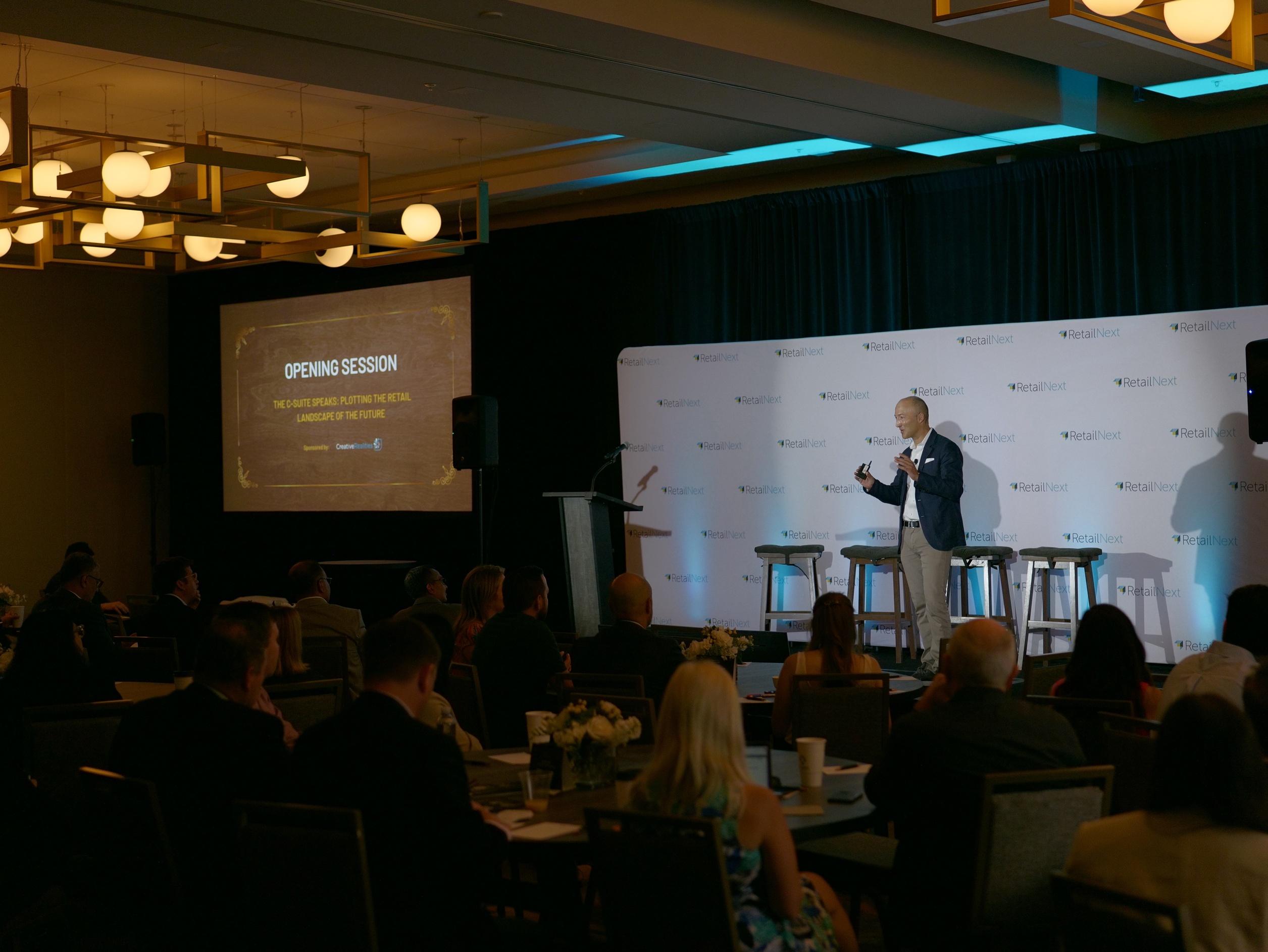
That same year, at RetailNext’s Executive Forum, he emphasized the value of letting retailers discuss their difficulties candidly. A gathering of customers can easily become an extended sales presentation. He described wanting a setting where disagreement and useful conversations could happen. The people in the room brought knowledge that a vendor needed to hear.
His personal account of business travel makes room for family, too. In early 2023, he wrote about taking his son to London after an earlier trip to New York with his daughter. He valued those individual trips and resisted treating work and the rest of life as entirely separate territories. Colleagues, customers, and investors were also relationships that helped carry him through difficult periods.
There is a boundary in his earlier travel habits that feels especially sensible. In 2018, he described giving up laptop work on planes and using the time to read or watch films. For someone in the business of measuring attention, declining to turn every available minute into office time seems a respectable application of the principle.
The manager still has to open the store
In August 2026, Agratchev published an essay about AI in retail. His interest lay in tools that understand a manager’s questions and working conditions. A new interface has to earn trust with useful answers. The grand promise of artificial intelligence becomes less persuasive when an employee has to spend the morning explaining what the question means.
He connected that challenge to the hard work of collecting dependable information from physical places. Sensors need installation and maintenance. Human mistakes can compromise the results. His argument for specialist retail tools rests partly on accumulated experience with those complications. He sees AI helping managers exercise better judgment, with people remaining central to running stores.
The following month, a conversation with Pine59 co-founder Thomas Walle extended the view beyond the entrance. The two had known each other since Walle’s earlier appearances at RetailNext’s Executive Forum. Their companies were connecting in-store information with a view of the surrounding market. An underperforming location might need changes inside, or its difficulties might begin somewhere down the street.
The radius of the question keeps widening. Agratchev’s career began with a willingness to enter unfamiliar rooms and learn from the people there. Now his business asks what those rooms can reveal, and what lies outside them. The cash register still has its uses. He remains interested in the people it never gets to meet.